
“Pastoral” by John Beardsley: A Review

Published in Vol. XXXVI, no. 1, John Beardsley’s poem “Pastoral” is reviewed by an editor of Mid-American Review.

As we enter Beardsley’s “Pastoral,” we take from the simple and familiar title a sense of impending rural comfort. The compendium of our experience with the pastoral rushes forward and leaves us anticipating a romantic exploration of rural life and landscape. 

We then are given the first line of this “Pastoral,” in “The snow sang like a shot,” and immediately know that there is a complexity here. Our attention is called to a dominating feature of this landscape, the snow, which seems to live so fully and joyously that it sings, but like a shot. The juxtaposition of the staunch violent noise of a gun firing with the purity of a living, singing snow leaves the reader fascinated about this world, this pastoral, in which the violent and the beautiful can exist in such magnificently direct proximity.

Beardsley continues to develop his initial image by crafting the snow into an all encompassing entity that “sunk all it could see / into its curves and blued / barrels…” The snow takes the underlying forms of the pastoral landscape and makes them its own, adopts them into its own intimate contours. But this pastoral snow is as willing to reveal as it is to consume and “gave it out / again blistering.” The snow releases the forms held within it just as strikingly as it takes them in.

Once we find ourselves situated within the poem’s snow capped pastoral body, the speaker of the poem enters, a voyeur over the snow, “looking across it.” The speaker looks through the snowscape “at the long black body / of an animal I cannot / name…” Just as the speaker cannot identify this black creature streaking through the trees, we are left with a blurred image of the animal fleeing from the “shot” through the white gleam of the snowy landscape. The animal “…moved like / a loss a blood through / paper birches.” We are struck again by the brilliant contrast of beauty and violence involved in the image of an obscured animal moving fluidly, “like a loss of blood,” through the trees of the landscape, staining the glistening snow with the ruby traces of its recent wound. The bark of the “paper birches” seems to magnify the contrast of red and white.

Next, we arrive joltingly at a sense of isolation within the snowfield, as “it was talking to itself.” The landscape maintains its sense of life and voice, but now it seems highly personal, as if the speaker of the poem is overhearing the field’s intimate laments. But the speaker is not obtrusive. Instead, they identify with this overhead self-intimacy, identify with the field talking to itself, “as I do at night.”

At this point, we see the speaker and the landscape as two isolated, intimate figures that share a sense of value in the personal voice.

But the speaker must address this bleeding figure that runs through the snow topped, birch-laden woods. This unnamed animal that seems so integral to the scene at hand. “O stranger in the distance,” the speaker announces, “I’ve made you a fetish / of neck-wrung chickens / to keep off our fathers’ / hungering ghosts…” In this shocking moment, the speaker reveals a depth in his sentiment for the distant stranger. The motives and actions of the speaker are brought into question, as well as the history involved in their complex present state.

The obscurity behind the “stranger in the distance” allows our minds to wander, wondering if perhaps the stranger is no longer the wounded animal, wondering if perhaps the stranger is now, to the speaker, something or someone beyond this scene in the snowy woods. We become aware of a depth in the obscurity of the images.

Still, the speaker is engulfed in the interaction of beauty and violence that has so far saturated the poem, as “I bound / their throats in my sawn-off hair.” But again, their internal stance on this interaction is questioned as they cry out, “O god of embarrassment, / god of bullets-in-the-back,” and make a sacrifice to this addressed being, exclaiming that “I give you my teeth, pink / at the root.” They proceed to “Sleep in this lot I’ve dug / where even the snow can’t see.”

We arrive back at the initial image, the all-encompassing snow that has taken every feature of the landscape under its vast white arms, into its body. But not the speaker. The speaker arrives at a point so personal, a point so privately intimate that they sleep “where even the snow can’t see.”

The final line of the poem revisits the ongoing theme of beauty interacting with violence. It weighs the joy of song against the brutality of retrieving that joy from within the core of a conflicted individual, as the speaker proclaims, “I’ll scrape out the song from my lungs.”
Accepted: “The Barnum Interview” by Michael Hurley

In the poem “The Barnum Interview,” Michael Hurley crafts an imaginative interview with P.T. Barnum, who becomes a completely unlikeable—but strangely seductive—speaker.  As with all well-done persona poetry, Hurley’s Barnum casts an unusual view of the world, but one the reader wants to believe could be real.  Barnum’s observations accumulate into character, perhaps most chillingly with the statement that men and women are “all small enough to fit inside a cage.” 

This persona sees everything through the lens of the circus, with other humans as its commodities, and unfolds in a finely-engineered, call-and-response format.  There is just enough of a looseness and disconnect between the questions and answers to create an eerie atmosphere, but all seem inevitable of Barnum’s character. 

The questions asked of Barnum generate as much interest as the answers: They are plausible, but uncommon to the celebrity interview format.  He is asked, “When did you realize you were mortal?” and responds with an anecdote about a man selling him an x-ray of his teeth; the first time Barnum understands that he has a skeleton inside of him, even though the x-ray is later revealed to be no more than a crude drawing.  A mix of long and short answers—ranging from full paragraphs to two-word, matter-of-fact conclusions—tightly control the pacing of the poem, and offer a wealth of world-and voice-building.

While the work is interesting on a first read and gives a quick first impression, this piece is one that yields more with each perusal.  It tackles large issues (God, death, human cruelty, money) with fine-tuned details that age well: teeth as cranberries, a train as success, humans as owls, mandrakes as a trick.  Barnum doesn’t care to know he lives on a spinning planet, and instead turns his attention to hedonistic pleasures and whatever happens to exist within train’s reach.

These strange images also play with the clichés of the circus.  The phrase “The crowd goes wild” leaves familiar territory when it is used to answer “What happens when you die?”  This poem does not avoid those images and phrases known to the circus and the time period in which P. T. Barnum lived, but rather recasts them in new material.

All of this adds up to a persona that can relate any image, any theme, and any question to the circus and the personal character it takes to lead one.  By reflecting on his own experiences, this Barnum indirectly shows the reader what he offers his circus audiences: the knowledge of mortality, but given by an illusion that forces you to think about what’s inside yourself. 

Barnum himself knows he is not above the call of the entertaining con man, and when asked about the x-ray he knew was fake, “Did you buy it from him?” responds, “Of course.”  This punch of an ending reminds the reader how captivated a human can be by what’s constructed and what’s cruel.  Even though readers of this poem will and should dislike this Barnum character, he couldn’t have built the world’s most well-known circus without the support of a roaring audience.

An interview with Christina Duhig, author of “Lesson” (by Coral Nardandrea)

I was a Gender Studies major in college, and I’m a person who, generally, just cares. It’s difficult for me, as an assistant editor on the MAR staff, to pass up a poem that speaks to something bigger and manages to remain artistic. Any of us can say an alarming amount of women are murdered each year—each day—but few people can say that in a way that’s different. Thankfully, “Lesson,” by Christina Duhig, does just that.

A poem like “Lesson” is hard to read. It deals with what every girl who makes it to womanhood deals with: the violence she knows is happening around her, and the violence she is unable to fully escape. “Lesson” speaks to the author’s first time grappling with this knowledge—a young girl trying to imagine the details of a murder and how this experience impacts her future.

All young women have the moment they realize they need to worry about something more than most of their male friends. The “don’t go out alone” discussion, the “take a friend to the bathroom” discussion. The moment they watch a newscaster talking about a woman who has been assaulted or killed or both. Duhig brings awareness to that in a way that hurts. Because it needs to.

When I first read “Lesson,” that hurt sneaked up on me. Duhig uses short, clipped sentences and powerful, controlled diction to put the reader exactly where she needs them to be—in the moment, on those train tracks, in the flames. Duhig forces readers to live these moments in time with her nine-year-old self, forces them to look at the dental records the way she looked at them, to “learn to see the body beneath the body.”

Duhig’s “Lesson” is such an important addition to Mid-American Review. A poem that reminds us what we don’t want to be reminded about, a poem that forces us to remember the moment we understood.

Do you have a writing ritual of any sort? Tell us about it.

I need a stack of poetry books, an iced coffee, and— about an hour into the effort— I usually need a cookie. Substitute iced coffee for Diet Coke, a cookie for a sleeve of saltines, books for different books. The caffeine helps with focus. The food soothes desperation. The books, of course, unlock the head- space.

Has your idea of what makes a poem a “poem” changed since you began writing?

My aesthetics and the aesthetics I appreciate in a poem have certainly evolved over the years. I’ve come to embrace a short and succinct title, the kind that seemed “too easy” when I was younger. (I was no good at writing those long, delightfully clever titles anyway.) I shy away now from abrasive language, which appealed to me as I was figuring out my feminist politics. What hasn’t changed is my desire for sincerity and the sense of urgency I feel as both reader and writer when piecing together meaning. I love the lines in Marianne Moore’s “The Steeple Jack:” “it is a privilege to see so/ much confusion. Disguised by what/ might seem the opposite.” I’m drawn to well-ordered confusion in a poem—the way the poem’s order shifts as it moves down the page.

What is your biggest writing-related success, other than a publication?

Cue the list of writing-related successes I wish I’d experienced by now. I’ve written a number of poems that attempt to confront the traumas that women I care about have endured. Each of those poems— poems that feel “finished” and honest—are my best “writing-related success” because they are my best effort to confront violence and support women, in writing. “Lesson” is one of those poems. Though I never met the woman that poem is about, her story—as I heard it on the news when I was nine years old—was the first of many I’ll never forget.

What was the most useful feedback you received for “Lesson” that helped it evolve into the poem it is?  

In “Lesson’s” early drafts the last three lines—a couplet and a final one-line stanza—were clunky and vague. I think I knew the couplet in particular was off, but I didn’t know how to fix it until a friend suggested that it wasn’t scary enough, that the poem had to hurt more. She was right.

A few years later, satisfied with the revised couplet, another friend suggested that the last line—“girl, fire, track, man”—move into the body of the poem. I resisted at first. I loved the last line. I felt power in the line, and I wanted that power. But, together, we moved the line, and the second line of revised couplet became the last line of the poem. She was right, too. The poem had to hurt.

Do you ever feel you are unable to write out of fear?

Yes—

Without this sounding like a therapy session, I am almost three years out of a terrible run involving deaths in my family, a breakup, bed bugs, panic attacks and parallel anti-depressants (my first!), adjunct exhaustion, and my escape (rescue) from Brooklyn. I’m convinced the poems that will ultimately result from all of this will finish my book, but I’ve also realized that I have a habit of avoiding the place where the poems are scariest, where they should hurt most. And I just have no interest in fear and hurt right now.

“Lesson” has a very distinct message concerning violence against women, and how women learn about this violence. What were some techniques that you used to help tackle such a loaded subject?

I tried for years to write a poem about her death, and in doing so I tried any number of times to find out more information about her. One of those times, I entered the right search terms, and the news was right there. I was stunned by how many of the details I remembered, and stunned again by the details I either never heard or forgot. In particular, that he “started a fire with gasoline.” At nine, when I heard “she was burned,” my little self imagined matches or a lighter held to her skin. And that’s one of the images—even as an adult—that stayed with me. Realizing, finally, the disconnect between how he actually set her on fire and my attempt at nine years old to understand how she was burned, the poem wrote itself.

So, time? Recollection? Detail?

I also can’t tell you how grateful I was to learn her name.

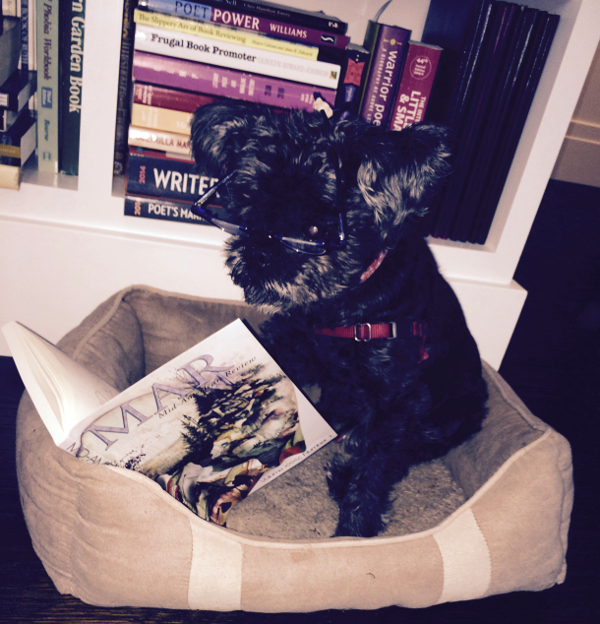
Pets with MAR: Smoky

Today’s pet is Smoky, owned by MAR 35.1 contributor Rebecca Foust. According to Rebecca, Smoky “likes poetry, but only if it comes with a doggie treat.”

Smoky reading poetry in MARIf you’re a poetry lover like Smoky, grab an issue of 35.1 to read Rebecca’s poem, “Dynamic Response of Multi-Layered Soil Media in the Frequency Domain.” You can also check out her contributor interview here. But you’ll have to find your own reading glasses — Smoky clearly needs his.

Want to include your pet in this special Pets with MAR blog series? Simply send your photo, along with your pet’s name and any other relevant details, to mar@bgsu.edu.

MAR Asks, Emily Schulten Answers

Emiy Schulten
Emily Schulten

Emily Schulten is a poet from Bowling Green, Kentucky. She is the author of the collection Rest in Black Haw, poetry available from New Plains Press. Her poems appear widely in nationally recognized journals such as Prairie Schooner, New Ohio Review, New Orleans Review, Fifth Wednesday, North American ReviewSalamanderThe Los Angeles Review, and others. She’s here to today to talk about her poem, “Navigating the Afterlife (Book of the Dead),” which appears in MAR 35.1.

Quick! Summarize your story/poem/essay in 10 words or fewer.

Attempting control over mortality despite its being a futile effort

What can you share about this poem prior to its MAR publication?

“Navigating the Afterlife (Book of the Dead)” I wrote after my brother began dialysis and his search for a kidney donor. It has a counterpart, “Navigating the Afterlife (Burial Goods).” Both were written quickly and follow into the category of those rare instances in which a poem comes to the writer more crafted than not. In the end, I obsessed over line and image quite a bit but ultimately changed little. This poem uses one of the ancient Egyptian burial customs of funerary texts, books that were placed into the coffins and that included the spells necessary to resurrect the deceased. I hope it’s a nice vehicle to illustrate the human longing – even desperation – for immortality (or perhaps only the difficulty in letting go). I also hope it might lead to consideration of the various ways cultures sought immortality throughout history, juxtaposed with the ways of doing this in the modern day.

What was the best/worst feedback you received on this poem?

I was collaborating with a friend and fellow poet who was writing a poem based on his reading of “Navigating the Afterlife,” and he could not completely connect with its narrative. That is, he took away the mythology of the piece and its quirks, where I’d hoped it was clear that this poem is about the desperation of a man who knows the abandonment of a father through death and is facing being on the other side of this prospect. Many of us can relate to the frustration of a reader’s takeaway being different than that which we, as author, intended. Or worse – no takeaway at all.

What do you consider your biggest writing-related success?

A stronger closeness to Keats’s negative capability: particularly, those brief moments “without any irritable reaching,” that without the practice of my craft I’m quite certain I would not’ve developed.

Your biggest writing-related regret?

In connection with my previous response, my broadest regret is that there are still such a great deal of moments in which I remain incapable of comfort in “uncertainties, mysteries, doubts.” As a matter of fact, this applies to both writing-related and non-writing-related regrets.

Thanks for the interview, Emily!
Laura Maylene Walter, Fiction Editor