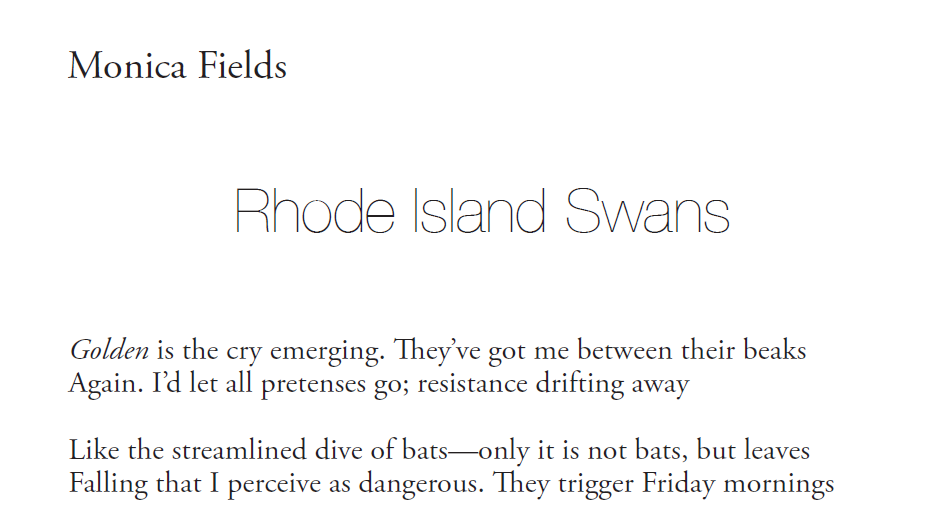
Why We Chose It: “Rhode Island Swans” by Monica Fields

Top of poem from MAR volume 44

“Rhode Island Swans” is a poem that transports you back to one of the speaker’s childhood memories through the eyes of her adult self. Describing the scene, “as it was in 1989, / and know[ing] the fine tremor of disorder,” the speaker reflects on feeding popcorn to swans at the park with her mother and brother; however, it’s not as blissful as it sounds. This poem is heavy with disorder, danger, wrath, and indifference.

It begins with: “Golden is the cry emerging. They’ve got me between their beaks / Again.” We as readers automatically question a few things: Why is the cry golden, and is it emerging from the speaker or the Rhode Island swans? In what way is the speaker between their beaks? The poem unfolds from this into images of falling leaves mistaken for swarming bats, and then into the scene of the swans being fed by the family. But the swan feeding scene is deceptively calm.

The description of the swans as, “cruel birds that would strike, defending / Their own beauty,” transforms the image into an uneasy representation of the family. Beauty and aggression linger in every part of this poem. Typically, we romanticize swans as alluring creatures, and we romanticize past memories and build them up to be something that they never truly were. However, memories can change over time, and swans can be angry and territorial.

I find it fascinating that the speaker admits these swans haunt her in dreams from “feathered enclosures,” in the present as she reflects on this memory.  When she sees swan boats in the city, the memory of the swans from Rhode Island resurfaces. “Wrath, they tell me. Power.” In this moment, the swans take on weight beyond the childhood scene itself, and represent the instability of power that the younger version of the speaker might not have recognized at that time.

This poem articulates meanings from a memory that can only be cultivated through distance and the passage of time. “I am the cry emerging and the hand covering my mouth,” she says, recognizing the power and fear she now carries with her.

––Tyler McDonald, Mid-American Review 

In Honor of the Eclipse

As BGSU is abuzz with excitement for the total eclipse, we at MAR can’t help but consider how the moon has been reflected in literature, more specifically, poetry.  

The moon has been an object of curiosity since the beginning of time, with many cultures regarding the moon as a symbol of power that holds the essence of life and time, and the ways of the earth in its clutches. Cultures including the Greeks, Egyptians, Mayans, and Chinese worshiped the moon and associated many deities with it. The moon has consistently appeared a female deity due to similarity with the menstrual cycles and its fragile appearance when compared to the flaming power of the sun. 

Thus, with these associations, the moon in literature has been a divine source of female fertility, love, purity, romance, beauty, mystery, madness, and power. The history of the moon’s symbolism, its glowing appearance shrouded in darkness, and its continuous cycle of changing appearances have given writers a lot of freedom to display a variety of emotions and themes. Poets and writers such as Emily Dickenson, Shakespeare, Percy Shelly, Ted Hughes, and more have used ideas behind the moon to express raw emotion, change, and death. 

Eclipses are not as commonly written as the complete focus of a poem of piece of work, yet many poets mention eclipses to once again signify change or the tense relationship between two people or ideas. A beautiful example of these themes expressed in poetry is by the American poet Ella Wheeler Wilcox (1850-1919): 

In that great journey of the stars through space 

About the mighty, all-directing Sun, 

The pallid, faithful Moon, has been the one 

Companion of the earth. Her tender face, 

Pale with the swift, keep purpose of that race, 

Which at Time’s natal hour first begun, 

Shines ever on her lover as they run 

And lights his orbit with her silvery smile. 

Sometimes such passionate love doth in her rise, 

Down from her beaten path she softly slips, 

And with her mantle veils the Sun’s bold eyes, 

Then in the gloaming finds her lover’s lips. 

While far and near the men our world call wise 

See only that the Sun is in eclipse.  

Wilcox here uses her expression of the moon and the eclipse to express intimate love and change. As an activist, Wilcox also makes social commentary within this poem, noting that men at times only can acknowledge the masculine energy that they relate to (the sun), missing the beauty and the effort of the opposite sex (the moon). 

So, as we prepare to celebrate the eclipse, I encourage you as readers and writers to find your own favorite examples of the moon in poetry and ponder how the author uses the moon to carefully craft their narrative. Eclipses are more than just a special phenomenon, but a chance to express so much emotion and power within our own works. 

-Ellie Timmins, Mid-American Review 

Interview with Jose Hernandez Diaz, On Poetry & Publishing No. 16

Jose Hernandez Diaz is a 2017 NEA Poetry Fellow. He is the author of The Fire Eater (Texas Review Press, 2020) Bad Mexican, Bad American (Acre Books, 2024), The Parachutist (Sundress Publications, 2025) and Portrait of the Artist as a Brown Man (Red Hen Press, 2025). He has been published in The Yale Review, The London Magazine, and in The Southern Review. He teaches generative workshops for Hugo House, Lighthouse Writers Workshops, The Writer’s Center, and elsewhere. Additionally, he serves as a Poetry Mentor in The Adroit Journal Summer Mentorship Program.

I really fell in love with the poems in Bad Mexican, Bad American. The poems in the first section are largely in verse and the rest of the collection’s three sections have poems exclusively in prose: How do you view this book’s relationship between the poems in lineation and the poems in prose?

The first section, in linear verse, tends to be autobiographical poetry about my real life growing up first-gen Mexican American, back and forth between Northern Orange County and Southeast Los Angeles. There are a few prose poems in the first section, however, that are not entirely autobiographical.

The rest of the book is written in prose poetry, often surreal, often absurdist, often with Mexican and Mexican American imagery and/or settings. As far as why dual or varied aesthetics/forms? I like to play the blues, Ranchera, psychedelic and Mariachi. I try not to put limits, borders, or boundaries on myself.

Bad Mexican, Bad American feels very close to the poet but also, at other times, feels distant. How do you view the relationship between the poet and the speaker in this collection?

Yes, some of the poems are more confessional, personal, autobiographical. Others are more surreal, absurd, and existential. I contain multitudes as Whitman said. 

I thought about separating the books into separate collections: autobiographical linear verse and prose poetry, but then thought: no, I’ll mix it up as it is a closer representation of my complex self and my hybrid aesthetics… more representative than if I split the books into only showcasing one style or aesthetic. Plus, I hadn’t really seen such a varied voice or aesthetic in other contemporary poetry books, so I thought: why not break boundaries and be different/innovative.

You had The Fire Eater (Texas Review Press) publish in 2020 and Bad Mexican, Bad American (Acre Books) publish this year and two collections, The Parachutist (Sundress Publications) and Portrait of the Artist as a Brown Man (Red Hen Press), forthcoming in 2025: How has this success and exposure impacted your writing?

I have been more calm lately in terms of not feeling as much pressure to write. Trying to balance my life out more, not just as focused on the writing. Teaching more. Going to more readings. Early on I felt more pressure to have a book published and out in the world. Now, I want to enjoy being an author with various books out and on the way and no pressure to produce. Can take a deep breath and enjoy the fruits of my labor. 

The first poem of yours I ever read was “The Jaguar and the Mango” from the January 2020 issue of Poetry Magazine which is a prose poem. Why is the prose poem the perfect form for this sort of personified exploration in the poem?

I think it is the perfect form for condensed writing and you can still get a scene or an angle of storytelling in. Sometimes we just need a window into a scene not the whole backstory and inner monologues. We sometimes want to fill in the blanks on our own. Minimalism, haiku, short stories, have always been fascinating to me for their brevity and intensified mode/power of expression.

Your chapbook The Fire Eater is all prose poems and Bad Mexican, Bad American is primarily prose poems. What is it about the prose poem form that keeps you returning to it?

It hasn’t gotten old to me. I still love writing a vibrant prose poem. The discovery, spontaneity, freedom, The associative leaps. The imagination, The pace of it, musicality. The voice. The persona. The art of condensed writing.

There’s a lot of discourse surrounding the composing of poems in lineation and poems in prose. Do you feel that the form dictates how you approach writing the poem?

For me: my autobiographical work tends to be primarily in linear verse while my fictional or surreal work tends to be in prose poetry. Not always, but generally this is how it works for me.

After drafting a poem, how do you approach revision?

After getting the first draft on the page I will go back and read it to myself until I get it just right paying attention to line break and form if it’s a poem, specificity of imagery, do I need more description, or less description, musicality, titles, awkward moments which need to be blended in a seamless way, and overall wow factor, does the poem leave me wanting to read it over and over in awe..

Your publications range from first issues of magazines to well-established journals, what advice do you have for emerging writers who are submitting their poems to literary magazines/journals?

I like to have a range of submissions and publications. Would be a long and boring wait if I only submitted to the heavy hitters. It also feels good to be part of a journal’s early issues and help get them off to a good start. This is a poetry community and oftentimes you can connect more with smaller journals. With that said I like to be in fancy journals like anyone else, can’t deny it, so I always send out to dream journals as well even though they require more patience and perseverance. 

My advice: prolific writers are always prolific readers first, rejections don’t always mean bad, talent is important and worth ethic but also we must have the ability to bounce back in the face of constant rejection and knock on doors to places we might feel like are too big for us or we’re imposters for trying to get into.

Bad Mexican, Bad American is a collection that challenges its readers, but it’s also a collection that allows the reader to have some fun as well. When you’re reading a collection, what is it about the experience that makes a book spectacular for you?

I love getting pulled into the language, storyline, imagery, voice, persona, politics, struggle, humor, craft of it, passion of it, duende, Kafkaesque quality, deadpan, codeswitching, Spanglish, barrio poems, hood poems, surrealism, gritty realism, honesty, vulnerability, empowerment, love.

For writers soon to be leaving MFA programs, what is a piece of advice you wish you had coming out of your MFA program?

The book publication process is a marathon not a sprint. Time will help the process. Patience is difficult but a virtue. Time also allows for fresh eyes with revision. Enjoy the small victories along the way. Don’t compare yourself to other writers though this is hard to avoid. Treat others how you want to be treated. Call your parents, if they’re supportive, on the weekend.

***

––Tyler Michael Jacobs, Blog Co-Editor

Featured Writer: Amorak Huey + Interview

On Thursday, February 29th at 7:30 pm, Poet and writer Amorak Huey will be reading some of his work for the Spring 2024 Prout Chapel Reading Series at Bowling Green State University. The reading will be held in the Prout Chapel on the BGSU campus. The event is open to the public.

Amorak Huey, a poet and writer, has authored four poetry collections, including Dad Jokes from Late in the Patriarchy (Sundress Publications, 2021) and Seducing the Asparagus Queen (Cloudbank Books, 2018). He co-authored Poetry: A Writer’s Guide and Anthology (Bloomsbury Academic, 2024) and won the Diode Editions Chapbook Prize for Slash/Slash (Diode Editions, 2021). Currently a Professor of English at Bowling Green State University, Huey hails from Kalamazoo, Michigan, and has a rich literary background.

Assistant Editor, Ahmad Bilal interviewed Amorak Huey for the blog.

Ahmad Bilal: You’ve had a fascinating journey from journalism to poetry. How has your experience as a journalist influenced your approach to poetry, and vice versa?

Amorak Huey: I have a couple answers for this question. The first one has to do with language: my years as a copy editor were spent considering the sentence. How efficient is this sentence at delivering information? How does it connect to the sentence before, the sentence after? What work does each word here do? Are they necessary, and if they’re not necessary, are they important in some other way? I think (hope) this practice has shaped my poetry.

The second answer has to do with audience, purpose, the larger world. When you’re writing or editing at a newspaper, you have a very clear sense of audience and purpose with every story, every image, every headline. You’re communicating in a very real sense with a very real and very local audience: the 65,000 people in the Tallahassee area who subscribe to this paper or grab it from a newspaper box because they care about what’s happening in their community, for instance. So, you always have them in mind. I hope this practice, too, carries into my poetry: a sense that I’m writing to a real, human audience interested in what I have to say about the world, in how I make sense of the mess that is the human experience. 

AB: Your poetry often combines humor and social commentary, as seen in titles like Dad Jokes from Late in the Patriarchy. How do you perceive the impact of this blend within your poetic work?

AH: I don’t know if I think deliberately about the effect or rhetorical outcome of blending these things, humor and commentary. At least not when I’m writing a poem; if I were writing, say, a newspaper column or a speech, it would be different. But in a poem, for me, it’s more about how we’re always operating at multiple levels of language. Think about code-switching, how we’re all using different diction and vocabulary for different facets of our life. Poems are looking for layers of meaning, right, like, instead of code-switching it’s code-layering — all the versions of yourself can be present at once in a poem. We contain multitudes, etc., so yeah, sometimes the joke-making self and the grief-drowning self and the self with something important to say about the planet (among myriad other selves) — in a poem, they can converge, coexist, contradict each other. 

AB: In your poem “BROKEN SONNET WITH CLIMATE CHANGE AND OFFICE HOURS,” how effective do you find the use of dialogue in addressing intergenerational perspectives on climate change?

AH: Effective within the confines of that particular poem? No idea. That’s a question for a reader, not the poet. But as a reader, I do have a fondness for dialogue in poetry. There’s something about the use of quotation marks that changes the poem’s relationship to truth; the quote marks are a kind of promise that what’s inside them is what a person (perhaps an imaginary one) actually said, though certainly a poem has no obligation to keep that promise. And of course, dialogue is a great way to explicitly give a poem multiple voices, to explore contrast and juxtaposition. 

AB: You’ve also published several chapbooks. What draws you to this shorter form, and how does your approach differ when writing chapbooks versus full-length collections?

AH: For me, a chapbook happens when I have something I’m interested in exploring for 10-15 poems or so. A chapbook is the perfect container for something like this. As a reader, I prefer chapbooks that stand alone, that aren’t just a bunch of loosely connected poems that will eventually also be published in full-length. As a writer, I’m not really a project poet, not enough to fill out a whole collection. My attention span, my willingness to listen to myself go on the same topic — it tends to cut off after a chapbook’s worth of poems. I can’t imagine writing 48-60 or however many poems that are as tightly connected as a chapbook allows. I would bore myself way before that point. I’ve said before that I don’t write books, I write poems, which can cause problems late in the process when it’s time to assemble my poems into a manuscript. So, I tend to have to write double or triple the number of poems a book needs before finding the ones that speak to each other, that coalesce into some larger form: the book. 

AB: Co-authoring a textbook on poetry is a unique endeavor. How did you and W. Todd Kaneko approach creating Poetry: A Writers’ Guide and Anthology? What insights did you gain from collaborating on this project?

AH: Our process began by spending a lot of time talking and thinking about what we wanted the book to be like, what sections and ideas we wanted to include. Helped that our offices were right across the hall from each other at the time (again, the value of local community). Once we had a rough outline, we just each drafted the chapters and sections and dumped them into a Google folder; once we had everything drafted, we went in and edited each other’s work. Because we trusted each other, because we knew we were on the same page about the direction of the book, it was easy to set ego aside and know that the other’s edits were always about moving the project forward, helping it find its final form. We learned a lot about our own writing process and about trust. After we finished that first edition, we also collaborated on a collection of poems about the rock guitarist Slash, following virtually the exact same process. Because we’d done the textbook that way, we had the kind of trust you need to let someone else mess around in your creative work, right? By the end, these were not Todd’s poems or my poems, but our poems, which is kind of magical place for a project to end up. The chapbook is called Slash/Slash, and diode editions published it. 

AB: As a professor and an active writer, how do you engage with the literary community? What advice do you have for emerging poets seeking to connect with other writers and readers?

AH: My advice is: find your people and hold onto them. Make cool shit with your friends. Share your work with people who are excited about what you’re doing. Don’t think of it in any kind of mercenary or reciprocal sense—what can I get out of this—but because you value the kind of connection, the kind of relationships that art makes possible. It’s not about collecting followers on social media or networking on LinkedIn or whatever, it’s about finding people who value what you value, people you can talk to about reading, or writing, or the beautiful messy chaotic work of shaping our lives into and around art.

––Ahmad Bilal, Mid-American Review

How to Play “Forcemeat”: The Boardgame

If you haven’t yet read the article on how this game changed my life, you can find it here.

These are the instructions and materials for the board game adaptation of “Forcemeat” by Henry Goldkamp, which appeared in issue 42.1 of Mid-American Review.

If you enjoy this game, please consider making a small donation to MAR here, or at least checking out Henry’s Instagram.

Materials:

  • Muskpaddles™ (recommended)
  • Cards with random concepts written on them (Here is a PDF of MAR’s cards. Honestly, though, a random word generator will do. That includes your brain.)
  • A Google spreadsheet, shared with and made editable by all players. (This is easiest for us, because we already use a lot of spreadsheets, but you can use an actual board if you’re fancy and don’t have a ton of people.)

Set up:

For the most dramatic effect, I prefer to cut out the muskpaddle circles and attach them to a popsicle stick, but they don’t even have to be glued/taped together if you’re in a rush. Just make sure every player has a way to vote. You can even forgo the muskpaddles entirely, using instead a closed fist to vote “muskmelon” and an open hand to vote “muskrat.”

I recommend using a shared Google Sheet as the “board.” All players can pick a row and put an emoji in its first cell to represent themselves. Choose which space you want to be the finish line (20 worked well for us.) Highlight that column in a fun color. Every 5-10 columns (your discretion), highlight one in red. These will be “debate squares.”

Instructions:

The player with the most unread emails in their inbox is the first flipper.

The flipper flips over the card at the top of the deck, reads the text out loud, and displays the card for all to see.

After reading the card, the flipper counts to 5. On the count of 5, voters must raise their Muskpaddles™ to show either the rat or the melon, based on which they think the card’s object is closer to.

If there are an even number of players, the flipper does not vote on the card they draw. If there are an odd number, the flipper votes along with everyone else.

The votes are tallied. The “correct” answer is the one the most players voted for. Everyone who voted for the “correct” answer advances a space on the board. The flipper responsibility rotates clockwise.

When someone lands on a debate square, when the next card is flipped, only they will declare their melon/rat verdict on the count of 5. Then, any player can challenge this verdict if they disagree. The defendant gets 30 seconds to argue their case, then the challenger. On the count of 5, the remaining players will vote. The debater that’s in the majority will move forward 3 spaces, and the loser will move backwards 1. The other players move or stay still as normal.

(If you have 8+ players, we recommend only going through with the debate for the first players to land on the square. If multiple people land on it at once, the person in the row that is numerically first goes first. Everyone who landed there initially will debate, though, even if they end up advancing while other debates happen.)

If one person lands on the final space before anyone else, they win.

If multiple people land on the final space at once, these are the finalists. Another round of voting takes place (and non-finalists can still advance up to the second-to-last square.) If one of the finalists is in the minority, they are disqualified (but continue voting.) Voting like this continues until only one finalist remains. 

If all remaining finalists are disqualified at once, everyone who had been a finalist moves back 5 spaces and the game resumes as normal.

––Jamie Manias (they/them), Mid-American Review