“My Little Pony’s Easter Message” by Debbra Palmer

My Little Pony

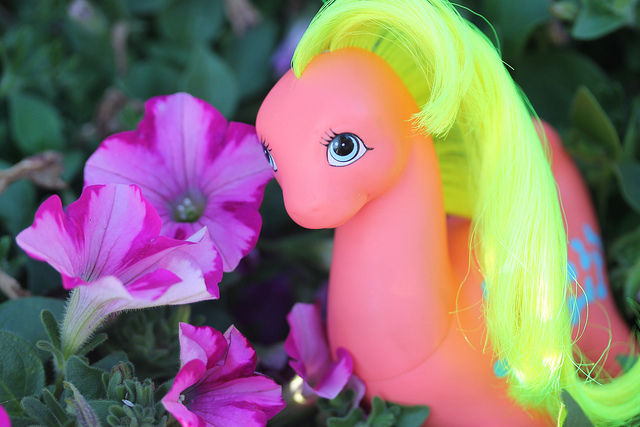
I studied the pony as I peeled the foil from another chocolate. Her silky mane draped over one eye. Between the chubby cheeks on her oversized head, a slight smile curled like an apology. Or intuition.

After last week’s magic, let’s keep the pony love going with our second My Little Pony Contest winner: “My Little Pony’s Easter Message” by Debbra Palmer.

My Little Pony’s Easter Message

For years on Easter morning our friends who also didn’t have children left an Easter basket at our doorstep without waking us. We always knew it was them, and they knew we knew. But afterward we’d text them. “Can u believe it? Easter bunz has struck again!”

We’d gorge on peanut butter eggs, chocolate bunnies, marshmallow peeps and jellybeans. But our favorite were the toys: Slinkys, troll dolls, Etch-a-Sketch key rings, wax lips and a mini Gumby.

After three years of this we decided to be Easter Bunny too, and snuck a ridiculously over-filled basket onto their porch before sunrise.

“Is this sad?” I asked my husband on the drive home.

“No, I like candy,” he said as the sky broke open in pink clouds.

Returning home, we found a basket at our door. We must have passed our friends on the highway, or maybe they’d taken a different route. It hadn’t occurred to me this would happen. I’d imagined them waking up and finding their basket like we always had. I silently berated myself for not thinking of this simple logistic.

This year, our basket was topped with a retro My Little Pony our friends had defaced in ink with the words “He is Risen!” I recognized the My Little Pony from childhood, though my mother never let us have them. She thought they were like Barbies, sexualized, shapely plastic figures with eye makeup and dyed hair that little girls swooned over. I explained this to my husband.

“She is kind of hot,” he said rubbing the pony’s blue speckled behind. He whispered into her ear. “Hey little filly, you are so fine! How ‘bout a ride, pony? Ooooh, I might be in looooove.”

“Stop it,” I said trading him a mini Krackel for the pony. I showed him how to stroke her purple hair.

“It’s mane, not hair,” said my husband digging for jellybeans. I studied the pony as I peeled the foil from another chocolate. Her silky mane draped over one eye. Between the chubby cheeks on her oversized head, a slight smile curled like an apology. Or intuition.

At this moment, I saw My Little Pony for who she really was—a girl so pretty she broke everyone’s heart. She didn’t know how, or why, it just always happened, and she couldn’t help it, so all she could do was apologize. And when that didn’t work, she tried apologizing in ways that made her hate herself. And when people talked, they always said she deserved it. My Little Pony’s atonement? Denied.

Later that Easter day, our friends called to say the Easter Bunny had come to their house, too. We all pretended to be surprised and inventoried the contents of our baskets like children. But it was the last year the Easter Bunny walked among us, the year we passed each other in the predawn. We made no apologies or revelations. It just seemed best to wait for him to come again.
SONY DSC
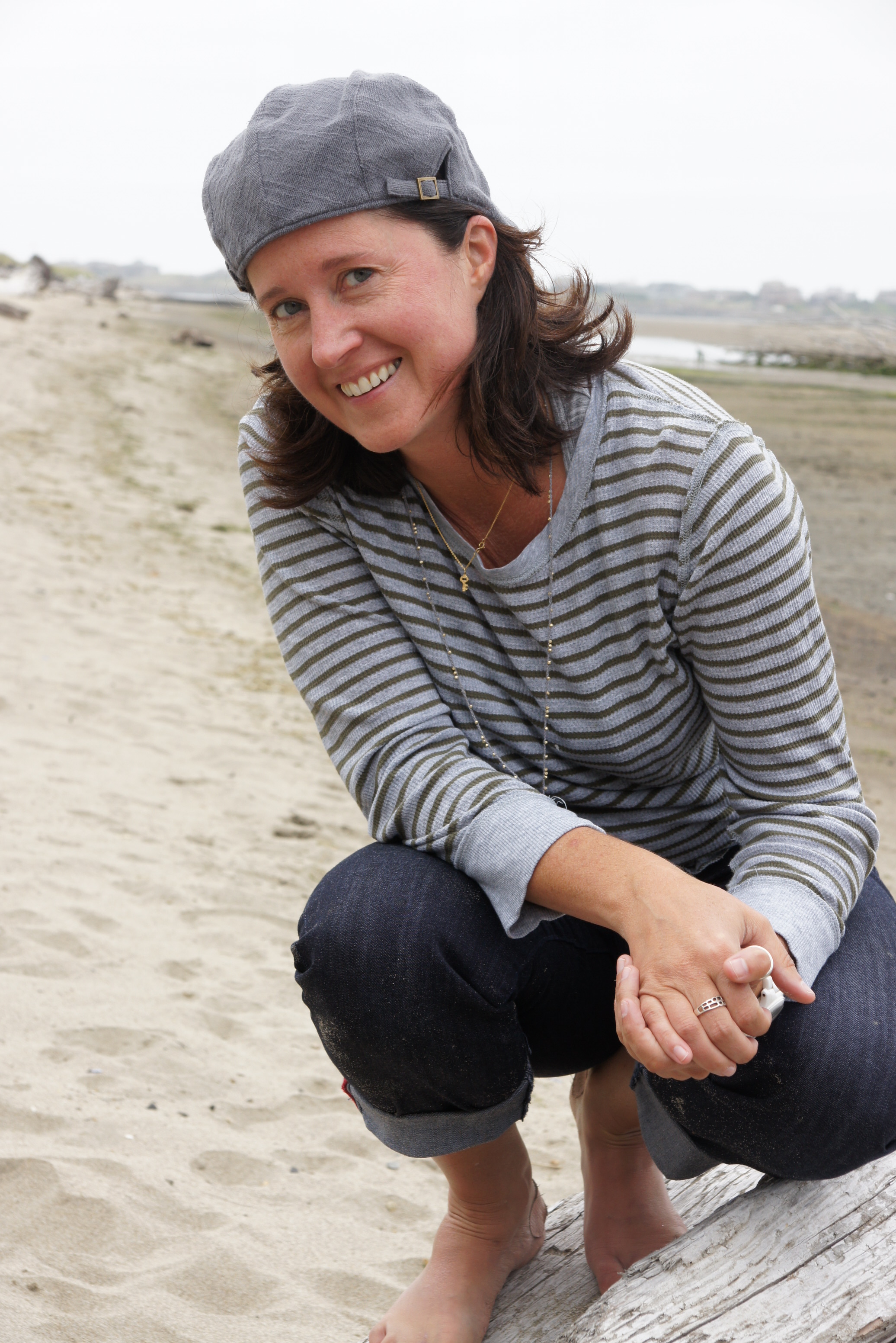
Debbra Palmer


An Idaho-born Oregonian, Debbra Palmer studied writing at Portland
State University. Her poems have appeared in Calyx Journal, BLOOM,
Pectriloquy (CHEST Journal for the American College of Chest Physicians)
and The Portland Review. She is the writer and director of the feature
documentary Sky Settles Everything profiling an old-time cattle rancher
and his poet cousin, Verlena Orr.  Currently, she is exploring the southwest
and working on a collection of poems inspired by the military alphabet.


We are in the process of posting all four My Little Pony Contest winners on this blog. To read another winner’s prize-pony work, see “Friendship is Magic” by Marci Rae Johnson.

Pony Photo: Hina Ichigo
“Friendship is Magic” by Marci Rae Johnson

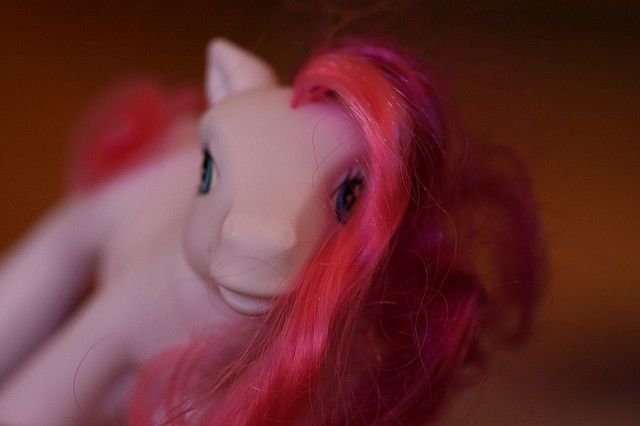
pink pony

At AWP 2014 in Seattle, amidst the star-studded panels and readings, one event stood out from the pack as the most magical. That’s right, folks. We’re talking about the MAR My Little Pony Writing Contest.

The challenge was simple: write a poem or flash fiction piece somehow celebrating the magic of My Little Pony. From a herd of pony entries, four winners emerged. Today, we’re pleased to publish the first of the winners: “Friendship Is Magic” by Marci Rae Johnson.

Friendship Is Magic

This article may contain an excessive amount of intricate detail that may only
interest a specific audience. (November 2013) – My Little Pony, Wikipedia

You are all my very best friends,
you cutie pies you pink
and purple lovelies I have kept
in the original packaging until
the day I need you most,
until the day the stars fly out
of the sky and I can’t stop
crying with the one eye
remaining, the other having
already been given to the Friends
of the End of the World. You
my sugar cubes, my rainbow
brood, each with a sign that makes
you unique, the mark of the beast
the pony, the unicorn that remains
after the flood made everything
new. It doesn’t matter anymore
what your sin, it’s all afire O
the Grand Gala, the Pink Gala
where everything you eat is sweet.
Put the sugar in your mouth,
O taste and see. The magic
makes it all complete.

Marci Rae Johnson
Marci Rae Johnson


Marci Rae Johnson teaches English at Valparaiso University, where she serves as Poetry Editor for The Cresset. She is also the Poetry Editor for WordFarm press. Her poems appear or are forthcoming in The Collagist, Quiddity, Hobart, Redivider, Redactions, The Louisville Review, The Christian Century, and 32 Poems, among others. Her first collection of poetry won the Powder Horn Prize and was published by Sage Hill Press in 2013.


The magic will continue when three more winners are revealed in the coming weeks. *sparkle*

Photo: Sharyn Morrow

Laura Maylene Walter, Fiction Editor

MAR Asks, Carrie Shipers Answers

Carrie Shipers

This latest contributor interview may go down in MAR history for being the only one to include a sentence like, “His biggest decision is whether to lick his rear end before or after he takes a nap.” But that kind of poetic insight is what we’re here for, folks. Enjoy this lively interview with Carrie Shipers, whose poem “How Sandbag Lives Up to His Name” appears in our Spring 2014 issue (Vol. XXXIV, Number 2). Carrie’s poems have appeared in Crab Orchard Review, Hayden’s Ferry Review, New England Review, North American Review, Prairie Schooner, The Southern Review, and other journals. She is the author of two chapbooks, Ghost-Writing (Pudding House, 2007) and Rescue Conditions (Slipstream, 2008), and a full-length collection, Ordinary Mourning (ABZ, 2010).

Quick! Summarize your story/poem/essay in 10 words or fewer.

My eleven-pound dog keeps me safe.

What can you share about this piece prior to its MAR publication?

I’ve been in love with dictionary poems since being introduced to A. Van Jordan’s amazing collection M-A-C-N-O-L-I-A during my MFA program. Unfortunately, as much as I love those kinds of poems, I’m actually pretty terrible at writing them. One of my challenges with “Sandbag” was to let the dictionary definitions do their work without my over-explaining or simply repeating them. As I revised the poem, I trimmed as much as I could from the non-dictionary parts of the poem and tried to trust the juxtaposition between the authoritative voice of the dictionary and the more searching voice of the speaker.

What was the worst/best feedback you received on this piece?

One of the first times I sent this poem out into the world, an editor wrote on the rejection slip, “Of these, Sandbag shows the most promise.” On one hand, I was thrilled to get a personal note of any kind because I know how busy editors are. On the other hand, I kept thinking, “Of course Sandbag shows the most promise! He’s a dog! His biggest decision is whether to lick his rear end before or after he takes a nap.” (Sadly, these are exactly the kinds of arguments I have in my head with editors, even when I know they’re right.)

You’re at a family reunion and some long-lost relative asks about your writing. What do you say?

Since I’m currently writing a series of poems about professional wrestling, I really hope no one asks me this question. I’d hate to knock over the potato salad while demonstrating some of my best wrestling moves.

What do you consider your biggest writing-related success?

This might sound silly, but I’d been submitting to 5 AM for a decade and always got rejected, although sometimes I received an encouraging note. About a year ago, my poem “A Bed of Grass and Stolen Hay” appeared in the magazine’s last issue before its current hiatus. I really hope the magazine eventually continues publication, but I’m thrilled I finally made it in there.

Tell us one strange thing about yourself that does involve writing.

My writing brain works best in the early morning hours, which means I’m usually at my desk by 5:30 or so. In the four years since my husband and I adopted Sandbag, he’s been sitting on my lap while I constructed most of my first drafts, including this one.

Do you have another favorite piece of writing in this MAR issue?

I’m totally in love with Janet Smith’s poem “To Do List.” Every time I read it I’m reminded how often we seem to make choices designed to make us miserable rather than happy, and how easy it becomes to justify these choices as necessary or responsible rather than seeing that they’re really inspired by fear. It’s easier to keep crossing items off our lists than to move through the world anticipating joy, even when the items on the list are making us actively unhappy. I especially admire these lines: “Decide it’s okay you never see / Prague. Work late for no reason. / Turn down the music. Keep your shoulders / hunched in case of unexpected attack.” Reading them reminds me to do the opposite, for which I’m grateful to their author.

Thanks for the interview, Carrie!

Laura Maylene Walter, Fiction Editor

Submit a Winter Wheat Workshop Proposal

Winter Wheat

We are now accepting workshop proposals for Winter Wheat: The Mid-American Review Festival of Writing, which will be held Nov. 13-15, 2014 on the campus of Bowling Green State University in Bowling Green, Ohio. Workshops are held Nov. 14-15.

Interested presenters may propose workshops in any area of creative writing, including but not limited to the craft of fiction, nonfiction, or poetry; publishing; revision; the writing process; and more. Each workshop is one hour and fifteen minutes long, and preference is given to workshops that include writing time for participants. The proposal deadline is Sept. 10.

Curious what type of workshop proposals we’ve accepted in the past? Here’s a sampling of several workshops held at Winter Wheat in 2013:

2013 Accepted Winter Wheat Workshops

“Whose Story Is It? Ethics in Creative Nonfiction” with Sarah White
Whose story is it to tell? You have a creative nonfiction piece you want to write, but it involves your mom, your spouse, your child, that crazy ex-girlfriend from high school…. Where do we draw the line? If it’s part of my experience, am I justified in sharing it? Let’s discuss the ethics of nonfiction.

“Haunted Places” with Catherine Carberry and Katrin Tschirgi
By exploring our past and collective memories, we see that haunted places provide a wealth of inspired stories and allow us to understand the intersection of past and present, living and dead.

“All Scenes Are Duels” with Brad Felver
In this session, we will examine ways to create and elongate tension in a scene. We will consider a few famous examples, discuss potential strategies, and then try our hands at infusing scenes with tension.

“Writing the Imaginary Landscape” with F. Daniel Rzicznek and Bryan Gatozzi
This exploratory workshop will offer suggestions and prompts for writers of all genres hoping to sharpen their senses of expanse and enclosure. Writers will come into closer contact with their physical and psychic surroundings while investigating the landscapes of memory and imagination.

“Poetry with Personality: Writing Persona and Character in Poetry” with Casey Nichols
This workshop will discuss the ways in which we write about people we know (or people we don’t), the challenges of writing from the perspective of a persona, and what our persona poems reveal about ourselves. Participants will spend time writing to create a strong persona or character of their own.

“Diagramming the City, the Experience, the Population of Butterflies: Using Maps and Cartography in Creative Writing” with Anne Valente
In this interactive session, we will discuss and test out using maps to enhance or even define creative work. Writers of fiction, poetry, and nonfiction alike can find innovative ways to use maps and cartography to diagram both tangible and intangible aspects of their creative writing.

Proposals can be accessed here. Please email your proposal to Abigail Cloud (clouda@bgsu.edu) and Laura Maylene Walter (lauwalt@bgsu.edu) by Sept. 10. If you prefer to submit your proposal via mail, please use the address below:

Mid-American Review
Department of English
Bowling Green State University
Bowling Green, OH 43403

Good luck!

Join us Nov. 13-15 for Winter Wheat: The Mid-American Review Festival of Writing! Winter Wheat features dozens of panels focusing on publishing, craft, and technique for writers of fiction, poetry, and creative nonfiction. Keynote readers for 2014 include Sharona Muir, Anne Valente, Marcus Wicker, and Allison Joseph; Mid-American Review editors will also offer publishing insight.

Interview with Laura Madeline Wiseman, On Nonfiction

Laura Madeline Wiseman

Martian mascots, murder cases, James Bond, and geography spanning from Russia to Nebraska? It’s all part of our inaugural Mid-American Review contributor interview with author Laura Madeline Wiseman, whose creative nonfiction piece “From Russia with Love Melancholia” appeared in our Spring 2014 issue (Vol. XXXIV, Number 2). Here’s a quick sampling from the essay:

“Do you want to touch my monkey? Do you like his yellow shirt? What about his teeny pair of jeans? How about a picture with my monkey? He will climb up on your shoulder or sit on your hip, his little hand will clutch the silver heart of your necklace. Would you rather hold this red parrot? Listen, he says hello in Russian. He says goodbye, da-svi-da-nya.”

Let’s hit it!

1. Quick! Summarize your story/poem/essay in 10 words or fewer.

An essay on traveling to Russia for with love.

2. What can you share about this piece prior to its MAR publication?

I started drafting “From Russia with Love Melancholia” while I was traveling in Moscow and Sochi in 2011. At the beginning of the trip, I was often jetlagged and/or culture shocked. Taking just a few moments to record my impressions allowed me to think through the cultural differences and reflect on my experiences while I was there. When I returned home to the United States, I continued writing bits and pieces of the essay, focusing on the parts of my travels that lingered, or that I found myself returning to without conscious effort. Russia didn’t just go away after I returned to my normal Nebraska summer of gardening, bicycling, and working. Rather, like learning a new word, Russia seemed to filter into my everyday life. I found myself seeking out more of Russia in the form of renting movies like the 1963 James Bond film From Russia with Love, reading books like Elliot Holt’s You Are One of Them, and attending cultural events like The Russian National Ballet Theatre’s production of Sleeping Beauty. Even recently, I enjoyed the audiobook version of Donna Tartt’s The Goldfinch for the literary quality and the story, of course, but also for the reader’s performance of Theo’s Russian-born friend Boris.

3. You’re at a family reunion and some long-lost relative asks about your writing. What do you say?

Actually, something like this recently happened. I was giving a reading in Omaha at a local art gallery this spring and a woman approached me before the event to ask if we were related, given that we had the same last name. She said, “I came to this reading because of your last name.” She asked specifically if I was a descendant of a Charles “Chick” Wiseman. I was. He was my great-grandfather. She was a descendant of his elder brother. We talked a little about that connection and then I explained that I’d recently written a book about our mutual ancestor, Matilda Fletcher Wiseman, who was a nineteenth century lecturer, suffragist, and poet. Matilda was my great-great-great-grandmother and Chick’s great-grandmother. My book Queen of the Platform follows Matilda’s career by exploring the connection to the men in her life: her brother, a civil war solider, her first husband, a school teacher and a lawyer, and her second husband, a minister who became her agent. Matilda spoke to support herself and her family. On the stage she spoke among other lecturers of her time, such as Susan B. Anthony and Elizabeth Cady Stanton. I didn’t have extra copies of Queen of the Platform with me at the reading, but I did have a copy of my chapbook Men and Their Whims, a series that focuses specifically on the bond between Matilda and her younger brother, Geo, who was charged with murder. Handing over a copy of the chapbook for free to my recently discovered Wiseman cousin, I said, “Here,” adding, “Thank you for coming to my reading.” I also told her how she could find Matilda’s book about the murder case.

4. What do you consider your biggest writing-related success?

I always feel like my latest released book or chapbook is my biggest success. Thus, I’m delighted to have my newest book of poetry, American Galactic, in the world. Opening with an epigraph from Charles Simic, “Lots of people around here have been taken for rides in UFOs,” American Galactic, explores Martians, crop circles, abductions, and how humans face an extraterrestrial invasion via sci-fi poetry.

5. Tell us one strange thing about yourself that does not involve writing.

I successfully biked every mile of RAGBRAI this summer, biking 446 miles across the state of Iowa in seven days. My team’s mascot was a Martian.

6. Tell us one strange thing about yourself that does involve writing.

I write every day.

7. Do you have another favorite piece of writing in this issue of MAR? If so, name it and tell us why.

I adore Jeannine Hall Gailey’s poem “Every Human is a Black Box.” I’ve been a fan of Gailey’s work ever since I read her fabulous Becoming the Villainess. In the MAR poem, I love how she explores and charts the ways each of our bodies are marked by a world that none of us can fully read.

Great responses. Now, if we could only have a shot of you with your MAR issue….

Laura Madeline Wiseman
MAR is a gal’s best friend.

Perfect. Thanks for your time!

Laura Maylene Walter, Fiction Editor