
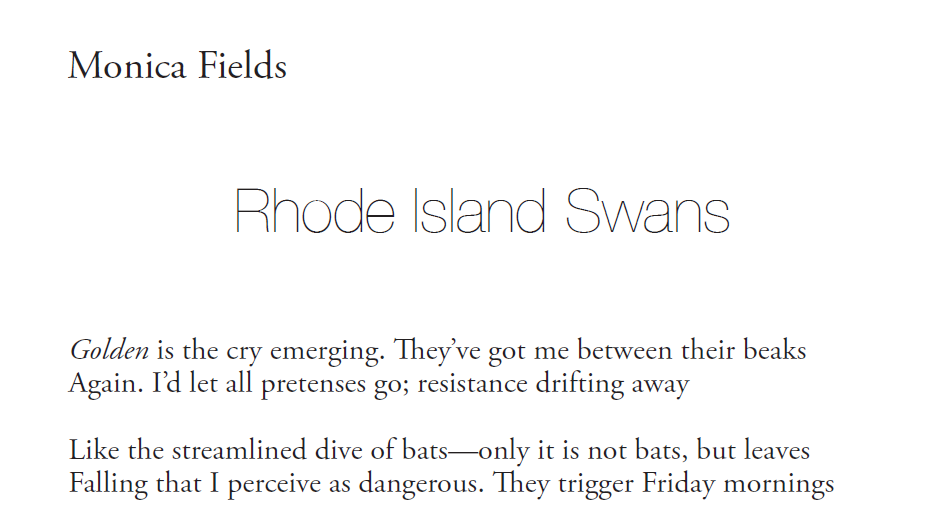
Why We Chose It: “Rhode Island Swans” by Monica Fields

Top of poem from MAR volume 44

“Rhode Island Swans” is a poem that transports you back to one of the speaker’s childhood memories through the eyes of her adult self. Describing the scene, “as it was in 1989, / and know[ing] the fine tremor of disorder,” the speaker reflects on feeding popcorn to swans at the park with her mother and brother; however, it’s not as blissful as it sounds. This poem is heavy with disorder, danger, wrath, and indifference.

It begins with: “Golden is the cry emerging. They’ve got me between their beaks / Again.” We as readers automatically question a few things: Why is the cry golden, and is it emerging from the speaker or the Rhode Island swans? In what way is the speaker between their beaks? The poem unfolds from this into images of falling leaves mistaken for swarming bats, and then into the scene of the swans being fed by the family. But the swan feeding scene is deceptively calm.

The description of the swans as, “cruel birds that would strike, defending / Their own beauty,” transforms the image into an uneasy representation of the family. Beauty and aggression linger in every part of this poem. Typically, we romanticize swans as alluring creatures, and we romanticize past memories and build them up to be something that they never truly were. However, memories can change over time, and swans can be angry and territorial.

I find it fascinating that the speaker admits these swans haunt her in dreams from “feathered enclosures,” in the present as she reflects on this memory.  When she sees swan boats in the city, the memory of the swans from Rhode Island resurfaces. “Wrath, they tell me. Power.” In this moment, the swans take on weight beyond the childhood scene itself, and represent the instability of power that the younger version of the speaker might not have recognized at that time.

This poem articulates meanings from a memory that can only be cultivated through distance and the passage of time. “I am the cry emerging and the hand covering my mouth,” she says, recognizing the power and fear she now carries with her.

––Tyler McDonald, Mid-American Review 

Why We Chose It: “The Buffalo” by Schuyler Mitchell No. 13

by Liz Barnett

Mid-American Review fiction staff chose “The Buffalo” by Schuyler Mitchell for publication in Volume XLIII, Number II.

“The Buffalo” is a story of a person whose father is a buffalo…or at least, that’s what our narrator leads us to believe. The narrator’s father has remarried a woman and our narrator wonders why the woman would do that. The relationship between the new wife and narrator leads to interesting tension as we watch from the narrator’s POV of passiveness.

The fiction staff enjoyed the internal conflict of the character being a passive observer of this relationship between the buffalo father and his new wife. The narrator wonders if she should tell Maryann, her father’s new wife, about him being a buffalo, but in the end has to reason that well…Maryann was the one who chose to marry a buffalo, while our narrator never got a choice of him being her father.

The buffalo is loud and violent and while we do not see outright acts of abuse, we see the effects on our narrator as she wonders about if she’ll also become a buffalo someday. We enjoyed this view of the generational cycle and the way the story handled abuse in general with its metaphor. While it was a lighter view of abuse, it still showed the guilt and domestic dynamics in a whole way.

The narrative voice will also leave the readers with a lingering sense of loneliness and worry for our narrator and her possible (inevitable) transformation into a buffalo someday. Readers will not want to miss this story.

Why We Chose It: “The Fall of Virgilio” by Michael Garcia Bertrand No. 12

By Sydney Koeplin

Promo photo for instagram. Over a snow wheat field. Why We chose it.

Mid-American Review fiction staff chose “The Fall of Virgilio” by Michael Garcia Bertrand for publication in Volume XLIII, Number II.

The short story begins with the titular character Virgilio—a Cuban emigrant back in his home country for his yearly visit with family and friends—falling down the stairs. He lands in a coma and is rushed to a dilapidated, undersupplied local hospital, where he remains for the rest of the narrative. This is the plot, in the simplest terms. But within this frame, Bertrand explores Cuban identity, memory, and history.

Coma stories can be challenging to craft because it is hard to move a story forward when the character is, by the nature of a coma, stuck in place. But “The Fall of Virgilio” overcomes that narrative pitfall. In Virgilio’s comatose state, he meets el Comandante, flies over Havana, and watches his family at his bedside. It resists sentimentality but still asks us to consider what constitutes a life well lived.

We discussed this story on November 6th, 2024, when we at MAR—and many millions of other Americans—were contemplating what the election results would mean for our health, mental well-being, and safety. Bertrand’s story was exactly what I needed to read that day. I choked up as I read the following passage aloud to the editorial team:

“I say it, too, to everyone I love or care about. Ten Cuidado. (Be Careful). Cubans tend to say it in place of Goodbye. It is part of who we are. The occasion does not matter whether we are going to the supermarket or Cuba. We are not pessimists, though. We do not say it out of fear (well, maybe a little fear). Do not make that mistake. We are the most joyful people alive. Even in adversity, we find ways to sing, dance, eat, drink, play, make love. Ten Cuidado is our way of pretending that we can ward off catastrophes, that is all.”

“The Fall of Virgilio” is a tragedy in the sense that any accident is a tragedy. But the story is also a story of hope, resilience, and the will of a people to continue living even under the most dire of circumstances. It explores what it means to return to—and die in—a place you’ve left. It is a testament to the human spirit delivered in prose that is all at once lyrical, surreal, humorous, and sharp.

Why We Chose It: “The Unbearable” by Brianna Barnes No. 11

American suburbs from a drone or bird's eye view

By Jane Wageman

Photo Caption: “Drone view of similar houses, driveways, and yards in the Utah suburbs.” by Blake Wheeler, Public Domain, Wikimedia Commons.

Mid-American Review fiction staff selected “The Unbearable” by Brianna Barnes for publication in Volume XLIII, Number 1, forthcoming.

Life has become increasingly unbearable for Judy, the protagonist of Brianna Barnes’ story—but reading about her existential crisis is anything but.  

Our staff loved the psychological complexity of Judy’s character, whose actions are often nonsensical—and yet make perfect sense within the framework of her own skewed logic.  

Judy is on a first-name basis with the agents at Poison Control, which she regularly calls while drunk to inquire about the effects of consuming certain toxins. She trolls the website FriendlyNeighborhood.com, posting under the pseudonym Carl Rogers and trying to get a rise out of the neighbors whom she lives alongside but rarely speaks to. She acts with certainty—even as she continually questions her relation to the world around her. 

The story begins in the aftermath of a forest fire, which has forced a bear into the surrounding suburbs. Judy, encountering her neighbors’ comments about this online, finds herself intentionally stoking their concerns about the animal. As she reacts to the bear-sightings, the story delves into her thoughts on consciousness and her place in an indifferent world. Walking through the trees’ charred remains in the opening scene, Judy notes: “The fact that. . . she was fully surrounded by a resplendent and unrepeatable beauty did not mean she was being loved by the forest or by nature or by some capital ‘G’ God; she was just as unloved as ever within a beauty which preceded her and did not need her, a wilderness, after all.” 

“The Unbearable” has a lonely, haunting quality in such scenes—but they are set alongside moments of sharp, critical humor that left many of us laughing to ourselves as we read. Ironic and funny portrayals of suburbia are sprinkled throughout the story: the particular smells and patrons of an organic grocery store, conversations between neighbors about recycling protocols in an online forum, and a description of Judy’s home, Pleasant Meadows, as “a suburb with profound rural pretenses, hyperbolic nature street names, and paranoid inhabitants.” 

As the story follows Judy’s growing sense of her own “nonsubjecthood,” it builds to an ending that feels both surprising and inevitable—one that you certainly won’t forget.  

Why We Chose It: “The Retch” by Colten Dom

Mid-American Review fiction staff selected “The Retch” by Colten Dom for publication in Volume XLII, Number 2.

“The Retch” is one of those stories that contains seemingly incompatible subjects: on the literal level, it is about dog vomit; on a thematic level, it delves into marriage, family, nostalgia. One of the pleasures of the story lies in this unexpected pairing, the way in which the surface conflict of the story subtly explores the underlying conflicts of the protagonist, Queenie, through a balance of pathos and humor. What starts as a fairly ordinary occurrence (the family dog, Bee, eating something she shouldn’t and throwing up on the carpet) quickly escalates into the absurd, as Bee begins regurgitating objects she couldn’t possibly have eaten. First, it’s items from the owners’ childhoods, then unnaturally large objects (“a golf club or an intact model ship”), and eventually orbs that resemble fish eggs “warm to the touch, with the texture of a flayed grape and the smell of a leather armchair gone rancid in the rain.” 

As evident in the above description, Dom’s language is striking, with attention to sensory details that make even the impossible feel physically real. The opening paragraph is rich in sensory details packed into rhythmic sentences: “There are hooks made of sound: the slap of sex, the generic jingle of the nightly news or the cacophony of your husband sneezing. There are pop song sippets of adolescence, guitar licks that drag you back to high school. And jaunty radio realty commercials, dropping through time to mom and dad and the typical divorce, leaving your childhood toys behind to guard the leaky attic where they became toothpicks for a family of raccoons.” The poetic syntax, alongside the story’s absurdity, renders the familiar conflicts of domestic life unfamiliar and therefore new.

The story as a whole is built around pattern—Bee vomiting increasingly unbelievable things—but continually moves in directions the reader could not anticipate. George Saunders, writing about Donald Barthelme’s “The School,” describes this kind of structure as a series of “gas-stations” that propel the reader forward. While advancing the pattern, the writer “fling[s] us forward via a series of surprises; each new pattern-element is. . . introduced in a way we don’t expect, or with an embellishment that delights us” (177). The patterns and surprises of “The Retch” accelerate the story forward in unexpected, but nonetheless fitting, directions. The ending, in which Bee vomits a web that slowly forms into a house, provokes questions about Queenie’s relationship to the domestic sphere and her family, particularly things she has kept inside herself that ultimately must come out, however messy and unpleasant that might be.

––Jane Wageman, Mid-American Review

Note from the editors: This essay contains a quote from “The Perfect Gerbil: Reading Barthelme’s ‘The School'” from The Braindead Megaphone by George Saunders. New York, NY: Riverhead Books, 2007, pp. 175-185.