
Interview Bites: James O’Bannon

James O’Bannon’s poems “Naming” and “Dad Keeps Saying Pray About It” were published in Mid-American Review Vol. XLI. In the spring of 2023, James agreed to answer a few questions by associate editor Christopher McCormick on his poetic work.

.

Your poem “Naming,” (after a poem by Diana Khoi Nguyen) which appeared in Volume XLI of Mid-American Review, utilizes non-sequiturs and surrealistic elements, as in the unforgettable line “If there is a child who is dead there is a bird alive somewhere,” yet a firm wisdom seems to underpin the entire poem. Can you tell our readers a little bit about what you sought to achieve with this piece?

“Naming” is written after the poem “Grief Logic” by Diana Khoi Nguyen. In her brilliant poem, she utilizes hypothetical syllogisms to explore grief as well as other ideas. For “Naming”, I wanted to maintain the sense of logical leaping employed in Nguyen’s poem, while using the image of a bird to symbolize a child in sort of a spiritual sense.

I found myself thinking about the language used in the death or incarceration of Black children and how that differs from the language used with white children. Considering that dehumanization, I wanted a poem where Black children could exist/stay alive in perpetuity, hence the “If the child stays alive” line’s repetition. Lastly, in all of my work where a god figure is mentioned, I think of it as a means to wrestle with an aspect of faith and hopefulness in a world that consistently contradicts those beliefs and antagonizes them. 

.

In your poem “Dad Keeps Saying Pray About It,” you write “I’d like to live / in a world where there is a god / who calls my name.” What role does religion and spirituality play in your writing? 

In being raised in a Black, religious household, participation in church and other aspects of Christianity were expected. I went to Sunday School, Bible study, participated in sermons, etc. As a child, you are never really allowed to interrogate your inherited belief system. As I got older, I found myself questioning many of ideas I was taught. Christianity felt too idealistic to me, and it excluded too many people I loved. 

In my writing, I see god as a figure used to interrogate those difficult questions.Much of my poetry deals in the questioning of how one could believe in not only a god-figure, but a god that is unquestioningly good, when so much of our world fails us in so many ways. 

.

Your poem “and now the doctor asks if depression is a family,” published in Waxwing issue XVIII, speaks on subjects such as race and self-love. Can you talk about how those subjects have been an influence on your journey as a writer?

​I wouldn’t really call my relationship to these ideas an influence. Race is definitely embodied in my writing because as a Black person in America, it is tied to every part of your being. You wake up Black, you breathe Black, you sleep Black. In this particular poem, I chose for the relationship between mental health and Blackness to be overt because of the ways it is stigmatized. There are so many negatives poured onto the waywe view the mental struggles of Black folks; even medically. So, I would say my goal in marrying these concepts would be to allow people to see the struggle I’ve dealt with (and still deal with) in its most open and bare form, hopefully, as a means for people to embrace the humanity in that struggle. 
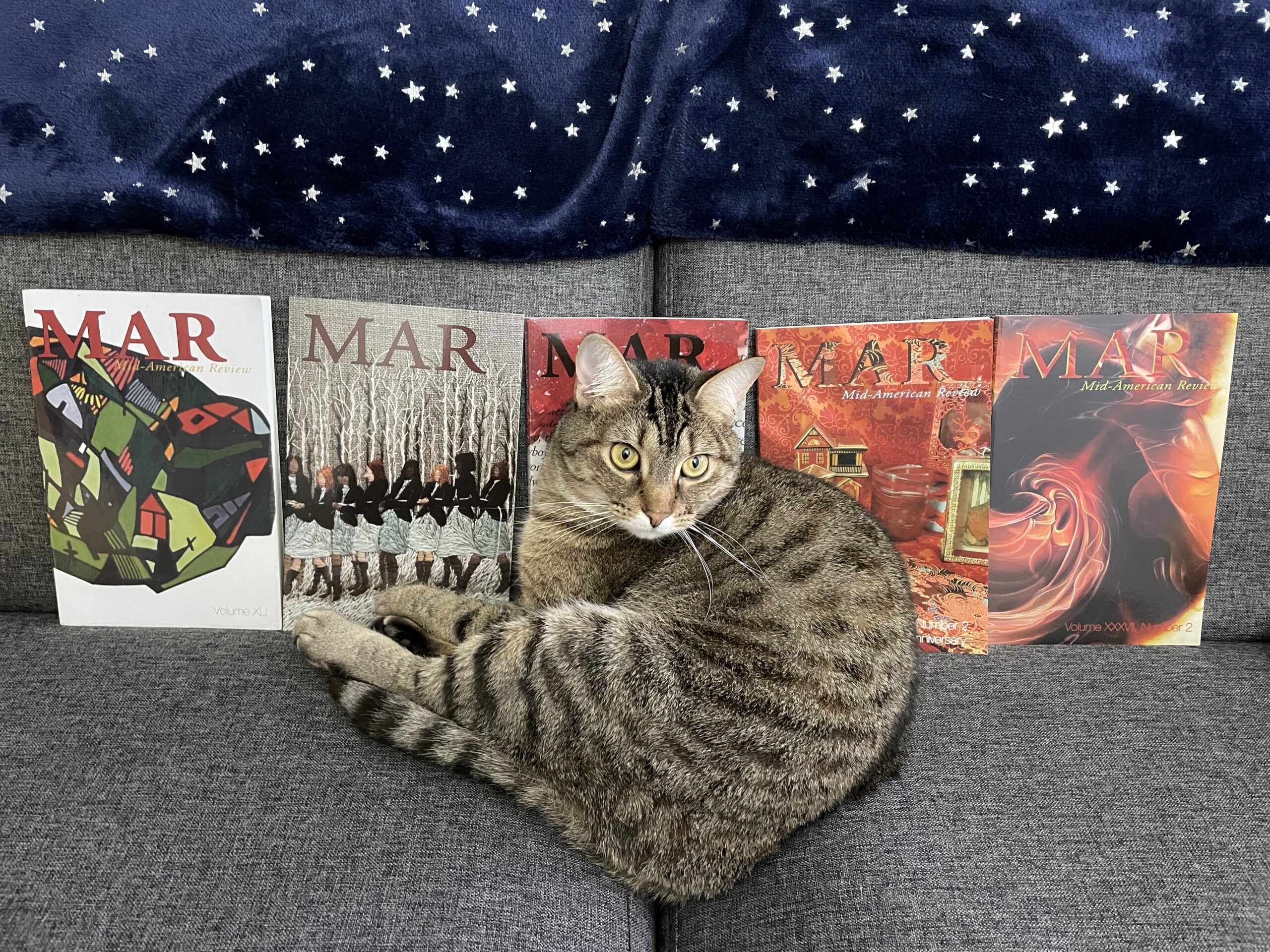
Pets with MAR: Suki

Suki Simmons is an almost two-year-old brown tiger tabby who splits her time between Bowling Green and Cleveland, OH. She likes the color blue, tunnels, her mouse toy Horatio, looking out windows, and jump-scaring her human. She can often be found yelling for food. 

(Photo courtesy of Mary Simmons, MAR)

Winter Wheat 2017: Fiction Panel Features

Are you a fiction writer and attending the 2017 Winter Wheat conference? Here is just a taste of the wonderful fiction panels we have planned!


“Beginnings. Where and How Does Your Story Start?” with Brad Felver

This session will aim to differentiate between strong story openings and weak ones. What makes one compelling and the other forgettable? How can you catch the eye of readers (and editors!) without relying on gimmicks? How much pressure is fair to place upon a story’s beginning? We will look at famous beginnings, as well as some lesser-known ones, as we discuss how exactly they are juggling all the various demands. Finally, we will spend some time writing some new beginnings of our own.

Brad Felver is a fiction writer and essayist. His work has recently appeared or is forthcoming in magazines such as One Story, Colorado Review, and New England Review. He teaches at BGSU.

This workshop will be held on Friday, November 3, from 3:00-4:15 pm. If you’re interested in attending this workshop, select A2 when you register!


“Speaking of Death: Dialogue & Funerals in Fiction,” with Dr. Kasie Whitener

Funerals are cliché and all editors will tell writers to avoid them. However, what if we just did a better job with them? This workshop provides samples of good and bad funeral conversations in fiction. Dr. Whitener will provide a checklist for evaluating effective funeral dialogue and some “shan’ts” and “musts” for novice and emerging writers. Learners will then practice their own. Seasoned and journeymen writers will enjoy this chance to break through clichéd treatments of death in fiction.

Dr. Kasie Whitener is a regular contributor to the South Carolina Writers’ Association Columbia II Chapter where she recently blogged “Writing About Death” and got interested in how to keep our universal death experience from dragging down the drama of our fictional funerals. Dr. Whitener is a member of the South Carolina Humanities Council Speakers’ Bureau, an entrepreneur and frequent workshop presenter to the Kauffman Foundation’s 1 Million Cups Columbia. Her fiction has appeared in The Petigru Review and Spry Literary Magazine. Her short story “Cover Up” won the Carrie McCray Award for fiction and was nominated for a Pushcart Prize in 2016.

This workshop will be held on Friday, November 3, from 3:00-4:15 pm. If you’re interested in attending this workshop, select A7 when you register!


“Using Prompts to Create Scenes and Character in Fiction,” with Susanne Jaffe

A prompt is a method to jumpstart your creative juices, and to get you thinking about the possibilities for a story, a character, a plot, or a scene. It is an effective tool whose primary purpose is to inspire a writer’s vision, not replace it. The class will consist of a great deal of writing in response to various prompts—usually short, maybe 500 words—and then reading a few of them out loud.

Susanne Jaffe is a former executive and editor in New York City trade publishing and the former executive director and creative director of Thurber House, a nonprofit literary center in Columbus, Ohio. She has taught at Thurber House and a library learning organization in Columbus. She is the author of several published works of fiction, many of them published traditionally and the most recent two self-published with 5-star ratings on Amazon. For more on Susanne, please go to either: www.susannejaffe.com or to her Amazon author page at: http://amazon.com/author/susannejaffe.

This workshop will be held on Saturday, November 4, from 11:00-12:15 am. If you’re interested in attending this workshop, select D3 when you register!


“Brainstorming the Novel,” with Lawrence Coates

“Brainstorming the Novel” will be a discussion/workshop on conceiving and developing your novel idea. The presentation will feature an outline of the seven basic plots, some guided exercises that can be shared, and some questions that can be used to strengthen your idea or the manuscript you’re currently working on.

Lawrence Coates has published five books, most recently The Goodbye House, a novel set amid the housing tracts of San Jose in the aftermath of the first dot com bust. His work has been recognized with the Miami University Press Novella Prize, an Ohio Arts Council Individual Excellence Award, and a National Endowment for the Arts Fellowship in Fiction.

This workshop will be held on Saturday, November 4, from 1:30-2:45 pm. If you’re interested in attending this workshop, select E1 when you register!


Winter Wheat 2016: Fiction Panel Features Part II

Fiction galore! Here’s some more fiction-focused panels at this years Winter Wheat!

“The Kitchen Sink, the Teaspoon: Telling It All vs. Telling Barely Enough,” with Brad Modlin

When should writing go maximalist and pack itself full with details, complexities, chewy sentences, asides, long paragraphs, regret from high school days, and nostalgia for the tangerines your aunt gave you? When to—minimalist—seize the jugular? We will explore examples of maximalism and minimalism from writers of all three genres, such as David Foster Wallace, Amy Hempel, Margaret Atwood, and David Shields. And we will flex both kinds of muscle in our own writing exercises. All genres welcome.

Brad Modlin is the author of Everyone at This Party Has Two Names (Southeast Missouri State U Press, 2016) which won the Cowles Poetry Book Prize—and the author of Surviving in Drought, a small forthcoming fiction collection that won The Cupboard’s annual contest. His nonfiction publications include River Teeth, Florida Review,Fourth Genre, and DIAGRAM. Find him at bradaaronmodlin.com

(this workshop will be held on Friday, November 4th from 4:30-5:45pm. If you’re interested in attending this workshop, select B6 when you register!)


“Look Who’s Talking: Writing Believable Dialogue,” with Courtney Ebert

Anyone can get stuck when trying to write dialogue that is believable and stays true to their characters. We may even let our own voices overpower our characters’ voices, forget that our characters are doing something while they talk, or let our characters ramble on too long. In this workshop, we will explore different ways to obtain believable dialogue from our everyday lives, to make sure that our characters’ dialogue/voices are not too similar, and to create dialogue with a necessary conflict for the story.

Courtney Ebert is a senior at BGSU studying French and creative writing. She is an intern at Mid-American Review.

(this workshop will be held on Saturday, November 5th from 9:30-10:45am. If you’re interested in attending this workshop, select C4 when you register!)


“Arias and Air Guitar: Writing about Music in Fiction,” with Rebecca Orchard

From A Visit from the Goon Squad to The Heart Is a Lonely Hunter to Kazuo Ishiguro’s Nocturnes, music plays an important role in the lives of many fictional characters. Just as a vivid description of setting can anchor a work in the physical world, a compelling musical moment can give insight into a person’s inner world. What makes a musical description vivid, interesting, and essential to the dramatic action of a work? This workshop will explore ways to write about fictional encounters with music through prose examples and musical prompts.

Rebecca Orchard holds a degree in music performance from the Peabody Institute of Johns Hopkins University and is a current MFA student in fiction at BGSU. In between, she has been a professional baker, a New Yorker, and a wannabe arts commentator.

(this workshop will be held on Saturday, November 5th from 11:00-12:15pm. If you’re interested in attending this workshop, select D4 when you register!)


“Brainstorming the Novel,” with Lawrence Coates

“Brainstorming the Novel” will be a discussion / workshop on conceiving and developing your novel idea. The presentation will feature an outline of the seven basic plots, some guided exercises that can be shared, and some questions that can be used to strengthen your idea or the manuscript you’re currently working on.

Lawrence Coates has published five books, most recently The Goodbye House (U of Nevada Press, 2015), a novel set amid the housing tracts of San Jose in the aftermath of the first dot com bust. His work has been recognized with the Miami University Press Novella Prize, an Ohio Arts Council Individual Excellence Award, and a National Endowment for the Arts Fellowship in Fiction.

(this workshop will be held on Saturday, November 5th from 1:30-2:45pm. If you’re interested in attending this workshop, select E3 when you register!)


“Flash Fiction Battle to the Death,” with Brian Lee Klueter and Zachary Kocanda

Back by popular demand! Contestants will have 40 minutes to write a flash fiction piece based on a photo prompt. Two finalists will be determined by the group. Those finalists will read their pieces to a live audience, who, through applause, will determine a champion.

Brian Lee Klueter has a BFA in creative writing from BGSU, and is the former creative nonfiction editor of Prairie Margins. He currently lives in Columbus, OH, and is addicted to chicken fingers.

Zachary Kocanda is a second-year MA student in creative writing at Ball State University. He earned a BFA in creative writing from Bowling Green State University, where he was editor-in-chief of Prairie Margins and an intern for Mid-American Review.

(this workshop will be held on Saturday, November 5th from 3:00-4:15pm. If you’re interested in attending this workshop, select F5 when you register!)

Winter Wheat 2016: Poetry Panel Features Part II


Our poetry panel features continues with these 5 great workshops that you can attend at Winter Wheat!

“From Lyric to Lebowski: Writing the Pop Culture Poem,” with Donora Hillard

What does it mean to write a “good” pop culture poem? How can poets use pop culture to access elements of love, anxiety, misery, hope? Led by Donora Hillard, whose most recent full-length poetry collection, Jeff Bridges, was released by Cobalt Press in 2016, this workshop will work through those questions and more. Participants will each leave with a poem draft that gets to the root of what we love—and why we love—in the public consciousness.

Donora Hillard is the author of Jeff Bridges (Cobalt Press, 2016), The Aphasia Poems (S▲L, 2014), and other books of poetry. Her work appears in Hobart, Women in Clothes (Penguin), and elsewhere. She teaches at The University of Akron and lives in a tiny house with the writer Andrew Rihn.

(this workshop will be held on Friday, November 4th from 3:00-4:15pm. If you’re interested in attending this workshop, select A3 when you register!)


“First, Put Pen to Paper: Instructions as Poetry,” with Daniel Gualtieri

Modern and contemporary poetry contains a great tradition of poems written as sets of instructions, advice, or even recipes. This poetic form can provide interesting structural advantages, a confident and assertive voice, and fresh content for the poet of today. In this workshop, we will delve into the nature, use, and assembly of these instructional poems, take a look at some examples from great poets of the past and present, and spend time writing our own instructional poems and discussing them in a small-group setting.

Dan Gualtieri is an MFA poetry student at BGSU, and a native of Columbus, OH. He writes fiction and creative nonfiction in addition to poetry, and thrives on continental philosophy, theology, caffeine, and sushi.

(this workshop will be held on Friday, November 4th from 4:30-5:45pm. If you’re interested in attending this workshop, select B3 when you register!)


“Poetry as Meditation,” with Karen Craigo

For the presenter, each day begins with a poem—one that aims to change her own mindset and to encourage peaceful contemplation in others. Join this workshop to consider the idea of poem as meditation—a tool for connecting with a universal mind. Most poetic education is based on the very useful idea of a piece of writing as a flawed product that requires tinkering. This session explores the notion that a piece of writing might just be an artifact of the spirit, rather than a workshop fix-it project—while understanding that neither mindset suffices on its own.

Karen Craigo is the author of the poetry collection No More Milk (Sundress, 2016) and the forthcoming collection Passing Through Humansville (ELJ, 2017). She maintains Better View of the Moon, a daily blog on writing, editing, and creativity, and she teaches writing in Springfield, Missouri. She is the nonfiction editor and former editor-in-chief of Mid-American Review, the reviews editor of SmokeLong Quarterly, an editor of Gingko Tree Review, and the managing editor of ELJ Publications.

(this workshop will be held on Saturday, November 5th from 9:30-10:45am. If you’re interested in attending this workshop, select C3 when you register!)


“Existence as Conditional on Others’ Perceptions and the Deconstruction of the Self,” with Remi Recchia

The goal of this workshop is to produce new poems centered on the idea of the existence or nonexistence of the self. The focus of this workshop will be to deconstruct your own ideas of who you are and see if there is a core “you” and how it affects your creative work. After a brief presentation, we will examine who we think we are as writers and, more importantly, humans, and challenge these perceptions during a discussion/workshop and in-session writing time. This session is appropriate for all levels of writers or anyone who is interested in existence.

Remi Recchia is an MFA candidate in poetry at BGSU. He has been published in Glass: A Journal of Poetry,Cutbank Literary Journal’s online “All Accounts & Mixture” series, and The Birds We Piled Loosely, among others, and has a piece forthcoming in Ground Fresh Thursday Press.

(this workshop will be held on Saturday, November 5th from 1:30-2:45pm. If you’re interested in attending this workshop, select E8 when you register!)


“Writing a Love Poem that Doesn’t Suck,” with Luke Marinac and Lyric Dunagan

How can an emotion as powerful as love so often give rise to overly sentimental, cliché-riddled poetry? Is it impossible to wrangle this emotion in writing without feeling as though we’ve forgotten our pantaloons and lyre?

Although the love poem is well-trodden territory, it’s constantly presenting us with new and strange paths to assuage our confessional impulses. From ancient Mesopotamia to Kobe Bryant, we’ll examine how the love poem has evolved throughout the years and its function in contemporary society, then experiment with approaches to crafting a love poem that doesn’t suck.

Luke Marinac, a transplant from Appalachian Tennessee, is in the MFA Program at BGSU. His poems have appeared or are forthcoming in the North American Review, Pittsburgh Poetry Review, Anamesa, and Stirring, among others.

Lyric Dunagan graduated with her MFA in poetry from the University of Tennessee in 2016. Her poetry has previously appeared in Cactus Heart, New Madrid and The Volta among others.

(this workshop will be held on Saturday, November 5th from 3:00-4:15pm. If you’re interested in attending this workshop, select F7 when you register!)