Chapbook Review: dear girl: a reckoning by drea brown

dear girl: a reckoning by drea brown. Gold Line Press, 2014. 47 pages. $10.00, print.

drea brown’s dear girl: a reckoning is the winner of the 2014 Gold Line Press Poetry Chapbook Competition and a hauntingly beautiful glimpse into the Middle Passage and the life of Phillis Wheatley. brown’s poetry attempts to envision not only Phillis Wheatley as the poet, but also Phillis as the girl aboard a slave ship struggling to understand not only her situation, but also her new identity as someone’s property.

Each of brown’s poems deals with a specific moment in the harrowing journey across the ocean and the themes of haunting, rememory, and giving voice to the dead. This theme of rememory, a term which brown borrows from Toni Morrison, is one that occurs in each poem and calls into question how memory itself influences not only an individual, but also perhaps, an entire group of people. brown tells Wheatley’s story not only to show how portions of the poet’s identity were erased or unacknowledged, but also to address how the girl in her poems could embody not only Wheatley, but also countless unnamed girls.

brown asks readers to reimagine, remember and employ rememory to give voice to the dead and through doing so, exorcise some of our own haunted, unacknowledged pasts and shared histories. The chapbook opens with a poem emphasizing the voices of the dead, but end’s with a similar request successfully closing the narrative. brown’s rich imagery, variety of poetic forms and narrative tells readers that the dead will have their stories told: “the dead will have their due. they will speak from graves or whisper into the ears of poets or search oceans, to begin here or rupture or capture loss” (45).

-Chelsea Graham, MAR
Pets with MAR: Smaug

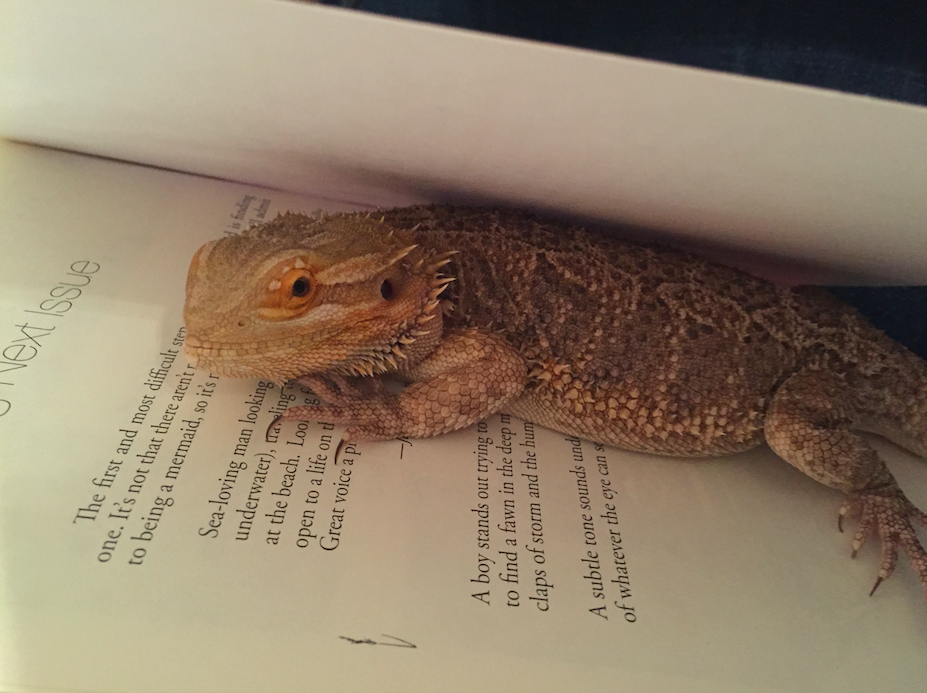
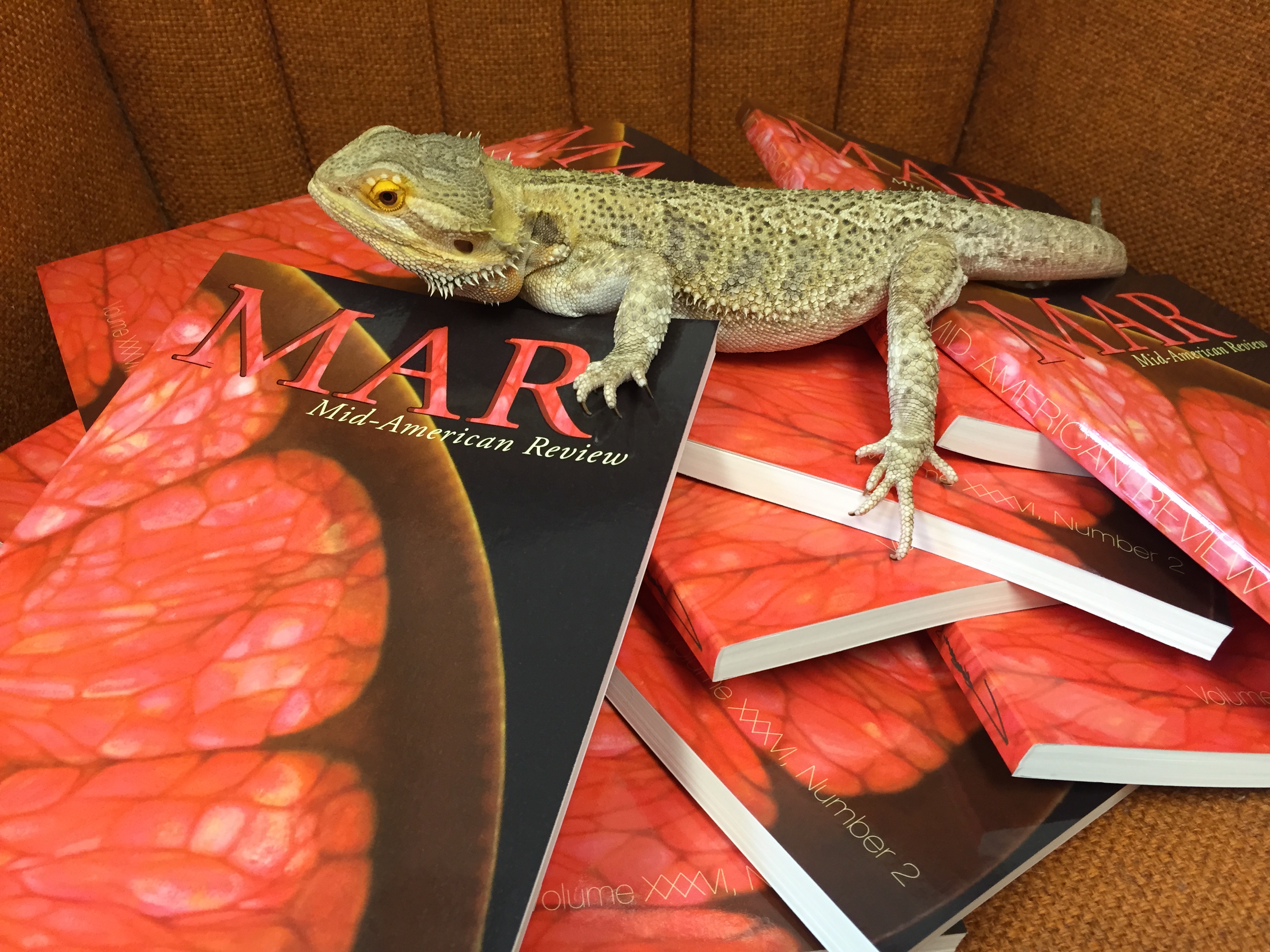
Last week you met some adorable cats, and this week MAR brings you a new pet–a bearded dragon, owned by the great Lisa Favicchia.
Lisa Favicchia is the Managing Editor of Mid-American Review and a second-year MFA candidate in poetry at Bowling Green State University. When she is not reading or writing, she is busy pampering the dragon whom she affectionately calls Smauggles (much to his chagrin).
And now, meet Smaug!
image4
Smaug is a bearded dragon and Mid-American Review’s honorary Office Lizard. While his ancestors came from the harsh deserts of Australia, Smaug prefers spending his days in air conditioning with the Mid-American Review staff, preferably sitting on somebody’s shoulder or keeping a close eye on office proceedings from his perch on the back of his owner’s chair. He enjoys digging around in office mail, licking things, and running circles around laptops. He has been very graciously received not only by the staff members ofMid-American Review, but by the BGSU community as a whole, much to the joy of his owner who loves to bring him everywhere she goes.
image1
Smaug has come a long way since his days as a starved, abused, and abandoned baby dragon to the illustrious Office Lizard you see before you today. His memoirs relating the tales of his difficult childhood and his struggle up the corporate ladder are forthcoming.

Chapbook Review: Candy in Our Brains by Anne Barngrover and Avni Vyas

Candy in Our Brains by Anne Barngrover and Avni Vyas. Missoula: CutBank Books, 2014.

Anne Barngrover and Avni Vyas recently collaborated to co-author Candy in Our Brains, a humorous and raw take on life and relationships told through a collection of poems. Full of unlikely combinations, and using a series of poems following “the heroine,” Barngrover and Vyas take the reader through the struggles of love. In the poem titled, “It’s My Party and I’ll Implode If I Want To” the authors pair interesting combinations such as, “You show up with a cake and moths fly out when I slice it” with the gritty thread of thread of dissatisfaction, “For your birthday: / heavy petting and a cake with your name in purple, gouged as if by my nails.”

Barngrover and Vyas pursue turmoil in nature in “The Heroine Shamwows Her Way Through A Hurricane” where “The fissures in our youth show up in our faces…tiny mushrooms breaking out in a rash: this / could be the tumor in my happiness swelling. This is my joy split wide open.” In “Fossils,” the language of forest and animal combine: “We were together, a cawing / battalion” and later, “How could we / have foreseen how much to camouflage in bruise and how much to coddle?” A collection that is unified by startling and vivid language, the turmoil of our relationships seeping through metaphor and everyday reality, Candy in Our Brains makes for a powerful collaboration.

Teri Dederer, Mid-American Review

Pets with MAR: Chloe and Lucy

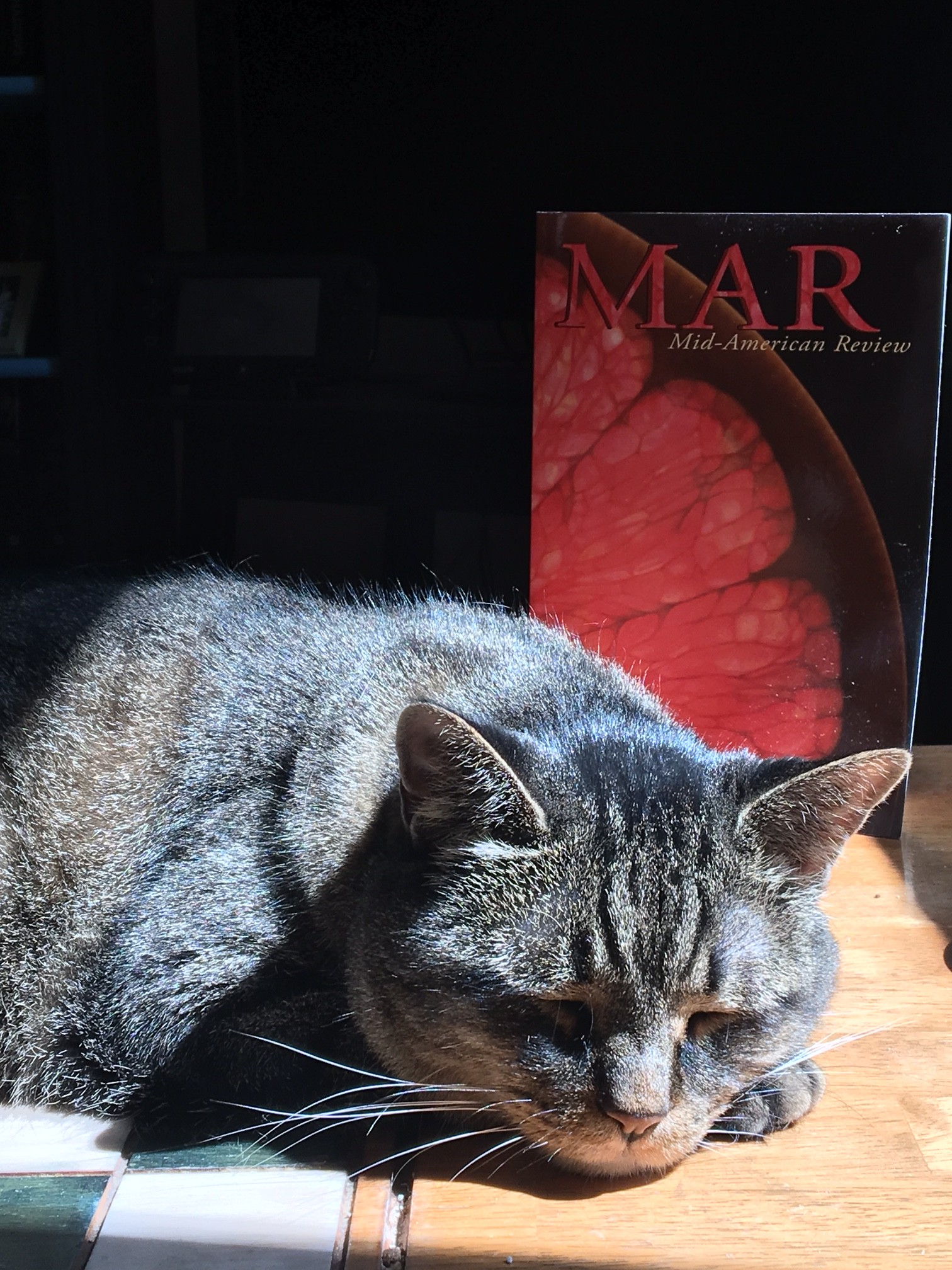
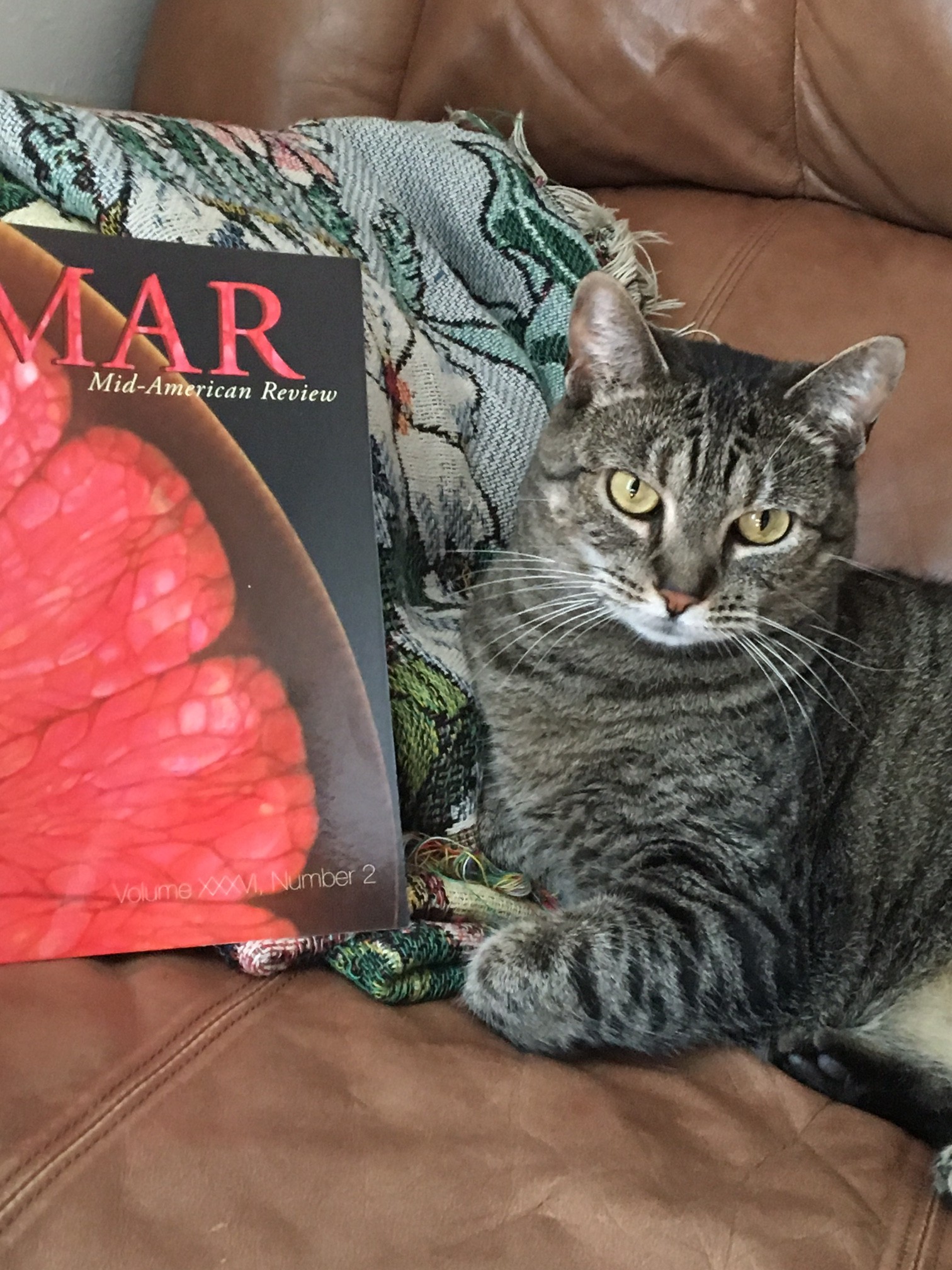
Welcome back to Pets with MAR. Meet two adorable cats, Chloe and Lucy, owned by our Winter Wheat Coordinator and editor on the poetry staff, Coral Nardandrea. Her fellow MFAs designated her a crazy cat lady even though she only has two cats. (And a cat pillowcase. And a cat blanket. And a cat wine rack.) Coral is finishing her second year at BGSU’s MFA program and plans to go into the business of publishing.

First up, meet Chloe!

IMG_6921IMG_6925


Chloe has been training her human for twelve and a half years now. The human has since figured out which blanket is her favorite, which meows signal hunger, and the list of the few movements allowed when being sat upon. Once a hunter of bottle caps, hair ties, plastic bags, and flip flops, Chloe has since retired, and can rarely be persuaded to play by any toy except her old tennis ball. To earn her favor, hopefuls must be impressed by her snore and respectful of her disdainful expression.


And now, Lucy!

IMG_6929

Lucy is the most recent addition to the family, much to Chloe’s displeasure. A little round, simple-minded, and unable to meow, Lucy likes her life just the way it is, with a lot of food and even more sleeping. She’s preferred her quiet lifestyle since getting stuck in a chimney for a week when she was a kitten under another human’s care, and certainly avoids traipsing over roofs several years later. She can be distinguished from her sister by her often-dazed expression and signature waddle.


IMG_6945


Chapbook Review: Waiting for the Enemy by Brandon Davis Jennings

Waiting for the Enemy by Brandon Davis Jennings. Kindle Edition, 2014. 44 pages. $2.99, electronic.

Brandon Davis Jennings’ Waiting for the Enemy is composed of five distinct, yet connected, stories examining the life of men linked to the United States’ armed forces. This collection is aptly titled because these stories explore the moments and experiences of war when there is no clear enemy present; however, just because there are no depictions of the traditional battlefield does not mean that this collection lacks urgency. We see the characters deal with trauma, loss, horror, and detachment.

The title story, “Waiting for the Enemy,” best encapsulates all that Jennings is able to accomplish. In this piece, the narrator and his comrade, Rake, are stationed to keep watch in a control tower, and while they are there a camel falls into the barbed wire that surrounds their location. The characters’ respective personalities are revealed and explored in the ways that they react to the trapped and tormented animal. In fact, it is this injured animal that most haunts the narrator years after he returns from war.

Jennings has crafted five pieces that can stand well on their own, but when viewed together create a cohesive view of war’s effects. While all of the connections may not be clear the first time through, this fact allows readers to uncover new discovers with successive reads—each one as rewarding as the first!

-Dani Howell, MAR