
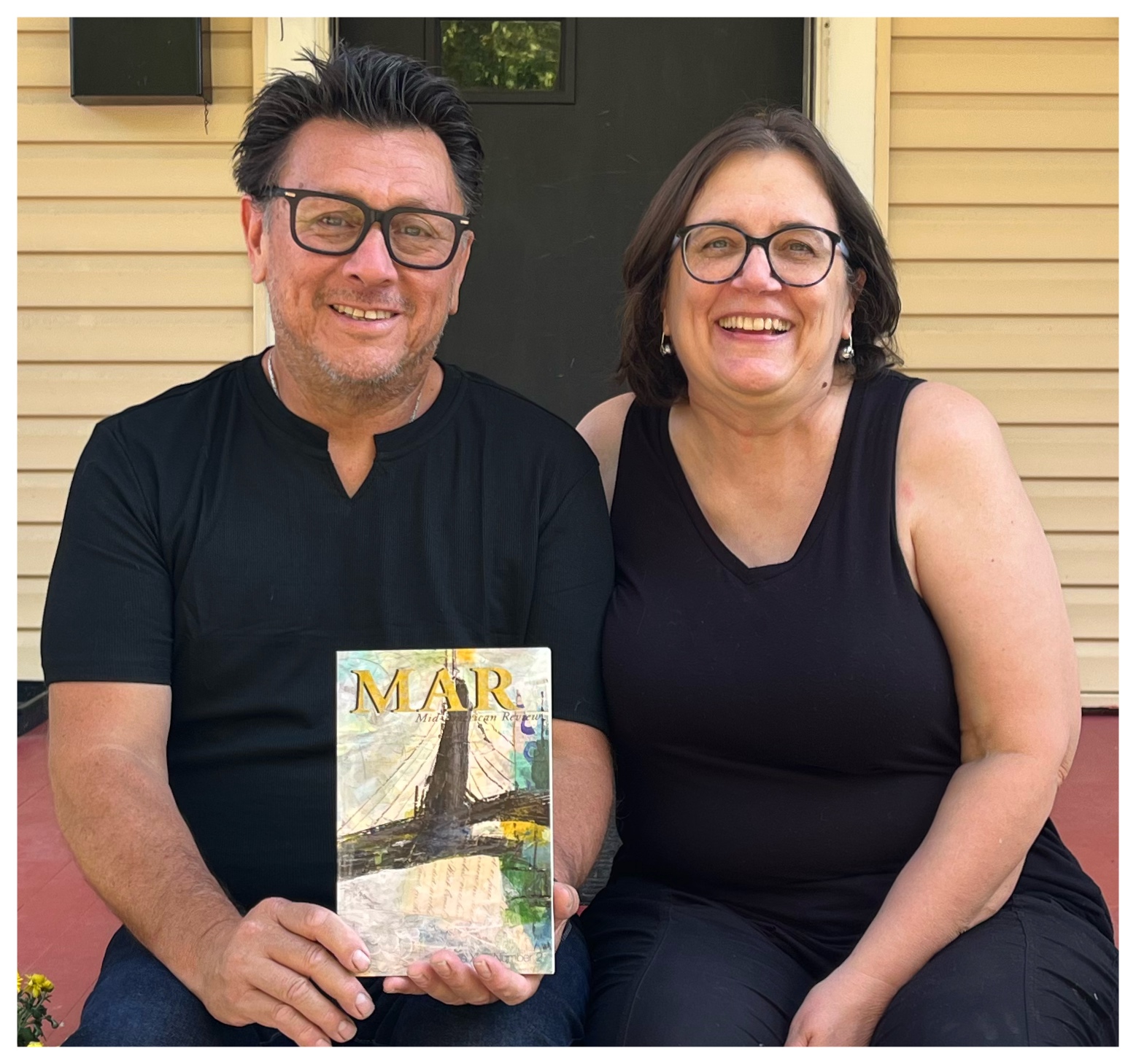
An Interview with Paula J. Lambert & Juan Rojas: On Translation, Collaboration, and Community

With Winter Wheat just around the corner, we asked our guest readers, Paula J. Lambert and Juan Rojas about their work, what they will be reading, and about their Winter Wheat experiences to share with our readers and participants.

Lambert and Rojas were asked to respond to the following questions via email and what follows is their written descriptions depicting the beautiful working relationship they have developed to produce their works of translation and the importance of their communication and understanding of each other.


Can you share with us a little bit about what you will be reading? 

Paula & Juan: We’ll be reading poems excerpted from Juan’s full manuscript El camino que lleva nuestros nombres / The Path that Carries Our Names in the original Spanish and the translated English. The last section, as you know, was published in MAR as a featured translation chapbook, so we expect to finish the reading with that last section of the book in full. We also look forward to discussing the translation process itself, as time allows—how it unfolds, and the key elements that shape it.


Your work is a work in translation. Can you speak to the process of translation?

Paula: For us, the work was as much a process of editing as it was translation, as Juan came to me when he’d finished the first draft of the manuscript, and the poems needed quite a lot of work. I’m a very good editor, and many of the poems that were quite long and rather confusing were edited down to something far more concise. Additionally, some of the poems had already been translated to English by another poet who was not a native English speaker, and though that should have made things easier for me (I actually don’t speak or read Spanish) it actually made some things more difficult, as we had to sort out what was problematic from the original words Juan wrote and what may have been a problem with an inaccuracy in the first translation. So, ours was a sitting-side-by-side process, with me asking him over and over, “Is this what you really mean? Is this what you intended?” Sometimes that led to him realizing the drafted poem was not very clear, and sometimes it meant there was something in the language or the cultural references that I was not yet understanding. And of course once we got through all the individual poems, all translated fully and clearly into English so that I had a much clearer understanding of the overall story being told, we had to take a look at how the poems were working together—where there were redundancies, for example, or how some parallels needed to be highlighted.

Juan: The translation process involved four essential elements: excellent communication—between poet and poet, poet and editor, and poet and translator; a willingness to explore new creative possibilities; trust in our instincts and in the original poetic essence; and the courage to embrace transformation.

For me, it was crucial to truly listen to Paula—not only as a translator, but also as a poet and editor in her own right. I wanted to ensure that what I originally intended to “chant” could be creatively reimagined through translation. After all, every translation is its own new creation.

I made a point to reflect on the changes Paula suggested—not simply agreeing or disagreeing but engaging in meaningful discussion. Dialogue has been essential throughout—before, during, and even after the translation of the manuscript—especially as we’ve shared this work together in multiple conferences and literary festivals.


How did you come to collaborate and what was that process like collaborating?

Paula: We’ve been friends and colleagues for many years. I’m not honestly sure where we first met, but I’d heard him read on the local poetry scene and, as I was hosting Peripatetic Poets here in Columbus and a show called “Celebrating the Night Sky” at Perkins Observatory in Delaware, I invited him to read. When he read at the observatory, he brought his two children, very young at the time, who played “Twinkle Twinkle Little Star” on the violin as he read his poems over their music. It was magical. When that event evolved into the Sun & Moon Poetry Festival, I invited him to take part in the Haiku Death Match. It was fascinating watching audiences respond to his performances. People literally swooned over his tiny, powerful poems. So, I invited him to do a little chapbook for Full/Crescent press, and that turned into De caña de maíz y miel: 12 haikus de Ohio / On Cornstalks and Honey: 12 Ohio Haiku. Haiku are very hard to write, and the original poems he gave me needed a lot of work, so the process was similar. “Is this really what you mean? Why did you use this image?” And so on. I was not yet his translator, but we found through that process that we worked very, very well together as poet and editor. It turned into a gorgeous little pocket-sized, hand-stitched chapbook with a cover that was just beautiful. And it sold out almost immediately. When he found himself in need of a new translator a few years ago, he told me he had a new manuscript and asked if I might like to try working together on that, to ensure the work was solid in both languages. And here we are. We’re co-workers and friends, able to be very honest with one another. I’m able to tell him when something is not working—and of course, when it’s working incredibly, beautifully well. He’s able to tell me that something needs to be a certain way and can’t be changed. It’s very give and take and very rewarding for both of us.

Juan: My collaboration with Paula has developed alongside our friendship. Not long ago, translation was often limited to the works of deceased authors. Today, the translation of contemporary poetry is increasingly common—and vital. Many poets now see their work published in multiple languages and take part in international festivals, a trend that reflects the global reach of poetry.

When a poem is translated, the process depends greatly on the poet’s involvement. If you know the language, you work closely with the translator. If not, you trust that the translator will remain faithful to your voice and vision. I feel very fortunate that Paula and I have spent countless hours together on this project—reviewing, discussing, and fine-tuning every line until we both felt completely satisfied.

I always know when Paula is truly moved by a poem—she gets goosebumps. That’s when I know we’ve done something right.

Paula: (Yeah, that goosebump part is absolutely true.)


As past participants, how does it feel to be coming to Winter Wheat as a reader this year? How might that experience feel different for you?

Paula: Well, I can say for myself that I’m thrilled, as I last read in Prout Chapel as an MFA student in 1995 and 1996. I was focused on fiction at the time and read both years with poet Tania Runyan, who is still a close friend. So to come back as an invited guest reader, and as a poet, and as part of a translation project, is deeply meaningful. It’s an honor to have been invited back to read, and it’s humbling to think of all the ways my work as a writer has changed in nearly 30 years!

Juan: It’s an honor—one I will always cherish—to have been invited to Winter Wheat. It’s a meaningful opportunity to engage with both regional and national writers, to learn from their work, and to share my own.

As a poet who writes primarily in Spanish, my mother tongue, I’m aware that language can sometimes limit access to new readers. But translation changes that. It opens doors, allowing English-speaking readers to connect with and appreciate my poetry.

I was genuinely thrilled to learn I’d been invited as a guest reader, alongside my friend, poet, and translator Paula J. Lambert. It feels like a living testament to the idea that poetry—shared across borders and languages—can make the world a better place.

Winter Wheat offers a moment to connect with other poets, to explore new paths, and to feel welcomed by the vibrant Ohio poetry community.


Can you speak to your experiences at Winter Wheat? What have you encountered/experienced? What has kept you returning? 

Paula: I’ve heard so many extraordinary writers at Winter Wheat! Tyehimba Jess was a favorite, when Leadbelly was brand-new. That was a favorite poetry collection for so many years. Carl Phillips was just lovely, as was Camille Dungy. Allison Joseph…so many great writers and readers. For a while, several years after I graduated from the program, I came back to BGSU to teach, so it was easy to attend, and it always felt like a reunion of sorts, as many former students and faculty would come to town for it. In recent years, I’ve tried to come up more often again and though I recognize fewer attendees each time, it’s always great to meet new people, and it’s interesting to see what the current MFA students especially are interested in and wanting to teach. And of course it’s been a chance to think through whatever new project I’m working on, as when Juan and I together taught a workshop on the long poem. At the time, I was writing very, very long poems, and Juan and I had just started working on his manuscript, which is made up of short poems but together tell a single, long story. Teaching is always a wonderful discovery process as, if you’re going about it right, it makes you think hard, in explaining to someone else, about what exactly you’re doing and why. And of course you learn so much from your students in the questions they ask and what they share of the projects they’re working on. I think all writing, ultimately, and even all teaching, is at its core collaborative. It’s a discovery process for everyone.

Juan: Paula and I first participated in Winter Wheat two years ago. At that time, we presented some of our initial translations and reflected on the fresh, unfolding experience of co-creation. It is a true joy to return as invited guests—to share what has happened since, how the manuscript has evolved, and what we envision for the future of El camino que lleva nuestros nombres / The Path that Carries Our Names.

Winter Wheat has become, for us, a kind of homecoming—a return to the wellspring of language and creative energy. Like going back to the well to draw water, we return in search of poetry—expecting it, welcoming it, dreaming it.

There’s a poem in the manuscript that speaks to this feeling:

“Wandering my Dreams, I Find Direction”

We’ll drink water from the well.

We’ll meditate.

We’ll meditate within these dreams,

     unraveling mysteries not yet revealed.


Paula J. Lambert and Juan Rojas’ translation chapbook, The Path that Carries Our Names, a collection of poetry written by Rojas translated from Spanish by Lambert, was published in the most recent issue of The Mid-American Review. Rojas is a Mexican-American transborder poet, essayist, and scholar.  He currently serves as the President of the Hispanic Ohio Writers Association. Lambert is an alumna of Bowling Green’s MFA program and author of five full-length poetry collections. Lambert owns Full/Crescent Press, a small publisher of poetry books and broadsides, through which she has founded and supported numerous public readings and festivals that support the intersection of poetry and science. You can read our guest readers’ full bios here.
Winter Wheat Sessions: How to Choose and Suggested Tracks

Winter Wheat is less than three weeks away! Have you registered yet? This year’s festival will take place November 6-8th at Bowling Green State University in the Education Building. We are offering over thirty generative and informative workshops. Whether you want to learn more about publishing, explore experimental writing forms, blur the genre lines, or learn how to get unstuck from the middle of your work, we have workshops for you! You can see our full schedule of workshops here.


Not sure what to pick? Too many decisions? Check out some of the potential workshop pathways we’ve brainstormed for you!


Session Archetype Paths: Choose your Fighter!


The Activist: Are you interested in art as activism? How your poetry, fiction, or nonfiction can be impactful? Do you want your writing to stretch beyond the page? Think about your work as it lives in the world? Then check out this workshop pathway!


Suggested track: AZ1 → B4 → C4 → D5 → E2 → F4


The Wanderer (a.k.a. “I’m stuck” or “I want something fresh”): What better way to get unstuck than to hear other writers talk about their processes and methods? How about stepping outside your comfort zone and exploring experimental forms, flash, surrealism, or prose poetry (Maybe something short and sweet will spark new ideas)? Or maybe you just need a session on how to get through the trickiest part of your novel? With a balance of generation, process, and methods, check out some of our sessions on flash, writers talking about other writers, and how to get unstuck.


Suggested Track: A2 → B3 → C1 → D4 → EZ-4 → F1 or FZ-5


The Magician: Are you interested in genre work? Worldbuilding? Magical realism, fantasy, or horror? Check out some of these creative workshops on myth, fable, roleplaying games, monsters, and more.


Suggested Track: A4 or A5 → B1 → C2 or C3 → D-Z3 → E1 → F2


The Girl Boss: So you want to publish? Or maybe you just want to grow your writing career, hear about the industry, or learn about submitting to magazines. Read about our sessions that discuss writing query letters, marketing, or generative sessions that help you create short pieces ready to send out!

Suggested Tracks: AZ-1→ BZ-2→ C2→ D3 → E3 → F3


The Experimenter: You’re a nonconformist. (It’s okay, you can say it aloud). You’re the protagonist in a chosen one novel or the rebel in a dystopia. You’re a rulebreaker. Some of these workshops might just be as strange as you as they explore weird perspectives, gather from other nontraditional sources, think about weird forms or structures, and spark new ideas using ekphrasis.


Suggested Track: A3 or A5→ B2 → C3 or C5→ D1 → E4 → F3 or F5

We hope you find something to spark new ideas, suits your fancy, or makes you excited to write and be in community! We can’t wait to see you there! Register here.

Personal Essay: Winter Wheat 2024 – In Review No. 6

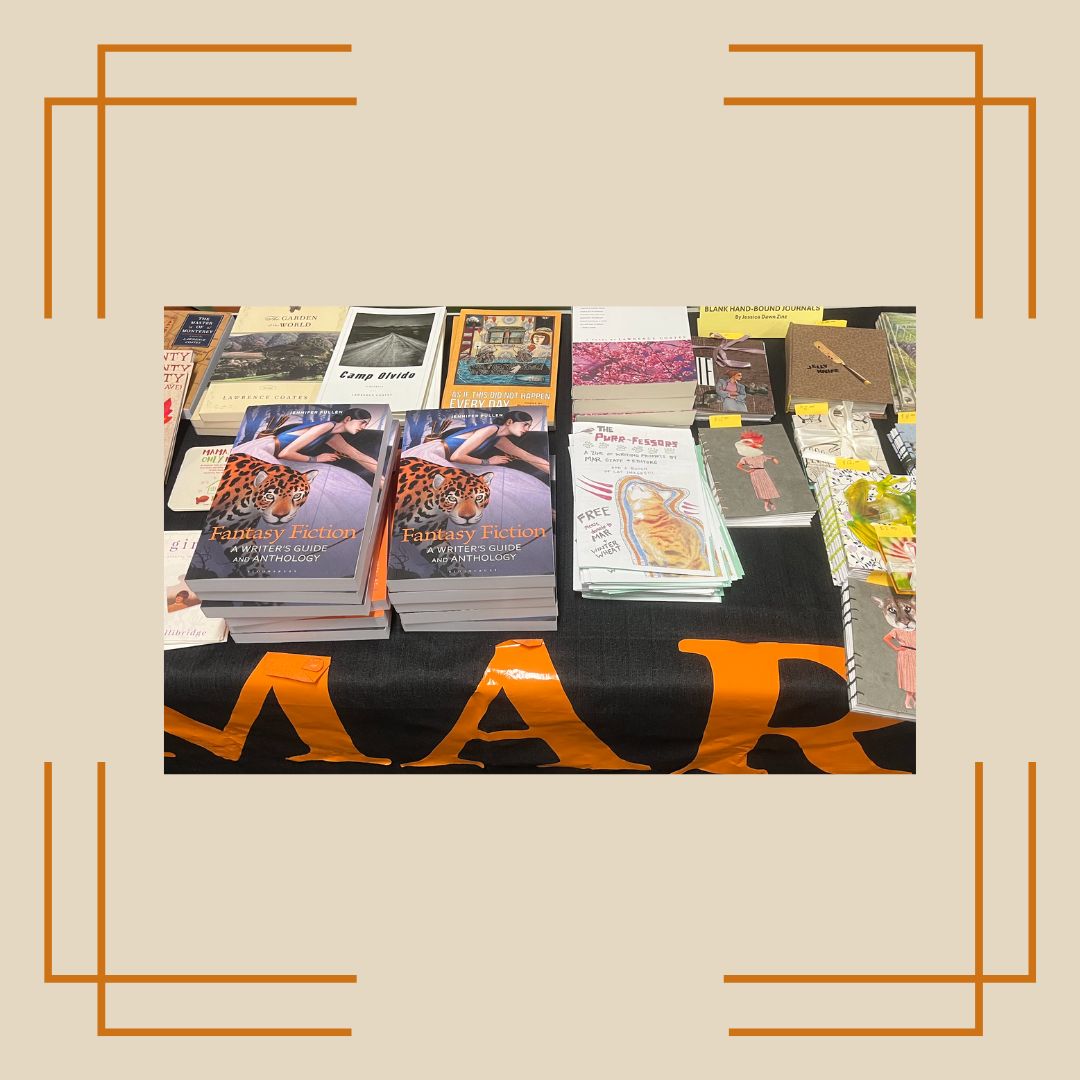
Photo captured of the MAR book sale table at Winter Wheat 2024 framed with a beige background and yellow border

By Garret Miller

I’ve been tasked with capturing the spirit and experience of Winter Wheat 2024. I’ll offer first a series of images and momentarily shift responsibility to you, earnest reader: imagine the Education Building, in all its eastern bloc nobility; a gaggle of impassioned writers, buzzing in disquiet; dark, fall evenings with winds a shade warmer than we deserve; and a smooth Saturday morning where hope sprinkles in tease of snow. There was coffee. There were snacks. Writing was done. Some learning, too.

But it’s all best stated by our presenters, guests, and organizers.

Nathan Fako, poetry MFA student and co-presenter of the Elegies for Disappearing Nature workshop, finds that Winter Wheat “was fine, wonderful. It was warm. Gatherings of writers… I feel like we’re all kind of awkward people. We wanna keep to ourselves. We like to be alone to think. There’s an apprehension, generally, when we get together, but the warm atmosphere assuaged that feeling. It was fun.” He felt that the “workshops were accessible. There was clear work put in to make the content accessible to someone with no experience with writing, but also to make it interesting to those who are experienced.” His concluding thoughts, which should be remembered: “I’ve never been to a literary festival before, and I really enjoyed it. I thought it was great. It was nice to see so many people passionate about the same thing. I find that heartwarming. Or terrifying. I don’t know which.”

Liz Barnett, fiction MFA student who presented on adaptation, found that Winter Wheat “went really well.” They stated, “In the end, I had a lot of people tell me it was fun. [The workshops] I went to were accommodating; they provided materials, it never felt like I wasn’t prepared, and it didn’t feel like I was being excluded from any activities.” Liz said finally that they’re “looking forward to running a workshop again next year” that will explore revenge stories.

Michelle, an attendee, offered similar sentiments on the warmness: “I had concerns that Winter Wheat would be workshops where the presenters sort of droned on about things they didn’t seem to really care about, but I was happy to find that the presenters had interesting topics that I didn’t know much about. They seemed excited to be there but also relaxed. It felt like nobody was going to make fun of me for my lack of poetry knowledge.” She thought “people were going to be stuffy and have very specific and intense rules for writing,” but stated, “Thankfully, I was wrong. I feel like everyone there was open-minded and interested in exploring many different styles of writing.”

Abigail Cloud, Editor-in-Chief of Mid-American Review, thought “it went really well. People really needed it this year in a big way. There was a lot of worry going on, particularly among our population. People needed to be together and create together. [Attendees] wanted that opportunity to work in inspiring circumstances that are safe, where they can create and not be worried about anything else besides new work and new ideas.” Cloud spoke at length about the generative importance of Winter Wheat, how it “puts focus back on creation, the generation of new ideas and work,” an attitude shared by Haley Souders, Winter Wheat Coordinator. Souders stated, “I always come out of [Winter Wheat] wanting to write more. This year I left wanting to take a look at my thesis project. I feel like I’ve been in a little bit of a gray area with it, where I’m not feeling as much joy writing it, but after spending a few days talking to people who are interested in writing, I feel inspired.”

Cloud also highlights regionality, the “quintessential midwestern aspects of comfort and value of togetherness.” For Cloud, Winter Wheat fosters a sort of camaraderie: “The region, as much as it is here, it is a place, it is more about the attitude and knowledge that we are coming to a place that represents some level of comfort to people.” Souders also touched on the importance of place, stating, “I feel like the words “literary community” have gotten thrown around a lot when talking about Winter Wheat, but having events that are free to attend is important because people from all over can come together to talk about art and writing. Who knows in five years if we will be able to do these things? Humanities are being defunded across the board. It’s important to have [Winter Wheat] and maintain it.”

Finally, Cloud defines Winter Wheat: “The word I’m going to pick is fervent. There’s a real desire to put new work together and take advantage of seeing friends. That’s how I felt. I had some friends there that I haven’t seen in a really long time. I wanted to fervently soak time up with them while they were there with me. I think that’s the best energy that we can hope for and create, just having an immediate connection and desire to what we were doing.”

And here’s what I’ve been thinking about lately, pre and post Winter Wheat: among a few other pesky things, John the Savage tells us to find poetry, God, freedom, sin, and goodness. His distant cousin Alexander Supertramp tells us to honor Ahab, but advises we not forget the dominant primordial beast. Locate ambition, but do not forget hubris. Writers are strange; sometimes we are arrogant, sometimes self-dismissive. Maybe we have ethereal jobs, biblical duties, and great importance – maybe not. It does not matter. Find a warm atmosphere with gentle souls like Winter Wheat, sit awhile, and play toward peace.

Winter Wheat Flash Fiction Battle to the Death Winner

Mid-American Review is thrilled to congratulate Gretchen Troxell as the winner of the 2023 Flash Fiction Battle to the Death! Contest participants were given the prompt “ominous” and only forty minutes to write 750 words or less. Three finalists were chosen to read their flash aloud at the final open mic event of the Winter Wheat Festival of Writing, where the audience chose “Toby” as the winner by overwhelming applause.

“Toby” by Gretchen Troxell

     Toby didn’t believe in spiders. He had never seen one. Never heard one scurrying across the walls. Never felt the satisfying pluck of a daddy long leg’s limp snapping off.

     His therapist wanted to stop wasting their sessions on this. 

     “Does it really matter?” She would ask, unprofessionally.

     “It matters to me,” he would respond, and she would say: “okay, Toby” or “fine, Toby” or “you’re paying for this session, Toby.”

       But Toby could tell even she didn’t believe him. No one did. Or, worse, if they did, they’d call him lucky.

      “It’s like a superpower,” his best friend, Adam said. 

      “Yeah, I’d give anything to never see a spider again,” his former girlfriend, Juliet said. They had broken up from a spider-based argument. Juliet, like his therapist, had grown old and tired of hearing the same old story. “You know what, Toby,” she finally said, “why don’t you just try a little fucking harder to find one then.”

       So, he did. He tried harder.

       Toby went out to his mother’s garden at night and scraped through the soil, burying hard rocks into his rotting nail beds. He slurped through worms and maggots, ants and beetles. His knees became hard-pressed and misshapen. His face darkened by the time the morning sun came up, and still no spiders.

      Toby had taken up five one-hour sessions up with his therapist with this spider talk. On the sixth session, she outlawed the discussion.

       Toby broke into the vents at his old church. He had heard rumors of spiders existing in attics and other dark spaces. He broke his left index finger from pounding the metal too hard, and he put a permanent crick in his back from bending over inside them. Rusty nails scraped across his jeans, creating new gashes of venomous blood. Some bugs came to it. Some reveled in it, cleaning his wounds with microscopic tongues. 

       He tried the cemetery. He cut himself open across the tongue with an old razor he found in the medicine cabinet. A grown man disguised as a vampire came along and called the police, but they didn’t bring any spiders with them. 

      “Why do you want to hurt yourself, Toby?” His therapist asked.

      “I thought the spiders would come.” His therapist shushed him and pointed at a sign over her right shoulder. It said no spider talk allowed. 

       The next night his dad printed out pictures of spiders from Google. “See, they’re real. Now stop this nonsense, now,” he commanded. 

      This pattern will continue until twenty years from now when Toby will get a girlfriend named Sarah. Sarah will be a nice girl whose seen spiders herself and has never known anyone to not believe in them, so Toby will never bring up his problem until Sarah finds him digging once again in the yard. His mouth will be covered in maggots, and ants will rest on his upper eyelids, and Sarah will scream so loudly, the neighbors wake up, but Toby will take her inside and try to explain. 

      “Why didn’t you say anything before?” Sarah will ask, and Toby will not answer.

       But they will talk about the problem for a few hours that night and the next and the next.

       Something very strange will happen with Sarah. She will listen, and she will follow Toby out to the garden and watch him slit his tongue and cry to the ground, and she will not leave, and one day, they will get married.

       Toby will never wake up and see a spider.

       Sarah believes this to be true.

       And weirdly, one day, it just won’t matter anymore. 

About the author: Gretchen Troxell is a third-year undergraduate student studying creative writing at Bowling Green State University. She is the fiction editor and treasurer for their undergraduate literary journal, Prairie Margins, and an intern at their graduate journal, Mid-American Review. She has been published in Fleas on the Dog and Quirk and is forthcoming in The Bookends Review, Allegheny Review, and Euphony Journal.

Winter Wheat Writing Festival Is Back to BGSU!

We’re thrilled to announce that Mid-American Review’s twenty-third Winter Wheat Writing Festival is back to BGSU from November 9th to November 11th. This year’s festival boasts an exciting lineup of over 45 in-person and online workshops covering fiction, poetry, non-fiction, and more. The full workshop schedule can be found here.

We’re honored to introduce our distinguished keynote speaker, Faylita Hicks, renowned for their critically acclaimed poetry collection, HoodWitch. Additionally, we’re excited to feature one of BGSU’s faculty members, Sharona Muir, the author of the story collection Animal Truth and the novel Invisible Beasts.

Winter Wheat is also featuring not one, but two exciting open mic nights on Friday and Saturday evenings. Friday’s open mic will take place at Howard’s Club in Downtown Bowling Green, and will be followed by a music performance by Zack Fletcher + The Toro Quartet, By the Willow, Chloe and the Strings. The event is co-hosted by Pella Felton and Bea Fields (THEYDAR). Our second open mic night will take place in Prout Chapel at the BGSU campus. Attendees are encouraged to attend both events and to share their own work with the audience! 

More information on our website

Winter Wheat is open to the public and free of charge. To register, visit our website: www.bgsu.edu/winterwheat.

To individuals with disabilities, please indicate if you need special services, assistance or appropriate modifications to fully participate in this event by contacting Accessibility Services at access@bgsu.edu or 419-372-8495. Please notify us prior to the event.

––Mays Kuhail, Winter Wheat Coordinator