
Page Turning with Our MFAs

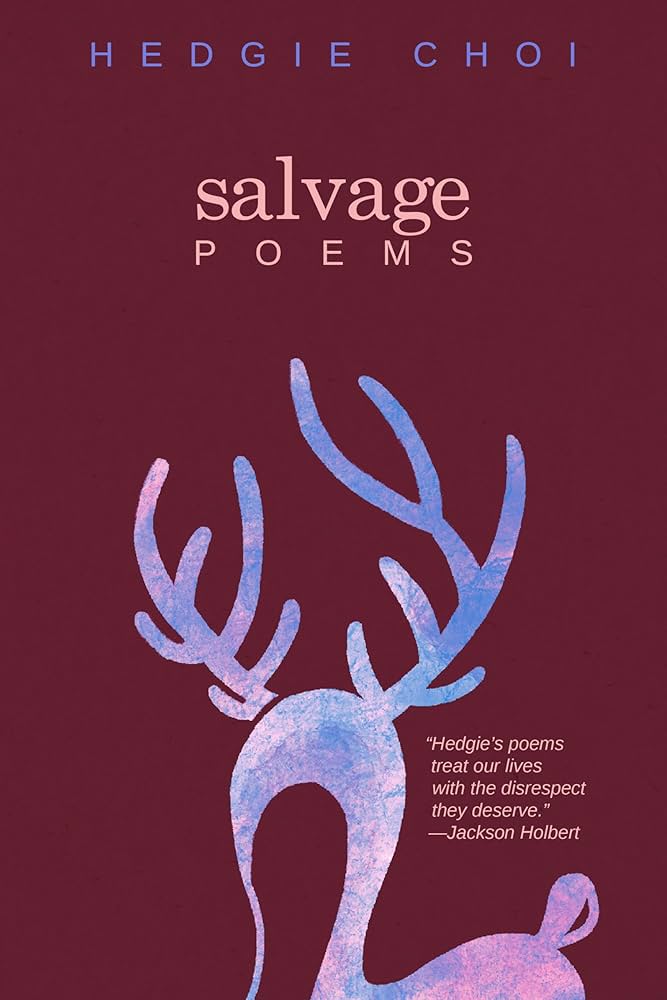
Dark red background with ghostly antlers; Hedgie Choi book cover

Recent and Current Reads

Annie Williams, 1st Year Poet: Salvage by Hedgie Choi (Poetry), The Bee String by Paul Murray (Literary Fiction), and Smashed by Junji Ito (Horror Manga)

Tyler McDonald, 1st Year Poet: The Pillow Book by Sei Shonagon (Essays), Invisible Strings edited by Kristie Frederick Daugherty (Taylor Swift-Inspired Poetry Anthology) and Wicked by Gregory Maguire (Fantasy)

Gayle Castle, 1st Year Poet: Poemcrazy by Susan Goldsmith Woolridge (Poetry Craft Book)

Emilea Justice, 1st Year Fiction: The Glass Castle by Jeanette Walls (Memoir)

Kelly McElroy, 1st Year Fiction: No Country for Old Men by Cormac McCarthy (Fiction)

Orion Emerick, 1st Year Fiction: Boy Island by Leo Fox (Speculative Trans Fiction Graphic Novel)

Mo Orr, 1st Year Poet: Selected Poetry Collection of Rita Dova (Poetry) and How We Fight For Our Lives by Saeed Jones (Memoir)

Elijah Woodruff, 1st Year Poet: The Circle Hanh by Bruce Weigl (Memoir)

Kiersten Burtz, 1st Year Fiction: This Is How You Lose The Time War by Amal-El-Mohtar (Science Fiction)

Alex Wagner, 1st Year Fiction: Guards! Guards! By Terry Pratchett (Fantasy)

Liz Barnett, 2nd Year Fiction: The Buffalo Hunter by Stephen Graham Jones (Horror)

Hannah Goss, 2nd Year Fiction: Mothers, Tell Your Daughters by Bonnie Jo Campbell (Short Story Collection, Literary Realism)

Jaden Gootjes, 2nd Year Fiction: Poverty, By America by Matthew Desmond (Nonfiction)

Gathered by: Annie Williams

What We’re Reading, with Assistant Editor Mays Kuhail

I’ve been enjoying reading more poetry over the summer, and I’ve recently picked up If They Come for Us, a raw and poignant collection by Fatimah Asghar. I was instantly drawn to the rich themes of South-Asian culture, identity, and the undeniable link between past and present in the effects of political turmoil and violence. Asghar employs varied forms in this collection featuring both lyrical free verse as well as more experimental forms. I was especially intrigued by the creative experimentation which I thought worked really well with the themes Asghar taps into.  In “Microaggression Bingo,” Asghar contrasts intense and complex notions of Western microaggressions with a simpler bingo card form, many of which ring true in terms of one’s ability to address such statements and actions. In “Script for Child Services: A Floor Plan,” Asghar lays out her poem as a floor plan to portray being an orphan in the foster care system. I don’t think I’ve seen innovative forms like the ones Asghar makes use of. The collection is also a very informative one and builds on other intersectional struggles which share common themes and hardships. I often found myself having to pause to put the collection down and take in the work. It can be a quick read, but I held onto the collection for a couple of weeks to make sure I was able to grant each poem enough time and thought and to connect recurring threads anchoring the work, especially with more haunting and complex pieces.

—Mays Kuhail, Mid-American Review

What We’re Reading, with MAR Blog Co-Editor Gen Greer

High-Risk Homosexual by Edgar Gomez. Penguin Random House, 2022. 304 pages. 17.95, paperback. 

Earlier this month I decided to revisit Edgar Gomez’s memoir High-Risk Homosexual (2022). This was partly in honor of the book’s recent Lambda win in the category of Gay Memoir / Biography and partly because I’m obsessed with chaotic queer books. Gomez’s debut memoir tells his story of navigating life as a gay Latinx man from his Florida childhood, going to uncle’s cockfighting ring in Nicaragua, dancing in the Pulse Nightclub in Orlando, and his move to California to pursue writing. One of the many things I admire about this book is the ways in which Gomez is able to capture both the agonies and ecstasies of queerness. Gomez’s narrative doesn’t avoid things just because they’re messy or painful. We follow them through nights obsessing over Jennifer Lopez rom-coms, his investigation of language and cultural identity, and the discovery of their community. They also take us through the struggles of surviving homophobic family members while still loving them, their fear of HIV & diagnosis of “high-risk homosexual,” and living with the echos of violence from the Pulse Nightclub shooting. If you’re looking for a brilliant queer memoir (you should be) that makes you want to laugh, cry, and possibly put on some coffee for a movie marathon this is the one for you.

––Gen Greer, Mid-American Review

What We’re Reading, with Managing Fiction Editor Dan Marcantuono

I’m not normally drawn to stories of the American West, but I picked up Battleborn by Claire Vaye Watkins anyway after reading and enjoying one of the stories from the collection a few months earlier. That story, titled “Ghosts, Cowboys,” piqued my interest through its use of time as a means of studying place. It is set around and within the Mojave Desert of Nevada, along with many of the other stories in the collection. Watkins tries again and again to find a moment to begin this story, jumping from silver prospectors in early Reno to the testing of a nuclear bomb over the desert in 1941. These beginnings amount to a story, a series of settings and characters that inform how the narrator has ended up in the present, specifically in Nevada. As the opening story in the collection, it also provides the reader with history and imagery that feel essential to the stories that follow. 

Watkins uses the retrospective tools she introduces in the first story throughout the collection and adds to them as she goes. “The Last Thing We Need” is composed of a series of letters written by a man who discovers a car abandoned on the fringes of the desert addressed to the vehicle’s owner. The letter writer never hears back from the owner and uses clues from objects inside the car to reverse engineer a story for him, one that ultimately rejects the reality of the owner’s life in suburban California and decides he belongs on Nevada’s dusty backroads. “The Past Perfect, the Past Continuous” presents time as a limited commodity for a young man lost in the desert’s harsh summer, as most who wander out there only last a week. But the story is told from the perspective of the lost man’s best friend who experiments with using the past tense to describe him as his chances of survival dwindle. The last story in the collection, “Graceland,” is one of the few that takes place far from Nevada, vividly set in the hills of San Francisco. But the narrator, reeling from her mother’s suicide, was raised there, and although she has achieved physical distance from the desert, her memory will never let her escape it. This book brilliantly examines the inextricable link between time and place and left me with the desire to explore the desert myself.

–– Dan Marcantuono, Mid-American Review

What We’re Reading, with Assistant Editor Christopher McCormick

For my first summer read, I decided to pick up Leila Chatti’s new chapbook Figment (Bull City Press, 2022). At 35 pages it goes by quickly, yet its emotional depth and experimentation make every reread a rewarding experience. The chapbook’s black cover and barely visible, embossed title set up the work’s mystery and coyness early on. Composed of half formally restless lyrics and half terse, associative abecedarian poems, Figment indulges in the mysterious and uses language to confront difficult emotions.

While the poems are withholding about their specific subject, the theme of thwarted motherhood becomes gradually clear in poems like from the root *dheigh-: where the speaker writes: “fictile I formed / you I didn’t know before / I did it what I was / capable of.” As the book progresses, the exploration of language becomes a way to confront this trauma. In the abecedarian poems, this formal constraint takes the poems on a journey of association the speaker uses to gain understanding and acceptance. The rewards of this endeavor, for the reader and speaker alike, are reflections on grief and loss that could only be gleaned through experimentation with this form. For example, the speaker writes: “faint / face less / fabrication / false falter / fault,” ending with “failure familiar.” This phonetic practice illuminates for the reader just how nuanced and bewildering the experience of grief can be and how language may be used to organize its mess.

––Christopher McCormick, Mid-American Review