Interview: On Fantasy & Fiction with Jennifer Pullen No. 23

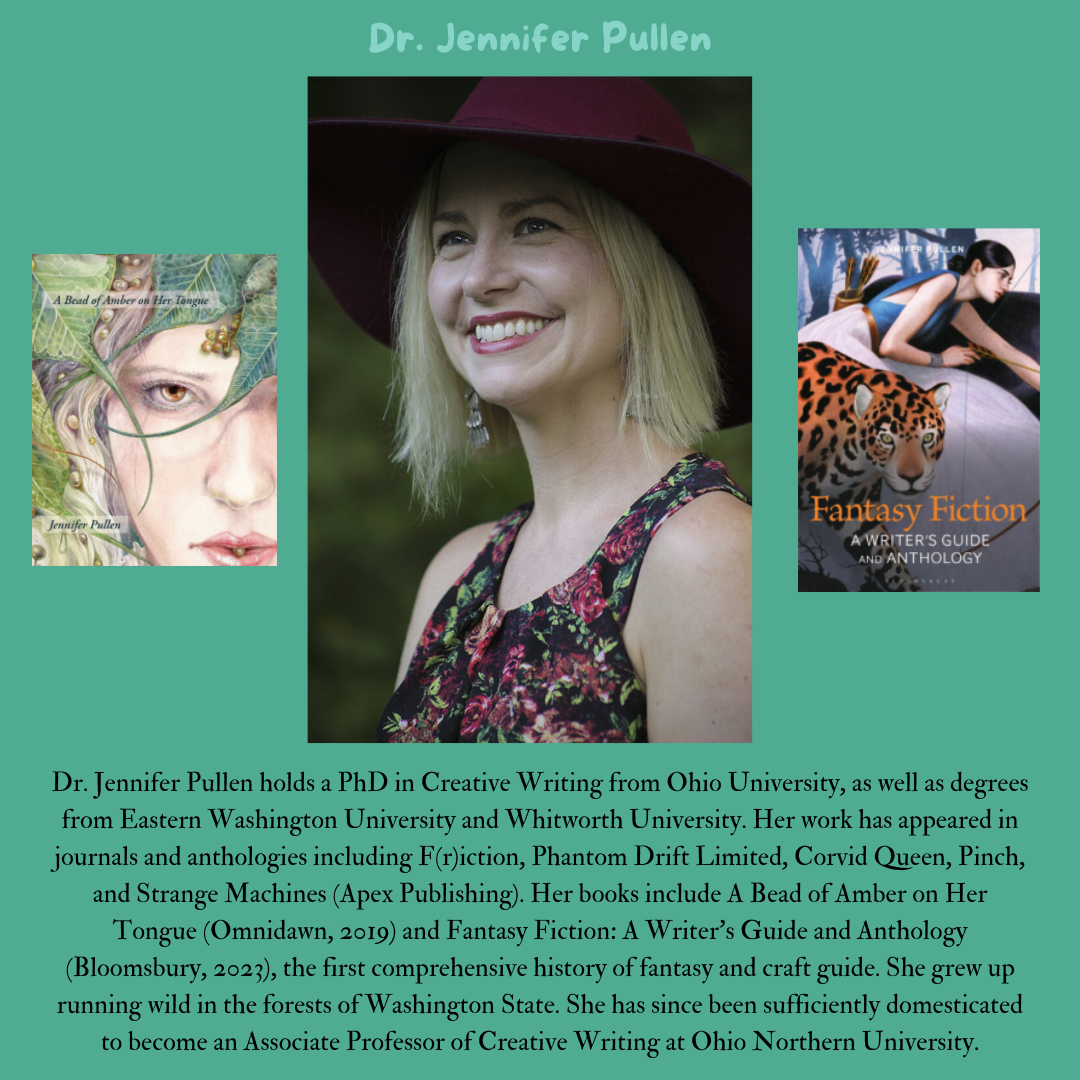
Jennifer Pullen with images of her published books
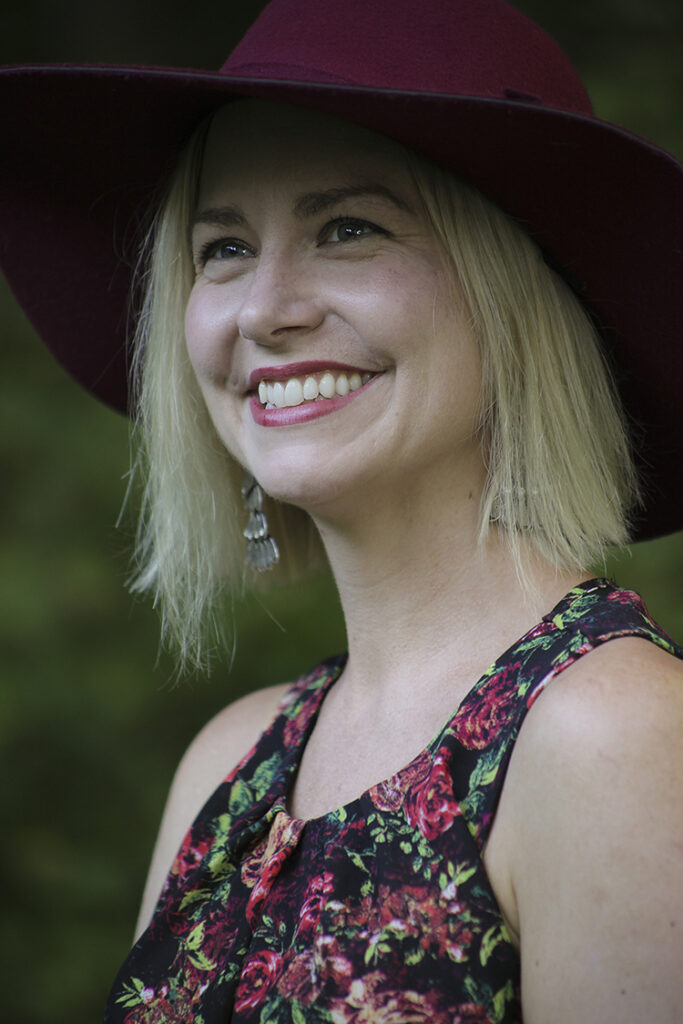
Professional photograph of Dr. Jennifer Pullen

Photo Caption: Dr. Jennifer Pullen

Jennifer Pullen holds a PhD in Creative Writing from Ohio University, as well as degrees from Eastern Washington University and Whitworth University. Her work has appeared in journals and anthologies including F(r)ictionPhantom Drift LimitedCorvid QueenPinch, and Strange Machines (Apex Publishing). Her books include A Bead of Amber on Her Tongue (Omnidawn, 2019) and Fantasy Fiction: A Writer’s Guide and Anthology (Bloomsbury, 2023), the first comprehensive history of fantasy and craft guide. She grew up running wild in the forests of Washington State. She has since been sufficiently domesticated to become an Associate Professor of Creative Writing at Ohio Northern University.

At Winter Wheat 2024, Dr. Jennifer Pullen was the keynote speaker. Between the festival chaos, Dr. Jennifer Pullen sat down with us for an interview which appears below. This interview was conducted by MAR Assistant Editor Jaden Gootjes.

Interviewer: How did you start writing?  

Jennifer Pullen: Honestly, I’ve been writing my whole life in a really nerdy way. When I was a child, I loved stories so much, and my parents read books to me constantly. Our house was full of books. So when I was five, I went up to my parents and said: “Mom and Dad, I have an idea for a novel.” They said: “Well, you can’t write yet. And I responded: “That’s why I’m going to dictate it to you. I’m going to tell it to you, and you will write it down.” My parents were very tolerant of me narrating some wild story that had a wizard, a princess, and a magical cat that was cursed. That’s all I really remember about it. So, I guess the storytelling impulse is something I’ve always had. As soon as I was able to scribble for myself, and I didn’t have to impose upon my parents, I did.  

As far as deciding I wanted to become a writer, that was probably when I was around 13 or so. I went to a festival in Spokane, Washington called Get Lit, and they had a section that was aimed at teenagers called The Writing Rally. I went, and I had this moment where I realized: “Whoa, there are people who make teaching and writing their life.”  I thought: “I want to do that.” So, I was determined to make writing my life from a really, really young age. Little did I know everything involved in that, but I knew that that was what I wanted.  

Interviewer: In 2023, you published Fantasy Fiction: A Writer’s Guide and Anthology, which has been called the first comprehensive history of fantasy craft guide. What were some of the challenges and successes you encountered while writing this book?  

Jennifer Pullen: I would say some of the biggest challenges came from the fact that I signed the contract to write the book with Bloomsbury, and then shortly thereafter COVID-19 happened. So, when trying to get permissions for the anthology, it became very complicated to get ahold of editors, publishers, and agents when everybody would have gone home. So, choosing the stories and doing the permissions while on lockdown was really surreal and strange. It added communicative challenges I hadn’t anticipated.  

The other challenges I encountered had to do with the fact that I had more to say than words I was allowed to write. I am a chronic overwriter, and after I wrote it, I looked, and I thought: “Oh no, this is like 30,000 words over my contracted word limit.” So I had to go through and really, really pare it down and think: “Okay, I know I have endless amounts of things I would like to say, but what is essential for what I’m trying to accomplish rather than me just being a giant nerd?” So that process was really interesting. Also, it was just interesting to be trying to write the textbook and work on a novel at the same time. I would be essentially working on the novel–sending portions of it and drafts of it out to my agent at that time–then while he was looking at it, which would take around six months, I would write chapters of the textbook. So, I was sort of alternating. I was still teaching a 4-4 load–four classes each semester–and alternating between critic-scholar brain and artist brain. That was a fascinating sort of challenge. It kept me grounded when writing the craft portions, because I was writing about the craft of fantasy as I was trying to write a fantasy novel myself.  

Interviewer: What were some successes you faced while writing Fantasy Fiction: A Writer’s Guide and Anthology

Jennifer Pullen: I felt confident in writing the book, and I knew that this was something I knew a lot about. It had been the focus of my research and, frankly, just my lifelong, nerdy passion. But what startled me was I didn’t fully understand how much I knew until I sat down to write, and I was able to pull it out of my head. Then I thought: “Oh, I can actually just remember all of this.” And that was a really validating thing.  

I think as women, we are often not taught to think about our own expertise or to feel like you could be say: “yes, I know a lot.” So to have the validation of realizing that I was able to write so much of it basically from memory made me feel really good and confident in myself as a scholar and teacher. I also really enjoyed getting to write the book that I wished existed my whole life, because I spent my entire time as an undergrad and graduate student in a world in which fantasy and science fiction–really any so-called genre fiction–was hardly taught in the classroom. I took a Tolkien class in undergrad, but the professor chose to teach in the course in the theology department and they were interested in the books’ theology, not in their craft. So, getting to do what I’d been doing informally, being an evangelist for the genre, and getting to actually put it out there and make the book that I wished existed was a really fabulous experience that made me really happy.  

Interviewer: I watched an interview of yours where you talked about the influence of The Last Unicorn by Peter S. Beagle on your work, which is my favorite movie. Could you talk about the book or another book or author that has had a significant influence on your writing and appreciation of fantasy? 

Jennifer Pullen: Well, The Last Unicorn–the movie and the novelwas definitely the big one, formative in my youth. If you want an explanation of my entire aesthetic, that’s it right there. Sort of sad, melancholy, and lightly gothy, but also beautiful at the same time and hopeful. I’m really interested in the tension between sadness and beauty. Beyond that, a novelist that I’ve really, really admired for many, many years is Guy Gavriel Kay. He’s a Canadian fantasist, and he’s considered our best living historical fantasy novelist. He essentially writes mostly single one-off novels. He’s mapped the globe and created fantasy versions of different medieval cultures. He researches really heavily for each period and place. Then, by changing aspects of period and place, he’s used his fantasy to turn up the volume of particular aspects of place and time. And his work is really beautiful and very prose-forward. He does a lot of really interesting experimental stuff in some of his more recent works. He’s retold a portion of what happened with the Crusades, but entirely from the perspective of civilians or people who get caught in the edges of war, characters who would never normally be the center of a fantasy novel because they’re not involved in the big scheme of the conflict. They’re just people. His novel, The Last Light of the Sun, is one of my favorite books. The end makes me cry every time because all the pieces of the characters and the world and the conflict that’s been building comes together perfectly and snaps into place. He does some really interesting, masterful things with point of view as well where I think: “are you allowed to do that?” He pulls it off, but you’ll encounter a side character for a moment, and they’ll live through something they probably shouldn’t have. Then, he’ll move 30 years down the road, and you’ll get a brief explosion into the future over around a page of the character’s life and how this moment where they should have died impacts them. It’s incredible. If I could ever pull off some of the stuff he pulls off, I would be a happy woman.  

Interviewer: That really shows you the kind of work that fantasy and fiction can do outside of themselves. You talked about how when you were a young writer, there wasn’t a lot of emphasis on fantasy and science fiction in academia. But how would you describe the state of discourse in fantasy writing communities and academia today?  

Jennifer Pullen: I would say it’s better. I think now if people outright prohibit writing fantasy, you’re not in vogue. When I was 16 and taking classes at a community college, I turned in a retelling of “Thomas the Rhymer.” It was handed back to me, and I was told to “write a real story without fairies.” That was very common and normal at the time. I think most of academia is aware now that’s fuddy duddy, and you probably shouldn’t do that. I think that’s been a pretty radical change, particularly as the boundaries between “realism” and “genre” have gotten a lot of fuzzier. I think we’re in a transition period where people realize that anti genre bias is a social construct. But, I don’t think most programs in academia have completed the shift to actually offering classes in genre. It’s entirely possible to have a PhD in American literature but have ignored fantasy entirely, versus I would never have been allowed to just pretend realism didn’t exist. I think we’re in that period where the hostility has decreased but coursework–especially at the graduate level for people qualifying–has not shifted to include teaching people about fantasy or thinking of it as essential. You always see on the Creative Writing Pedagogy Facebook page people saying: “all right I have an undergrad who is applying to MFA programs, who’s genre friendly?” and you still have to pour over the faculty and classes. There are a few programs that specify popular fiction as their emphasis, but that alone is actually evidence of the fact that it’s not fully included. Nobody would ever say “this is an MFA for people who want to write realism.” You would never feel the need to create a realism-emphasis MFA program. So, hostility is way down. But I don’t think we’re at the point where people recognize you should and must include an inclusive genre program.  

Interviewer: You grew up in Washington. How does the natural world, or the world outside of fiction generally, influence your creative work? 

Jennifer Pullen: Oh goodness, so much. I grew up in Washington state, like you said, but also in a little valley surrounded by mountains on all sides. I was homeschooled, and my parents are bookish scientists. My father is a forester, and we grew up on 70 acres backed by thousands of acres of state land. So, I was kind of a feral woods and library child. I was always going outside with my mother and identifying plants, and if my dad has a religion, it’s nature. So, treating the natural world as vitally important and sacred in and of itself was very much a part of my childhood and my growing up. For me, I think stories and nature are the two cores of my life, and that’s why living in the flat cornfield part of Ohio causes me a lot of problems. I see all the corn, and I think: “industrial monoculture!” and get really angry every day when I drive through it.  

I feel like so many of the storytelling traditions I’m interested in–a lot of fantasy as well as folk tales and myth–come out of the understanding that there are forces that are larger than humans. Humans are not the center of the universe, and I think that is something that is different in a lot of fantasy, fairytale retellings, and myth as opposed to realism where individual human experience is centered. Human experience is important, but that’s not all it is. There are always larger things and forces that influence individual decisions. Be it larger, like social forces, but also the natural world. I think magic in a lot of fantasy is, in many respects, an acknowledgement of the fact that humans can’t control everything and there are things beyond us. So, for me fantasy and nature writing go like this [Pullen laces her fingers together]. I have a hard time separating them.  

Interviewer: Your [short story collection], A Bead of Amber on her Tongue, was published in 2019. What was the process of world building and character creation like while writing? 

Jennifer Pullen: That is a little chapbook of two short stories from my dissertation. They are feminist retellings of myth. I had a big project that I was working on all through my PhD program where I was retelling myths and fairy tales from the perspective of characters who I thought had been silenced in the original versions of the stories. I was trying to embody them and focus on their experience. The characters were mostly women and retellings of Greek myths and fairytales. In [A Bead of Amber on her Tongue] I have the retelling of Aphrodite in Hephaestus and the golden net. In Greek mythology, Hephaestus, who’s the god of smiths, makes a golden throne and gives it as a gift to Hera and Zeus, but it’s a trap. Hera can’t get off it, and Zeus says: “Free my wife.” Hephaestus responds: “Only if you give me your daughter Aphrodite as my wife.” So, Aphrodite just gets traded away to the God of Smiths even though she’s a goddess. She’s still property, which is just trash. She’s the goddess of love, and she’s now married to Hephaestus. But she has children with several other deities. There’s a story where she has a long running affair with Ares, and Hephaestus catches Aphrodite and Ares in bed together and throws a golden net over them and traps them. Then he calls all the other gods to see Aphrodite in her shame. That story always bothered me. So, I rewrote the story from Aphrodite’s perspective.  

The other story is a retelling of the story of Helen as she runs off with Paris. She’s so often vilified and treated as the cause of the war, and I really wanted to think about that from her point of view, what that would have been like. I wanted to be accurate to the myths; I didn’t want to change the plot. That gets done plenty. But what I wanted was to tell these stories and really, really take seriously what it would be like to be Aphrodite and Helen, who are both very powerful and very powerless, and infuse the stories with a deeply human sense while also maintaining the feeling of myth. So, I already had the plot; I just had to think about the individualized experiences and try to get the sense of the ancient world to come off the page without it being a history lesson. 

Interviewer: We’ve vilified female characters in stories for centuries, and today in TV shows and movies people still fall for it. 

Jennifer Pullen: They sure do. 

Interviewer: So, what do you hope readers will take away from your work? 

Jennifer Pullen: Kind of depends upon what it is that I’ve written. But in terms of all the short stories that were part of that project, I really just wanted people to think about what the stories are and what culture tells itself. Because that’s one of the things that’s fascinating about myths and fairytales, that they’re retold repeatedly again and again, and we don’t even have the capacity to discover what the original is because they’re oral. We can’t even verify where it began so every version that exists is technically a retelling, and it reflects what the reteller’s cultural values are and what they believe. Every retelling is a kind of a commentary on the ones that the writer had seen or heard before. So, I really want people to think about what stories we are telling to ourselves and what do they say about our culture? What is the relationship of the past to the present? I think the fact that these stories are so consistently retold shows that humans don’t change that much; we just put different dressings on our behaviors. If we can accept that we are part of the past–even as we’re living in our present–we can have more ability to actually change things. We don’t act as though we exist in a vacuum.  

Interviewer: I think one of the big draws of myth is its ability to stand test of time and still be relevant year after year after year because it’s just plainly about human nature. 

So, I want to end with what advice you would give young writers today. 

Jennifer Pullen: Oh goodness. Read a lot. Read, read, read so much and read widely and deeply and then just keep writing what you love and trying to make the best version of whatever it is that you love. Take good advice; take advice from other writers; learn from your classes but use advice and what you learn to become the best version of whatever kind of writer you want to be. I had mostly teachers who wrote realism, but I still learned a lot from them. I didn’t let them make me a realist writer. I just learned things from them anyway and read piles of books. I know sometimes people want to be writers, but they don’t read a lot and that’s just not going to work. You’ll never to be any good, frankly. So remember what you love and keep working at it.  

Craft Corner: The Myriad Faces of Love No. 8

What poetry by Adrienne Rich, Yusef Komunyakaa, and Gerald Stern can teach us about our own hearts and the ways we love. 

By Nathan Fako

Scrapbook hearts collage created digitally via Canva featuring poets meantioned in piece

When we think about poetry, our minds probably go to high school Language Arts classes. We get a flash of a Shakespearean sonnet, we feel again the deafening silence as the class struggles to “get” the poem. Or perhaps we think of Neruda, Rumi, or Billy Collins. Mary Oliver. The truth is, I think, that most people don’t spend a lot of time thinking about poetry. Poetry doesn’t pay the water bill or change a diaper. But there are moments in life when poetry becomes the only appropriate food for the heart and soul–falling in love, for example. How do you express the way someone makes your heart explode? Say you’re a teenager again. Maybe you make them a mixtape, or a Spotify playlist. Maybe you even venture to write them a love poem.  

Some of the first poetry I wrote to show to others was in the form of love poems for my first girlfriend. I still remember vividly the feeling of pouring myself into those poems–just as vividly as I remember her telling me the poem I gave her didn’t really say what it was trying to, and that I should “try again.” Well, at least she gave me another chance. 

So what separates strong love poetry from weak love poetry? We know love is one of the great themes. These are well-tread waters. Think of the bright-eyed Romantics or the ravings of Allen Ginsberg. Everyone, hopefully, has been or will be in love at some point in their lives. And what about platonic love? Love poems of brotherhood, sisterhood, love for the community, the city… the list of types of love could be endless. Gwendolyn Brooks said real art is that which endures, or something to that effect. A poet, I think, is one particularly suited to discuss love. To question it and its many faces. So here are three poems, by three different poets, and a bit of explication on the ways in which they have loved. 

Adrienne Rich’s Twenty One Love Poems 

“What kind of beast would turn its life into words?” So begins the seventh of Adrienne Rich’s Twenty One Love Poems. This is a series of poems I believe everyone should read for themselves, as they are visceral, full of longing, and intensely crafted. Broadly, Rich uses these poems to invent and examine a type of love that could exist “openly together”–she was gay, fighting for liberation–in a city, among others, where the lovers could be “like trees.” Inevitable. Natural. Throughout the poems Rich’s speaker examines a kind of love “where grief and laughter sleep together.” But let’s go back to the seventh poem.  

Poem “VII” utilizes a form I have come to know as the interrogation form. Every statement in the poem takes the pose of a question. When we think of love poetry we think of pouring out the pitcher of the heart. Not here! Rich’s speaker turns against their own heart and its actions as though they were enemies. She questions herself, her right to language, and her battle for gay liberation. She writes, of her lover:  

or, when away from you I try to create you in words,  

am I simply using you, like a river or a war? 

Through this speaker’s interrogation of the self, of the writing self to be more specific, we see the marionette love and language make of us. So while this is a poem about love, in a collection of poems about love, Rich has done something original and enduring. She turns to the self and interrogates it. How dare I turn the subject of my love into an object of my language, she seems to ask. In so doing, Rich brings us into close proximity with the speaker’s psyche. This is the true magic of the poem, and why her collection succeeds where others might fail. Rich’s poems pull us forcefully into a space that is lived in and inhabited entirely by the experience of being in love, with all of its messy questions and ruminations. Here are love poems that don’t proclaim to be the most in love of all, or the most moving. But they command their singularity. So let your love poems take a new shape. Turn a question towards your own heart and follow the poem into a “country that has no language,” a poem totally your own, “heroic in its ordinariness.” 

Yusef Komunyakaa’s “Anodyne” 

Another approach to love we may be more familiar with is the consideration of the body. Oh how many young hours spent thinking of nothing but the touch of another’s hand in your hand! But what about self-love? In this poem, Komunyakaa, like Rich, turns the lens towards the self. This is a poem which is widely available on the internet–go listen to him read it.  

Komunyakaa has spoken about “a poetics of the body” and this is tangible here in “Anodyne.” The lens of the poem moves slowly over the speaker’s body, proclaiming love along its path. He says: 

I love my crooked feet 

shaped by vanity & work 

shoes made to outlast 

belief. The hardness 

This poem is in free-verse, and the short lines propel us down along the language. Komunyakaa’s speaker takes his time in consideration of the body, the “quick motor of each breath,” the “big hands,” and the place it has come from, “the deep smell / of fish & water hyacinth.”  

So as we enter the season of love, Komunyakaa’s piece invites us to extend some of that heart power towards our own bodies. What might that look like, a love letter to yourself?  

Gerald Stern’s “Let Me Please Look Into My Window” 

Finally, we get to Gerald Stern’s short poem. This is another poem that you can find easily online through a quick search, and it is only ten lines long. While I won’t quote the poem here, I’ll summarize so that I can highlight two devices that it employs for effect. In this poem the speaker longs to return to a time when they lived in New York. They want to look into their window, to take a walk down Broadway and pass sights with which they are familiar.  

The first device Stern uses is anaphora, the repetition of a phrase. In this poem it occurs at the beginning of a sentence. You may think of the chorus of a song, or a spiritual. The anaphora in Stern’s poem is the phrase “Let me.” This phrase also contains the second device, which I would call a speech act, and that speech act is the appeal. The speaker is repeatedly appealing to someone, in this case the god of memory in their own head or some higher power, saying please let me go back. Let me have that time once more. At the root of an appeal is a desire. In this poem, the desire is fueled by nostalgia for a time past. But the subject of love, interestingly, is not just the past but the city as well.  

What might a love poem to a place look like? A neighborhood park you once idled away hours in with your friends after school, a certain booth in the family restaurant where you babysat while your parents worked… go write the love poem! 

Personal Essay: How to Write a Short Story No. 7

"How to write a short story" title written by Sydney Koeplin over vintage paper effects created on Canva

By Sydney Koeplin

  1. Open up a fresh Google Doc. Change your settings from default to Times New Roman, 12pt., double-spaced. The poets tell you that the best poetry is written in Garamond, but you’re a fiction writer, so it’s TNR all the way, baby.
  2. Crack your knuckles, then your neck for good measure. Curl up in your favorite chair in a way you know your mom would hate: legs pretzeled, spine slightly twisted, leaning onto the finest armrest Facebook marketplace could offer. This is why your back hurts! She’s probably right.
  3. Ponder for an hour or two. You had had a story idea in there, hadn’t you? Something about a woman turning into a goldfish or maybe a seal. It was going to be weird and wonderful and sneakily moving. Your workshop was going to clap for you as you walked in the door, beg you to show them how you did it. Grant you your MFA right there. Ask you to run the class, even. 
  4. Light a candle—Autumn Leaves scented, even though it’s 85 degrees in Ohio—as if to conjure the Writing Gods™.
  5. Write a first paragraph. Read it, realize it’s horrible, delete it. What type of opening line was this? She’d always loved using the lavender salts in the bath, but now she was a goldfish, and she found they rather stung. Stupid, stupid, stupid.
  6. Tap your forehead a few times like you do the busted flashlight in the junk drawer. A few good whacks should make the bulb turn on. Your bulb doesn’t turn on.
  7. Have a moment of understanding as to why all the classic writers were alcoholics. Think of the bottle of Costco Cabernet that is sitting in your very beige kitchen right now. Decide against it.
  8. Remember that you also have a bottle of whiskey a friend gifted you, aptly called Writer’s Tears.
  9. Decide against that, too. You’re not Hemingway. 
  10. Try a breathing exercise. Inhale, hold, exhale, hold. Box breathing, your mom calls it. Try it again. Choke on your spit, cough. 
  11. Find yourself on Instagram. Spend 27 minutes sucked into the feed. Impulse buy a tote bag with a frog in cowboy boots on it. Open your family group chat and watch the video your dad sent of a duckling who is friends with a goat.
  12. Look up from your phone and wonder what you’d been trying to accomplish in the first place. It was MFA-related, right? It was, oh—
  13. Unpretzel yourself and throw your phone—okay, gently place it—in your desk drawer.
  14. Channel Anne Lamott and her Shitty First Drafts. Write. Finally, just write. It’s awful. There are typos. Plotholes you can drive a combine through. Write like the muses speak through you in disjointed, misshapen prose. Just let it happen.
  15. Shut your laptop in a daze after a few hours curled over it like a cooked shrimp. Rub your eyes, unfurl your legs, shake your head, and feel a few marbles roll around up there.
  16. Spend several days agonizing over the utter filth you’ve just written. Swim laps at the rec center, and hope you don’t run into any of your students while you’re in a swimsuit. Eat a sub sandwich. Call your mom and tell her you’re a failure, ignore all her very sound advice to take a chill pill. During this time, you’ll seriously consider quitting the MFA and joining the vampire cult in Dayton. 
  17. When it’s marinated long enough, cautiously reopen your Google Doc. Read through your draft with your hands over your eyes as if they’ll shield you from how much you suck. Get through a few paragraphs, and sit up straighter. Read a few more and put your hands down.
  18. Realize that what you’ve written isn’t as shit as you thought. It’s salvageable, in fact. At times, you’re even clever! At times, your sentences are well crafted! Who would’ve thought? Not you.
  19. Spend all the time you have before your workshop submission deadline revising, revising, revising. Something’s deeply wrong with the intro, but you don’t know what exactly. And what happens, ultimately, when the goldfish woman is flushed down the drain? That’s anybody’s guess.
  20. When it’s as good as it’s going to get, when you’re trembling and spent, email blast your cohort with your attached story exactly one minute before the deadline, question marks and all.
  21. Imagine your workshopmates snickering over your story the entire weekend, wondering how it’s possible you could’ve ever been let into the program in the first place. No wonder she got in off the waitlist, you hear them laughing somewhere in the corners of your brain. You may revisit that notion to join the Dayton vampire cult.
  22. Slink into workshop on Monday like a dog who just found a half-eaten Krispy Kreme in the dumpster and is about to barf it up. Wait for the shuning that—miraculously—never comes.
  23. For an hour and a half, scribble down all your classmates’ comments in handwriting that is hardly legible. Learn that what’s wrong with your beginning is that it actually starts on page three. Bounce ideas off of them where the goldfish woman goes when she is sucked down the drain. Stain the side of your hand inky blue.
  24. Realize that you have survived the workshop, and get a brownie from the dining hall to celebrate. This step is very important. Unless, of course, you have an ice cream bar waiting in your freezer, in which case you can save the meal swipe and have your treat at home.
  25. Repeat this process until you finish your MFA, get hit by a bus, or are microwaved by the inevitable heat-death of the universe. Whichever comes first.

Craft Corner: Digging With a Golden Shovel No. 7

Image displaying golden shovel over a rainbow over beige background

By Melayna Pongratz

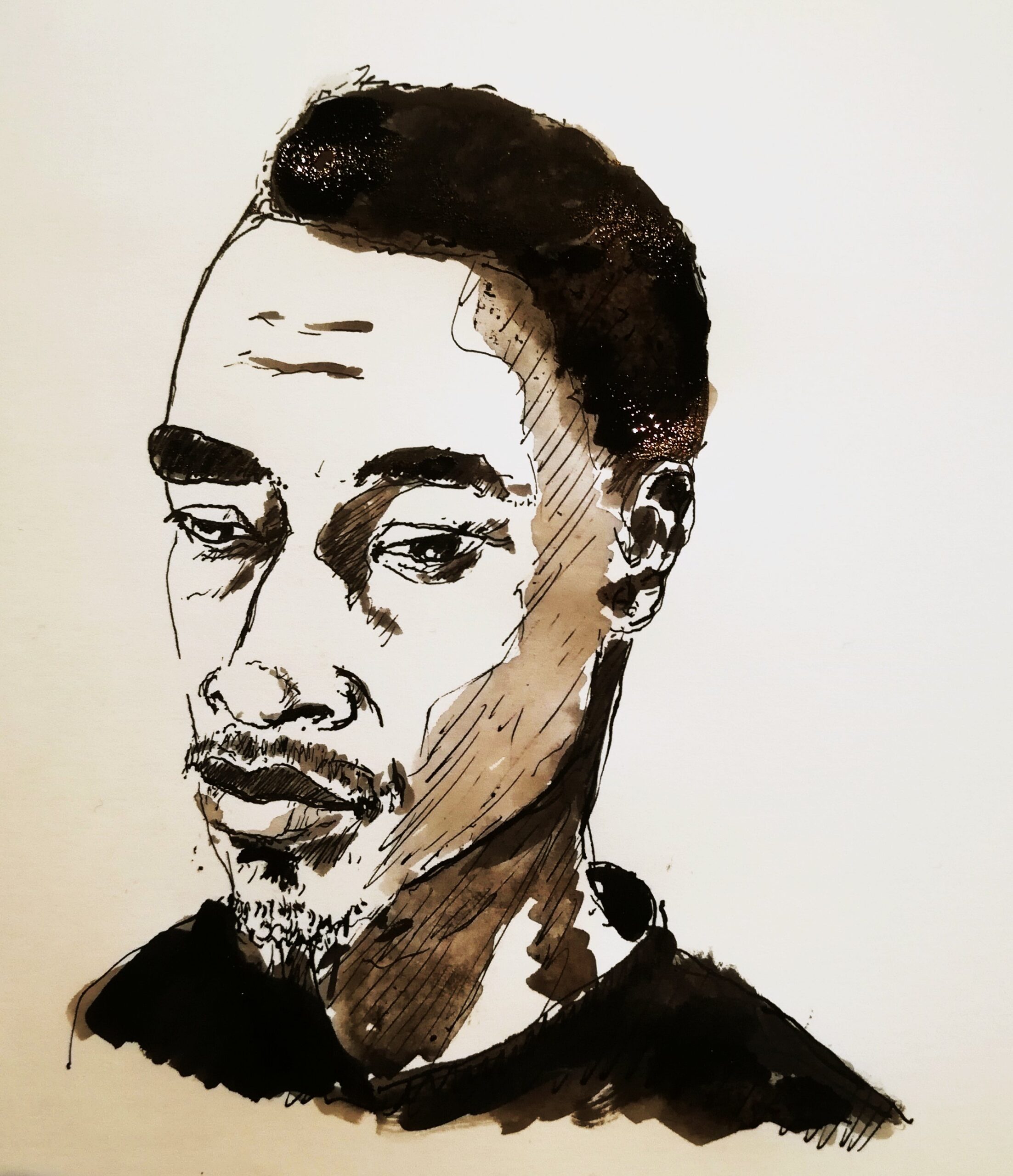
Photo Caption: Terrence Hayes, Poet, inventor of Golden Shovel poetry form.https://www.flickr.com/photos/ptenb/49977718682

pencil drawn image of terrence hayes

With a name that conjures a fairytale-like image, how could you not be curious about the golden shovel? If you haven’t heard of this form before, that’s because it is relatively new: it takes its name from the poem “The Golden Shovel” by Terrance Hayes, which was published in 2010. Hayes’ piece is written after Gwendolyn Brooks, and it contains the entirety of her poem “We Real Cool” as the end of its lines. As such, it establishes the rules of the form. The procedure is as follows:

Step 1: Identify a line of poetry you’d like to work with. We’ll call this your source material.

Step 2: Write a poem in which each word of your source material appears as the ending word of your own line. Be sure to keep the words in order.

Step 3: Credit the poet who wrote your source material.

And that’s it! But while the rules are pretty straightforward, a golden shovel is tricky to write… which is all the more reason to try your hand at it. You don’t have to be as ambitious as Terrance Hayes; after all, “The Golden Shovel” set an incredibly high standard for both craft and creativity. Instead of trying to write a poem that perfectly compliments a piece you love, you can start by using the golden shovel as an invention exercise: write one that uses a line or lines from your own poetry. Write one that adheres to the theme of the original work, then one that goes in a completely different direction— bonus points if you use the same line for both. Rather than using a line of verse, incorporate song lyrics, sentences from a work of prose, or dialogue from your favorite TV show.

This all begs the question: why build one poem from another? What’s the point of making another poet’s lines the backbone of your own piece rather than simply including an epigraph? One answer is that this form makes inspiration into something concrete: the golden shovel only exists when you construct it around another’s precise arrangement of words. You can write a poem with the same message, inspired by the same lines, but then you wouldn’t have to reckon with the same impositions on your language. Additionally, this form constrains you as both a writer and a reader. You can probably identify who and what influences your art, but writing a golden shovel will take your understanding of your inspirations to another level. When choosing a line to use in your own work, you have to know what makes you want to preserve it while you adapt it. Moreover, you need to know how much of that art to preserve: will you keep its meaning intact, or will you change it entirely? 

Regardless of the direction you take with this form, it will alter how you use art to converse with others. After you’ve experimented with digging up and repurposing your favorite lines, you can use the golden shovel to create a polished piece. Or, you can simply keep this form in your back pocket as a tool for investigation and invention.

Book Review: On Alex Pickett’s Camera Lake No. 19

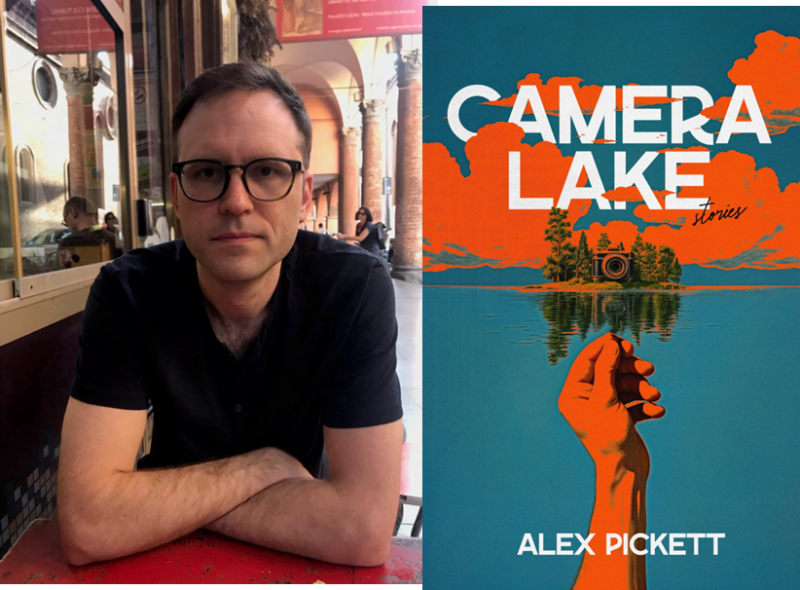
Photo description: Alex Pickett featured left and front page of Camera Lake featured right

Camera Lake by Alex Pickett. Madison, WI: The University of Washington Press, 2024. 189 pages. $17.95. Paper.

Alex Pickett featured left and front page of Camera Lake featured right

Photo description: Alex Pickett featured left and cover art for Camera Lake featured right

Photo credit: @alex_pickett1 on X

Book review written by Liz Barnett

Pickett’s short story collection Camera Lake has characters that feel human. This should be a given for any story, but Alex’s characters feel like anyone you might meet on the street. As a reader, you share with them their regrets, their anxieties, and even their loneliness.

The first short story in the collection “Practice” displays this wonderfully. The coach tests his teams’ fathers as a punishment for them, but it’s never anything embarrassing. Just the words “I love you Dad.” From this and a conversation with one of the team members we can feel how these are things the coach has probably never said to his own dad. It leaves the reader with a lingering feeling of things maybe they wish they had said to their own parents or even friends. There’s a sense of regret in the story that sits with the reader long after the story ends.

That feeling follows us into our next story, “At the Twin Pines Motel”. Our narrator who has run from her family to the motel is someone who seeks out thrills. Her old life bores her and she is currently lost with no idea where she is going. So much so that she begs Richard (A stranger) for any answer for who she is and what she’ll do next. She makes the reader confront their own feelings about what they want in life and who they want to be.

Finally, we come to the titular short story “Camera Lake”. A story in which our narrator thinks they’re being observed at home. We dive a bit into his past as a school counselor and begin to understand his need to move from a city to a small house on a lake in Wisconsin following the deaths of 3 of the students he counseled. We see his fear and the hesitation to get back to a normal life when he feels that everyone around him thinks he’s responsible for the deaths and the way he thinks he might have ruined his wife’s life because they moved so far away from their home of 16 years. When the main character finally lets out the breath he feels like he’s been holding, the relief for the reader is equally as satisfying.

Throughout the stories in this collection, there’s an ominous feeling that follows you. Like at any moment a twist could happen and the stories could turn into a horror film. Then the reader is

caught off guard when these expectations aren’t met. It’s interesting for the reader to be surprised by their own unmet ideas. Maybe Richard will be that creepy guy who murders our POV character…maybe the coach’s dog who goes missing was stolen by a student who was embarrassed by the texting punishment or their angry father who heard about the prank. Maybe our narrator in “Camera Lake” is really going crazy. There’s no one there with a camera watching them or his wife is gaslighting him or maybe he really is causing all these deaths. Then, we never have our fears confirmed. It should be something that leads the reader wanting for more excitement, but every time it feels satisfying to realize we’re jumping to conclusions and should just let Pickett’s stories carry us where he wants us to go.

Alex Pickett’s story collection Camera Lake plays wonderfully with the reader. Trying to tempt them into their worst fears and then always comes back to the human. Of course the dog wasn’t murdered. Of course Richard is just a normal guy taking over his uncle’s business. In fact, our POV character makes Richard uncomfortable.

Each story in Camera Lake excites you, making it hard to put down till you’ve read all 14 stories. The collection is gripping, powerful, and so human. A must read for fans of short story collections.

– Liz Barnett, Mid-American Review

Available for purchase: https://uwpress.wisc.edu/books/6240.htm