Interview: On Poetry & Memoir with Sandra Beasley No. 24

Author Photograph of Sandra Beasley

Interview Conducted by Anna Vaughn
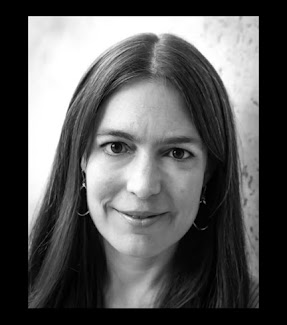
Photo Caption: Sandra Beasley

Photo Source: https://sbeasley.blogspot.com/

Sandra Beasley read poetry and creative non-fiction during her reading for the Prout Reading Series, which occurred on March 13th, 2025. During Sandra’s visit, she sat down with MAR Assistant Editor Anna Vaughn for an interview at Bangkok Kitchen (some of the best Thai food in N.E. Ohio.) That interview is found below.

Interviewer: What typically motivates you to write? 

Sandra Beasley: When I’m thinking about what motivates us to write, the first thing that comes to my mind is the practical reality that sometimes there are pained or anxious students who go into a meeting with their teachers and say “I’m just not really sure that I want to be a writer…” and usually the answer to that is, Then, for God’s sake, run as fast as you can, because being a writer is a grueling thing.  

Being a writer has lots of joy and lots of fun, but you have to be super open to repeated rejection, persevering, sending out, and not making enough money for the labor or the care that you put in—sometimes even sabotage or disappointment—and certainly, the vulnerability and the hurt feelings of those around you. Being a writer will kick your butt. So, if you don’t wake up in the morning and feel, at least some days, like it is the thing you have to do, that it’s the only thing you can be, then don’t turn yourself inside out trying to make yourself a writer.  

I write the pieces when I can’t not write them. I go for long stretches without writing. I am not a 4 a.m. “daily” writer—it’s just not a good practice for me. If that does work for someone, great. Most of the time when I have written a poem or essay, it is out of a kind of essential need to work something out on the page, or to express myself in terms of a strong emotion, or capture a memory before I think it’s going to lose its specificity. Writing out of emotional urgency is a time-honored tradition and it’s important and powerful. But it is important to then bring in that level of revision, getting distance from something, and not treating writing as a purely therapeutic act if you then intend to push towards publishing.  

If you’re writing for yourself as your only audience, great. If you’re writing expecting or asking for the audience of others, you owe it to them as part of a social pact to think critically about the work and to not have that kind of unfettered stream of consciousness. Both parts are important. Writing out of essential emotion is important, but that distance is also critical. Creative writing does live in academia and there are so many of us that are in a position interacting with each other not just as “mentors” and “mentees,” but as teachers and students in a work environment. I think it’s important to honor those boundaries and be up front about that.  

So, when you’re out of academia, as I am—and you think about writing from the essential moment—I have to ask myself, “so I got this down, now what? What is going to be the way that I professionalize my gaze?” Sometimes that’s getting excited about a particular magazine to send to, a particular contest opportunity; sometimes it’s about going to an open mic and reading and trying to really pay attention to my internal processing. Where do I feel it failing? Where do I see the audience struggling to connect? What do people say to me afterwards? I just try to take all of that really seriously.  

Interviewer: My follow-up question is why and how did you start writing? 

Sandra Beasley: I had a wonderful influence in my life at a very young age. Her name was Rose MacMurray, and she was known as the “poetry lady” of Fairfax County public schools in Virginia. I was selected—probably somewhat randomly—but all the way back in elementary school, I was getting opportunities to get out of the classroom, maybe once a week or once a month, and do poetry workshops with Rose MacMurray.  

I’m not 100% sure but I think it’s very possible she was donating her time. If she was getting paid, it wasn’t much. She was a local poet and just having someone stand in front of us and claim that identity and be very serious about her work as a contemporary writer meant a lot. Her prompts were great, super creative, she had us writing poems in shapes to describe the content of the poem; she had us responding to postcards like ekphrasis, she had us reading Edgar Allan Poe. She had us reading these kinds of moody, sophisticated, musical poets from the get-go. 

So, when you are fortunate enough to cross paths with someone who is both really enthusiastic and really sophisticated, early on, I thought: “oh, that’s a thing you can be in the world—and I want to do that.” Unfortunately, I missed my opportunity to tell Rose MacMurray how much her teaching had meant to me, but I’m still in touch with her daughter, and in fact just emailed with her and her husband this past month.  

Interviewer: Interesting, it’s nice to still be in contact with past influences or mentors. So, I’ve hear you describe a poet, or really the process of writing a poem, as like an oyster, where a poem begins with a little bit of irritant grit that enters the shell, the oyster or poet is trying to protect itself from the grit so it coats it over and over again, but always ends up as a pearl— 

Sandra Beasley: It doesn’t always end up as a pearl. Sometimes, there are some duds.  

Interviewer: That’s very true. I still believe it is a beautiful way to describe poetry and the process of writing a poem. Is your process of writing nonfiction similar or different to the oyster process of a poem? 

Sandra Beasley: I would honestly say that I have to be wary of that approach to nonfiction, because sometimes when I try to build it up as an oyster—I want to be honest here about my bias with nonfiction—I like larger, robust essays. Not all the time; I write flash occasionally. But I like big essays with arguments and ideas and, if I use the oyster strategy to build an idea for a nonfiction piece, what I can usually get it to being is a highly lyric, entertaining flash piece of 500 words or less. As I try to go beyond that, I start seeing filler come in. It would be like using the oyster principle to build an oyster the size of a bowling ball; at some point it just gets weird.  

I’ve gone on the record as thinking of nonfiction more like an egg. That’s in part to honor what I have said about myself, which is that I’m both a perfectionist and a procrastinator. The “egg principle” is you’ve got this fertile holding space of a story, which you probably experienced in real life, and realized immediately could make for a nonfiction piece. It’s hard because in its “egg” form it’s perfect, and you think, this is going to make the best essay. If you leave it in that form, it stays forever perfect and forever unrealized. That’s the biggest struggle for me with nonfiction—a commitment to the mess, a commitment to the broken egg, that is necessary.  

Poems, I can look back and, in every draft, typically find something that I love about the poem. Frequently, with nonfiction there will be an intermediary draft where I just hate it. I really don’t see the value in what I’m writing, in that moment, and I have to maintain some kind of fortitude, or at least patience, and pull it back towards something that I’m proud of.  

Interviewer: So now we have an egg instead of an oyster. That’s wonderful. I listened to your reading of “Let Me Count the Waves” and absolutely love your ability to incorporate humor into a poem that is surrounded by beautiful language and imagery. Is there any advice you can give to writers about using humor in writing? 

Sandra Beasley: One thing to remember is that successful delivery of humor—and the few friends I have who are either comedians or do full-time comedic writing have confirmed this—successful humor delivery is as much about the music of phrasing, and very specific things about how something is phrased, where the breath is, how a completing phrase is delivered or landed, that almost has as much to do with the audience reaction as the idea behind the joke or the idea behind the humor. So, that’s the first thing to remember is that it’s virtually impossible to land humor without musicality.  

The second thing is just the importance of honoring your reaction to the thing that you find funny and giving that reaction space. Sometimes that ends up needing to be edited out, but sometimes it’s that secondary beat of reaction or reflection on the thing that inspired you to think there could be a joke here. That is what helps the audience experience the humor. We have this tendency to think that our job is to “snapshot.” It’s a little bit like ekphrasis—it’s the problem with ekphrasis. A lot of well meaning, but failed, ekphrastic poems just try to replicate the aspiring artwork as dutifully as possible. All that does is make someone wish they were there in the museum gallery with the actual artwork.  

Same thing with humor. If you simply try to replicate with exactitude the sequence of events that you thought was funny, at best case scenario they’re going to wish they were there to see that. They’re not going to actually be able to laugh along. You have to include the reflection, and the reaction, and the layering of detail, in order to make it work.  

Interviewer: That’s really helpful. I often think about using comedy to reflect on childhood events or to merge it with other memories. I struggle to combine these two themes or ideas in my writing and hearing you describe how to express certain events to readers through humor is something that will stay with me for a long while.  

Sandra Beasley: Since you mentioned “Count the Waves” as a premise poem, even under the best circumstances, not everyone is going to get your joke—even when you successfully land it. That poem was submitted as part of a chapbook’s worth of sestinas to some editors. They accepted every poem in the packet that I sent them except that one. That poem, they didn’t want. The humor of that one was different than the others. I had some humor in the other poems, but it was all very earnest, and this one had a kind of meta, slightly sarcastic, ironic quality. And that ended up being essentially the start of a next book, and a poem that Poetry magazine not only accepted but gave a prize to. So it just is a great reminder that when humor works strongly, it’s not going to be equally appealing to everyone.  

Interviewer: That’s true. I’ve also heard you mention your interest in writing poems about specific research topics and sharing that history through creativity. What advice can you give to other writers on writing creative works that incorporate some kind of historical background or researched topic? 

Sandra Beasley: If you’re writing a poem that is specifically drawing on a particular historic context, you want to get to the point where your vocabulary is saturated with the language: the objects and the verbs that would have been appropriate to that context. Consider keeping—in addition to a working draft document—a matching document that is just a kind of “word bank” or idea bank. Stock things that come to you through research that you find interesting, even if you don’t necessarily know where they are going to fit yet. You can constantly tuck those things away so that, in the moment, you can sub them in as organically as possible.  

This is not a strong example, because it is not historically accurate by any means, but in the poem “Another Failed Poem About the Greeks” I have this figure from Greek classical myth show up in this contemporary setting. When I first drafted that poem, I had a vision in my head, but I had not done research in advance and so I ended up using placeholder language of 21st century American vernacular. But then I figured, “ok, it’s not going to be ‘quarters’ it’s going to be ‘drachmas.’” Trying to get the little substitutions that could give it some grit of reality.  

I do want to caution, though, that I do not consider myself a poet of historical persona. I honor and admire the people who dedicate whole book-length projects to capturing a historical moment or a set of events, but I don’t think it’s a destination I am drawn to. I think that we’ve learned, as a community, that a lot of times you can’t create those big comprehensive historical landscapes without doing at least some representation of others that borders on appropriation. We are in a moment where there is often resistance to those projects, because of those concerns about embedded identity presumptions, and I don’t think that’s a bad thing. There are wonderful exceptions to that. Paisley Rekdal’s recent book, West: A Translation, on the Chinese workers who built the railroad lines, is a great example.  

Interviewer: I just find the research approach to writing poetry so interesting because just thinking about poetry in a similar way to conducting research seems challenging but freeing in the sense that we might research something to fit into a creative work rather than to write with a prompt. I find that fascinating. So, in 2011 you published Don’t Kill the Birthday Girl: Tales from an Allergic Life which has been called a memoir that grapples your own experience with allergies and allergic reactions with how society deals with them. How do you decipher between various creative nonfiction categories, such as memoir or a personal essay, in your writing or while writing?  

Sandra Beasley: I wanted to write a cultural history informed by bits of memoir because, frankly, I wasn’t sure how my family or I felt about me writing a full-fledged memoir. That felt vulnerable, very self-indulgent. But I was prepared to take on the level of research that I thought would make for a good cultural history. Then I got into the actual project, and I discovered: A) my publisher really wanted a memoir—that’s what they knew how to market and sell, and B) some of the resources I thought I would be able to find for a cultural history were really hard to find, because of factors such as the fact that the word “allergy” was not coined until the very top of the 1900s. If you go earlier than that, you can’t keyword search. You can figure it out, but you’re not going to find a neat history.  

When I couldn’t find some of the resources I thought I’d be able to, I had to pivot and lean into the memoir. I still used cultural history as an anchor, chapter by chapter. I organized it in a way where I could, for each chapter, associate memoir elements that fell into approximately chronological order; so, you watch me “grow up” over the course of that book. In terms of my current book project, I have individually published—and anticipate continuing to publish—everything as personal essays, but I may want the whole to read as a memoir, and that’s really hard.  

Someone once told me that they thought that ‘personal essays’ are where you have a sustained first-person narrator, but the things that most interest that narrator are always the things going on around them. Whereas, in a memoir, the difference is that things go on around the narrator, but the thing that is most important is developing the record of their internal thoughts, the ego, and the development and journey of that narrator. That was how that author differentiated what made for a personal essay versus what made for a memoir. I don’t know if that’s true; I just know I’m still quoting it eight years later. 

It is a struggle, parsing personal essay from memoir, and I think that with memoir, one thing that I think about a lot is developing other characters on the page. You have a responsibility to fully develop a cast of characters, not just You and ‘a bunch of people who get mentioned maybe once.’ A lot of people, when they’re writing memoir, forget to develop the other people. Even though, in our actual everyday lives, the other people are huge.  

In Don’t Kill the Birthday Girl, I had to think about that with my mother; I had to think about that with the romantic partner I had at the time; I had to think about that with a couple of close friendships. In the work that I’m doing now I’m thinking about that with my husband; making sure that he exists on the page as a fully rounded person, and not just a catalyst for crisis because he got sick. He has a lot of dimensions beyond that, and I have to make sure that all of those are captured.  

Interviewer: I watched your interview with Kyle Dargan where you briefly mention some of the current projects you are working on that you stated deals with the medicalized body and life. You also mention that part of your reasoning for writing nonfiction is to allow you a larger space to explore science, medicine, and a sort of backstory. Would you share more about exploring your experiences with allergies/food through writing in nonfiction forms, and how this genre allows you to explore through this topic compared to poetry?  

Sandra Beasley: The biggest thing that I am struggling with, in my current project, is that I can’t write my husband’s story. There are limits to which I can even write the story of “our marriage.” I can only write my story. I’ve really had to struggle to recenter myself in my own part of the narrative. What’s funny is, this is a microcosm of something that anybody who’s ever been thrust into a caregiving role struggles with. Not as a creative writer, not on the page, but just in life. How do I recenter myself?  

People would ask me, in the first months after my husband had been in the hospital, “what are you doing for you today?” I hated that question. I thought that was such a bullshit question. They meant well. The fact that I couldn’t even fathom answering that question was an indicator of just how far away I had gotten from being centered in my own story. I was frustrated by the question—but it was really more my problem, not theirs.  

I wrote my own story as truthfully as I could in Don’t Kill the Birthday Girl. It was a memoir. It was not a manual. I acknowledged a lot of moments that I’m aware was not “best practices,” but it’s what I did; so, it’s what I’m going to share that I did.  

Then I had a reckoning, particularly as a poet, but also as a person, thinking about food allergy as disability. I became more engaged and, I hope, will continue to be more outspoken about disability. Now, as I continue writing about it, I’m just thinking through what does it mean to be older, mature, what does it mean to live with a lifelong and therefore essentially chronic condition? How does it affect how I interact with others? Where can I take responsible risks and make compromises?  

Because of my husband’s medical needs, we now have eggs and dairy in the house, which are dangerous food allergens for me. I had many years where I was able to just say no. That would be fine if it wasn’t hurting someone else, but now it would be hurting him to not have those available. So now, I am in a situation where my needs and his needs have to make peace with one another. Even though it is sometimes scary to me to have dirty dishes in the sink that have something that could cause me an allergic reaction, I’ve got to make peace with that.  

The fact that I have the allergies that I do is relevant to choosing not to have kids. I am fine with that choice; I feel good about that choice. But it’s something that when I discuss it with others, I notice sometimes makes them uncomfortable, especially parents with food allergic children. If I say that food allergies are something that shaped the choice for me, perhaps their thoughts immediately go to whether it’s true for their own kids. It’s a delicate thing.  

I hope that the book that I’m working on now takes all the experience, life, and knowledge of that first memoir and just complicates it. Just honors the complication. Someone who’s a best friend in the first book, on a practical level, doesn’t exist in the second book because she ghosted me. That’s the reality. Best friendships sometimes end suddenly. We have to own these more bitter-sweet elements and, yet, somehow maintain a sense of humor about it.  

Interviewer: My last question is what is the importance of poetry in your life and how would you describe the importance of poetry to emerging poets? 

Sandra Beasley: Poetry gives me a lot of hope and a lot of refuge. I always know, with a few rare exceptions, that I will have a good time in the company of poets. They really are a group that for the most part is creative, and understands scarcity, and understands service, and understands the importance of capturing the individual experience even when it creates a moment of discomfort or clash with others. It’s a group that I’m really proud of associating with.  

It’s also important for a love of poetry to not be equated with a love of hearing your own voice. I’m always delighted to meet people who love poetry but are not themselves poets. I’m in alliance with, and respectful of, poets who go through long periods of time believing that theirs is not the voice that needs to be heard.  

I think, particularly when you’re coming out of academia, there is so much pressure to go, go, go. Either if you’re faculty looking to get the next book to help secure your job position, or if you’re a student ready to get your work out into the world. All of that’s good, but I hope that people live long enough and work long enough to also have some period, for whatever life reason, in which they realize, “I don’t need to publish poetry in this time. And I’m still a poet. And I still love poetry.” 

I continue to marvel at the variety of poetry that’s being published. Not only in America today, but internationally. World poetry is where it’s at. If you’re not reading poets in translation, you’re missing out so much. I’ve done a handful of things where I’m judging or reading large selections of manuscripts, submission pools numbering in the hundreds. It never fails to amaze me how many different things are going on in poetry.  

Interviewer: Thank you for your time.  

Book Review: On “Be Gay Do Crime” No. 20

Cover art for "Be Gay Do Crime"

Be Gay Do Crime edited by Molly Llewellyn and Kristel Buckley. Ann Arbor, MI: Dzanc Books, 2025. 278 pages, $17.95. Paper. 

Photo Description: Front cover of collection.

Photo Credit: Dzanc Books (buy the book here!)

Book review written by Hannah Goss

With the increasing anxiety about LGBTQIA+ rights in America, this collection seems timely in its exploration of queerness, transgression, and love during economic, environmental, and other disasters. Edited by Molly Llewellyn and Kristel Buckley, these sixteen short stories, Be Gay Do Crime, live up to the cover’s claim to depict queer chaos. These characters exhibit chaos through not only crimes like trespassing, kidnapping, and drug dealing, but also lesser transgressions like cursing exes, entering a children’s coloring contest, and watching the neighbor’s TV from the yard. This collection showcases a range of queer experiences from a transwoman’s experimentation with a stolen drug, “Dysphorable,” to Ghanan-British women debating having children in a post-Brexit Britain, to a second-person narrator thinking about a bad hair removal as a “reaction to manhood.” Each of these stories is revealing of the desire to be human amid a world that represses identity. 

Within these stories, these characters struggle against systems of power and use these transgressions as a means of exercising agency. In “It’s a Cruel World for Empaths Like Us”, Soula Emmanuel depicts a narrator caught feeling powerless and invisible in corporate life, turning to threats via phone calls when their hair lasering goes awry. In a similar resistance to power, Priya Guns’ “Make Life Great Again,” follows a custodian’s observations from inside the White House bathroom with a familiar president watching water shortages impact the nation while he pursues a volcanic island expedition, ignoring the indigenous population that inhabited it first. Meanwhile, the narrator catches two women conspiring to assassinate the president in the bathroom stalls. Other stories more explicitly connect desire to economic inequality through Temim Fruchter’s “Redistribution” in which the main character M steals as a means of reclaiming some power she lacks, thinking each stolen object is earned from the loss of an ex. “The Meaning of Life” by Myriam Lacroix explores two women finding themselves destined for motherhood in the alley behind their apartment building where they find an abandoned child. They fear taking the child for medical care, losing custody, and finally ending up in a standoff with their son’s biological mother when she kidnaps them. These stories paint crime as a necessity, a desperate act born out of inequality from wealth, corporations, and other indifferent institutions, yet still, these characters must confront the consequences whether relational or legal.  

The characters that span this collection are messy, unapologetic, and somewhat unlikable but also deeply human in their conflicts. The narrator, Iris, of Anna Dorn’s “Bad Dog” is self-sabotaging and deflecting of blame. Yet as she dresses up like her twin to try to break her engagement up, she’s forced to confront that, like the dogs her sister’s fiancée rehabilitates, there are no bad dogs. Perhaps, she has some responsibility to take for her life choices rather than blaming her life’s troubles on the dog who scarred her as a child.  Alissa Nutting’s “Peep Show” narrator performs sex with her girlfriend because she thinks her boss’s dog that she stole is a robot he’s watching them through. It gives her the confidence to perform well at work and receive a promotion but at the cost of her relationship. This story explores the nuances of having to be straight-passing at work, the thin line of being sexually available but not sexually promiscuous to a male boss, and the inequality of being a white woman breaking the law versus a woman of color. The struggles of these characters are tangible, and their desires for family, love, and belonging are affecting. Each of these stories feels current and insightful in their exploration of queerness and in positioning crime as a means of protest, of reclamation, and of necessity.  

Why We Chose It: “The Fall of Virgilio” by Michael Garcia Bertrand No. 12

By Sydney Koeplin

Promo photo for instagram. Over a snow wheat field. Why We chose it.

Mid-American Review fiction staff chose “The Fall of Virgilio” by Michael Garcia Bertrand for publication in Volume XLIII, Number II.

The short story begins with the titular character Virgilio—a Cuban emigrant back in his home country for his yearly visit with family and friends—falling down the stairs. He lands in a coma and is rushed to a dilapidated, undersupplied local hospital, where he remains for the rest of the narrative. This is the plot, in the simplest terms. But within this frame, Bertrand explores Cuban identity, memory, and history.

Coma stories can be challenging to craft because it is hard to move a story forward when the character is, by the nature of a coma, stuck in place. But “The Fall of Virgilio” overcomes that narrative pitfall. In Virgilio’s comatose state, he meets el Comandante, flies over Havana, and watches his family at his bedside. It resists sentimentality but still asks us to consider what constitutes a life well lived.

We discussed this story on November 6th, 2024, when we at MAR—and many millions of other Americans—were contemplating what the election results would mean for our health, mental well-being, and safety. Bertrand’s story was exactly what I needed to read that day. I choked up as I read the following passage aloud to the editorial team:

“I say it, too, to everyone I love or care about. Ten Cuidado. (Be Careful). Cubans tend to say it in place of Goodbye. It is part of who we are. The occasion does not matter whether we are going to the supermarket or Cuba. We are not pessimists, though. We do not say it out of fear (well, maybe a little fear). Do not make that mistake. We are the most joyful people alive. Even in adversity, we find ways to sing, dance, eat, drink, play, make love. Ten Cuidado is our way of pretending that we can ward off catastrophes, that is all.”

“The Fall of Virgilio” is a tragedy in the sense that any accident is a tragedy. But the story is also a story of hope, resilience, and the will of a people to continue living even under the most dire of circumstances. It explores what it means to return to—and die in—a place you’ve left. It is a testament to the human spirit delivered in prose that is all at once lyrical, surreal, humorous, and sharp.

Craft Corner: Creating a Sense of Place No. 9

Collage of settings: the beach, the clasroom, a mountain, dirt, etc.

By Serenity Dieufaite

As a fiction writer, I find creating a strong sense of place to be an intentional and essential process. Setting doesn’t come naturally or easily to me. It’s something that I overlook in early drafts. During the revision process, I work on establishing a clear and captivating setting. I choose details and descriptions that create an image in the mind’s eye of the reader. I reflect on my own memories of the place or the research that I have done. Describing a setting is not easy. Yet, a strong sense of place is worth the time and effort it takes.

Why is setting so important? It is what allows readers to imagine themselves living amongst the characters. It brings the story to life. With a strong sense of place, readers are transported to the world created by the writer. Whether writing realism or speculative stories, setting is something that cannot be neglected or ignored. Readers are curious about where the story takes place. Setting is the means of providing them with details that make the story richer and more compelling.

Each writer has their own way of including place in their story. Some writers shape the story’s setting into its own distinctive character. The setting becomes an important mirror to the character or reflects important themes. A character’s perspective on a place can indicate their personality, preference, or beliefs. Sometimes, a character’s homecoming or leave-taking is an important aspect of the story’s plot and character development. Alternatively, some writers use place as the backdrop of their story. In these cases, setting plays a lesser role in the overall story. Still, details are included that ground the reader in a place. Every story must have a place where the events occur.

No matter what approach you take, setting is an important element of fiction craft.  

Here are some of my tips for creating a strong sense of place:

  1. Decide what approach you want to use. Is setting central to this story or not? What role does place play?
  2. Is the setting of your story specific or general? How specific or general do you want to be?
  3. Include poignant sensory details and descriptions. Do not limit yourself to a setting’s appearance. Consider sight, smell, taste, and sound. Be intentional and specific about the details that you include.
  4. Read how other writers create a sense of place. Explore the different styles writers use. Are they maximalist or minimalist? What do you like or dislike about their style?
  5. If your setting is based on a place you’ve never been, do your research. Watch videos. Find books. Check online sources. Talk to people who’ve been there.
  6. Share your work with others. Get feedback about the strong and weak points of your writing.

And the most important advice of all is to keep writing. The more you practice your craft, the more you will improve. Continue to make progress and learn from your mistakes. 

Happy Writing!

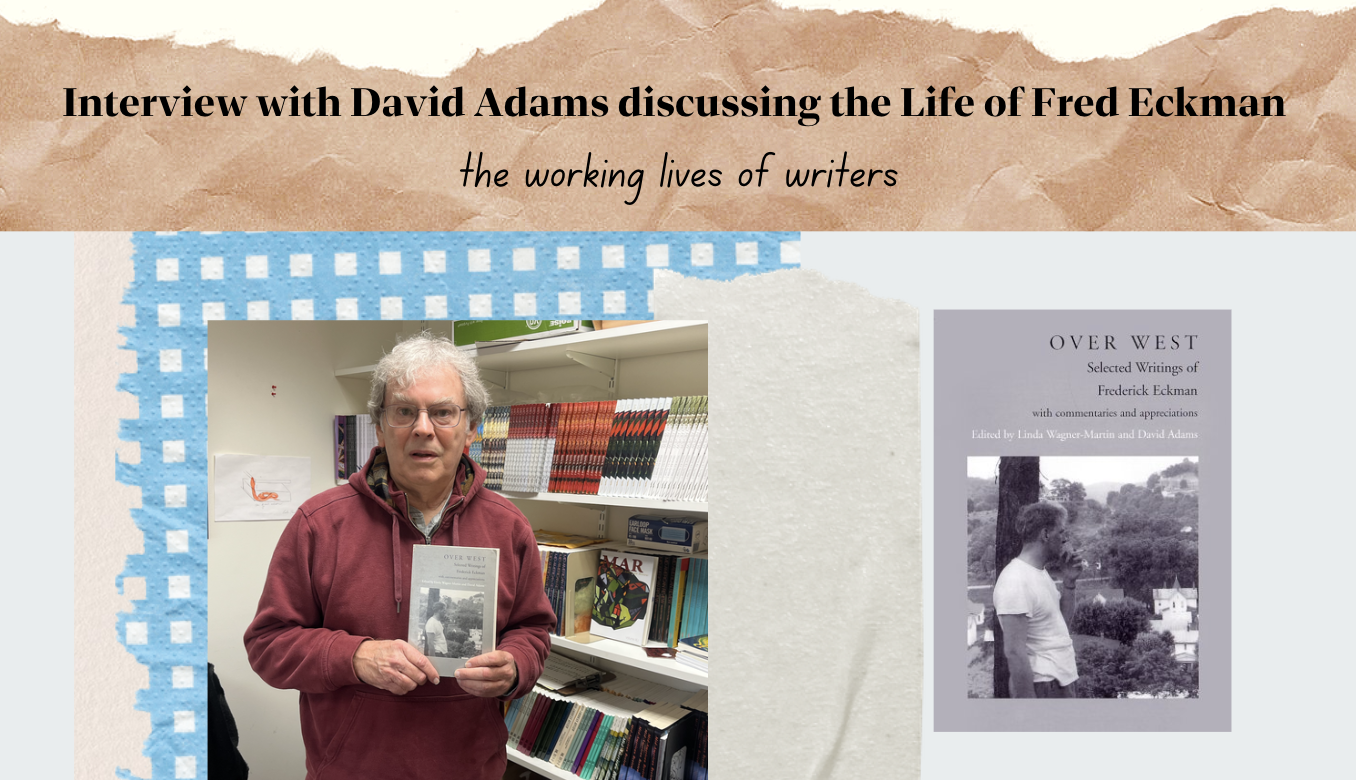
Interview: On the Life of Fred Eckman with David Adams No. 24

Photo of David Adams in the Mar Office

The Working Lives of Writers

In October 2024, David Adams visited his Alma Mater, Bowling Green State University, to read at Prout Chapel, present on the archives of Fred Eckman, deliver the archives of Fred Eckman to the archival department at BGSU’s library, and sit down with us at the MAR blog; you’ll find his interview below. This interview was conducted by Elly Salah.

Fred Eckman was David Adams’ mentor, guide along his path as a poet, and friend for nearly thirty years. In all their time together, Eckman never revealed his history working on CRONOS or The Golden Goose, two projects that forged a significant path across post-war literature. The works of Fred Eckman are housed in the Eckman Archive at BGSU.

You can learn more about the Eckman Archive at the following link: https://avalon.bgsu.edu/media_objects/12579s858 

Interviewer:

Can you tell us a little bit about yourself and your time at BGSU’s MFA program? While you were here as a student you worked as the MFA secretary and had a very close relationship with the program’s founder Fred Eckman, what was that like?

David Adams: 

Well, Philip O’Connor was actually the first director of the MFA program. O’Connor and Eckman were both involved in the planning of the MFA Creative Writing Program which was very condensed because you had to get it approved through the university bureaucracy, and then through the state regents, and, by the time that was all completed, it was fairly late in 1968. The program was set to begin in the Fall of 1969. Eckman didn’t want to be the initial director of the program and deal with all the administrative stuff. O’Connor was hired specifically to help bring the program into existence. It was only natural that O’Connor would see himself in that role, and that’s why he was the first director. I had a couple of classes with O’Connor as an undergraduate at BGSU; I had some familiarity with him. In the summer of 1969, I was recently married and scrambling for employment. O’Connor reached out with a job offer, and I accepted. So, in the daytime, I was working for the university grounds, and, in the evening, I would work for O’Connor, handling correspondence from prospective students; recruiting in that short of a period was a real challenge.

Interviewer:

I bet.

David Adams:

I handled correspondence for my future classmates. It was kind of a weird thing, and I did some typing of O’Connor’s fiction manuscripts. I did whatever he asked me to do, and it was just an oddity of the circumstances. I was still an undergraduate when the semester started, and I was student teaching at Bowling Green High School to wrap up my bachelor’s degree. But, I was also attending the MFA workshops. Fred rang someone up to get me graduate credit for those workshops that I did. So I wasn’t on an assistantship or anything. There weren’t too many of those because there were no undergraduate writing classes for MFA students to teach.

Interviewer:

The BFA program in creative writing hadn’t started yet?

David Adams:

Oh no! That was years later. The MFA grad students who got assistantships had to teach freshman composition. I was not doing any of that while I was doing student teaching; so that whole first year, I was there without an assistantship, which was hard. It was a strain on my family relations, my marriage, everything else. But I had, at that point, discovered that this was who I was, and I was pressing ahead. As I got through the program, I became less and less enchanted with higher education. I managed to piss off a lot of my creative writing faculty except for Fred Eckman. I especially pissed off Philip O’Connor, temporarily… That’s another story.

I dropped out of the MFA program with only my thesis and oral exams to finish. After that, I was working two jobs: one, a couple days a week at the University warehouse. I also had a very good friend who had been in the doctoral program here and dropped out to take a job managing a gas station in Toledo. So he hired me to work the night shift. I was doing this split shift stuff, living in a farmhouse in Bowling Green with a doctoral student that Martha Eckman had connected me to and his girlfriend. They were from Texas. I was paying my share of the rent in cash every month. I came home one night from work and the place was cleared out; they were gone. About two days later, the landlord showed up, saying he hadn’t received any rent for three months. He said I could stay three more days, but, after that, I’d better be gone. 

Interviewer:

The couple was taking your money?

David Adams:

Yes. Naturally, I wasn’t thrilled. But I went to Fred Eckman. At that point, he was still a friend and a mentor. I told Fred, “I don’t know what I’m going to do. I don’t have a place to live. I’m barely making a living.” Fred said, “Here’s the deal. I know you’re a stubborn guy, but listen to me, there will be a time when you will be grateful that you have this MFA degree. Come back. I will pay your tuition. You can live in my office while you’re completing your thesis. Type it on my IBM Selectric, and you can shower in the gym. You can get your meals in the union.” And I said, “Ok, I’ll do it.” That got me back to the program. I put my committee together. It was Dr.  Edgar (Fred) Daniels who was chair of the English department and somehow liked me. I don’t know why. And Dr. Stanley Coffman, the provost, who was the chair of my committee. I got the degree. Fred was right because I thought I was just going to be a rebel and work these odd jobs and write my poems whenever. Also, you have to understand, there were not many teaching jobs for MFA graduates at the time. The jobs were not plentiful because there were only four other MFA creative writing programs in the country at that time. We were the fifth. It never occurred to me that I was going to be teaching in that field. And as it turned out, I never did. I taught at the university level off and on for thirty-some years. Only once did I ever teach a creative writing class, and that was only with reluctance. That’s the story of my degree.

Interviewer:

That’s an incredibly touching story.

David Adams:

Fred Eckman was an angel to a lot more people than me. But, he and I, for some reason, had an especially close relationship. There were times even further out when I lived in Fred and Martha Eckman’s basement for stretches of time. My recent effort in my work has been to honor Fred Eckman and bring his legacy to wider attention.

Interviewer:

Could you talk a little bit more about CRONOS and The Golden Goose. Turning these archives into the BGSU library, is that the end of the project for you?

David Adams:

I hope so. It’s been a long road. Eckman never mentioned this work to any of his students. I checked with students who had been his students before I got there. None of them can remember him ever mentioning it. One of the preceding students said, “Well I saw a copy of The Golden Goose on his desk once. But Fred didn’t talk about it.” I think there was an abiding anger about the way that the whole thing ended. He just kind of cut it out of his presence. 

Interviewer:

It’s spectacular you’ve been working so long on preserving his memory.

David Adams:

Well, Martha Eckman asked me to. Fred Eckman had a memorial service in the BGSU library after his death. It was 1997. I would’ve been up in New England, probably, on a part-time job at the University of Maine, one of several that I had. I came back for the funeral, and James Thomas (one of MAR’s founders) came back too. Martha asked James and I to come to Kaufman’s place, an upscale eatery in downtown Bowling Green, and talk about this idea she had that somebody needed to produce a volume of Fred’s work but also his critical writings and appreciations by all of the people whom he had supported over the years. So that became Over West: Selected Writings of Frederick Eckman.

I told Martha when she asked that I might be able to interest the director of the National Poetry Foundation in Orono, Maine because I knew it was a period, late 40’s and early 50’s, that the guy was interested in. So I went up to Orono and pitched it to him on everyone’s behalf. He said, “Well, we might be interested if Linda Wagner-Martin is attached to the project.” The implication is that she’s somebody and you’re not. [David laughs.] I called Linda, and I said, “Would you be willing to co-edit this?” And Linda said, “Absolutely.” Then, it was on.

Interviewer:

Linda Wagner-Martin was Fred Eckman’s first doctoral student?

David Adams:

Yeah. Linda is incredibly famous in the world of literary scholarship; she wrote her dissertation about William Carlos Williams as a master’s student at BGSU, which she was only allowed to do after Fred Eckman advocated administration. After her dissertation was out there, Wesleyan University Press immediately published it as a book. That was the launch of her scholarly career which continues to this day. She’s still writing. She wrote a very famous book about Sylvia Plath, taking a more measured look at Plath’s life and relationship with Plath’s husband, Ted Hughes, which was very controversial. But Linda concentrated more on the poetry and the fact that as harsh as that relationship was it probably contributed to the quality and value of Plath’s poetry. Ron Johnson, one of my classmates in the MFA program, was married to a woman, a poet, for a long time. After they were divorced, she was dying, and she wrote him a poem. The title of which was: “Being Married to a Poet is like Having an Operation.”

Interviewer: 

I could see that.

David Adams:

I think it’s especially true when two poets marry. I have never had a romantic relationship with another poet. I just think it brings into play too many conflicting issues. I have known some relationships that worked out very well. Not many. But, that line was just so precious. I can imagine what she had to put herself through as Ron Johnson’s wife. And Ron’s a character. You have to think about the other half and what they live through.

Interviewer:

Definitely.

David Adams:

The publication of Over West was a major achievement. I’m really proud of it. We were supposed to do something about Golden Goose in there. Originally, I wasn’t going to edit the poetry. I wasn’t sure I was the right one to do that, so I approached Carroll Arnett, Eckman’s late-in-life friend and another accomplished poet, who was teaching at Central Michigan University. He agreed to it. When it got to the point where he was supposed to start that, I called him up, his wife answered the phone, and she said, “I’m sorry, but he dropped dead last night at dinner. Massive heart attack.” I was grieving with her. He was a good friend to me as well.

After that, I talked to Linda Wagner-Martin and she said, “David, you’re the person to do this.”  Then, I talked to NPF up in Orono, and they agreed. So I did it. I wrote the introduction to the poems. I selected the poems. I solicited contributions from former students. Linda handled the critical side of things. I found out later it’s the only book NPF ever published that actually made money for them. If you try to buy a copy now, it’s very hard to find. They’re going for ridiculous prices, up to $800, and alums have told Lawrence Coates, the director of BGSU’s creative writing program, their indebtedness to Eckman as a teacher. So I told Coates, “Y’know I have an extra copy of this at home. I want to get it in a place where your students can read it.” I’m very proud of the introduction I wrote. Linda Wagner-Martin wrote a fabulous introduction, touching on his teaching and scholarship. 

Interviewer:

Fred Eckman stopped writing at age 54. You’ve written 11 collections of poetry, releasing one just last year 2023. Ocean Voung came to Toledo recently and said that he wants to come to a place in life where he can stop writing peacefully. Do you envision yourself continuing to publish? Have you ever had the desire to stop writing?

David Adams:

There have been times over my career when I was having difficulty placing poems. One thing that has happened in the last couple of generations is poetry has become more time-bound in terms of what’s trendy and new. Not so much in terms of form but subject matter, and I’ve never been trendy. But, on the other hand, when Eckman stopped, he had been here at BGSU for a very long time: teaching, and doing the same thing. My life has been so erratic and disruptive in terms of place, what I’ve been doing, and where I’ve gone. I keep making discoveries. When I first moved to Maine that was a big door opening for me poetically. When I first started traveling to Micronesia, oh my God, it was a whole new universe on every level: culturally, sensually, the smells, the sounds, the colors. It all just kind of exploded.

I think part of the reason, oddly enough, that I’ve been able to keep at it is not so much that I’m well-known enough or anything because that’s not true. It’s just that I keep finding doors opening, doors of experience. I graduated in 1972. It was another two years before I felt like I had found my voice, which is what Fred Eckman kept saying, “You gotta find your own voice. You have to chart your own path.” I had lots of influences that were drawn into my writing. Because of Randall Jarrell’s writing The Lost World, I started writing in voice, doing poems in another persona. Because of the things that Fred Eckman opened to us as MFA students; he introduced us to so many things: French poetry, surrealist poetry, imagist poetry, and poetry from different regions. Eckman never expected us to write the way that he did. 

Even Robert Creeley who most people associate with these straight-line, jazz-influenced poems and rhythms. When I met up with Creeley in Cleveland in 1983, he was doing a week’s residency at Cleveland State University. Eckman must’ve talked to him and told Creeley to call me because I was in Cleveland. Creeley called me at my parent’s house and invited me out to dinner. He’d just come back from a State Department tour of Korea. You’d think being in an Asian country, his writing would get even more condensed but no. He said, “It opened up the need to start writing in longer lines, longer rhythms, more prosaic stuff.” And his later work was like that. Have you ever seen the movie Raider of the Lost Ark? Harrison Ford stars in it. There’s a line where he’s all beat up. His love interest, Marion, is trying to clean up his wounds. She wanted to find a place to kiss him where it didn’t hurt. She said, “You’re not the man I knew 10 years ago,” and he said, “It’s not the years, Marion, it’s the mileage.”

When you think of everything Fred Eckman went through, a soul change in him in 1960 when he quit his tenured job at the University of Texas, divorced his wife, and ran off with Martha Eckman to NOLA. They had no job, no anything. Fred and Martha had plans to go to Europe until their money ran out, but BGSU called about a one-year placement job that turned into a much longer career. Fred Eckman was in Bowling Green for about 5 years before the time his son was murdered down in Texas. Somebody asked me at the presentation if I connected Eckman’s drinking with his son’s murder. I said, “It certainly didn’t help but he was already an alcoholic.” Even in graduate school, Eckman was an alcoholic. When Fred was in graduate school at Ohio State, I could gather from the back-and-forth letters that Richard Wirz Emerson was joking about Eckman being a drunk. Eckman was making excuses for not doing tasks because he was hungover. It was a thing that a lot of poets fall into, and some of them never get out of. So Eckman already had that issue, and the grief of his only son’s murder hung with him for the rest of his life.

I never specifically asked him about his son’s murder. I just figured it was too deep a wound. I knew it was there, and I needed to tread around it; I tried to. When Eckman finally went on his last bender, he ended up in Saint Charles Hospital in Toledo. I was one of only two people who were allowed to visit him there. When he got out, I was about to leave for Maine. I drove him around town, and I was worried about him. I didn’t know what was coming next. I said to him, “Fred, are you going to be okay?” And Fred said, “Yes, I’ve decided that I want to live.” He had no relapses after that. He was sober for the rest of his life. But the physical damage had already been done. He lived with arthritis, pain, and the cancer of the esophagus, which eventually took him. So yeah… It’s not the years but the mileage.

Interviewer:

Have you heard this quote from Helen Vendler, “Immediate challenges arise for a lyric poet who is writing a poem about history.” I was wondering if you agree, and, if so, how would you classify yourself as a poet?

David Adams:

Fred Eckman once labeled me a “lyrrative” poet (a term coined by Eckman), and it’s true, I think. I talked about my affinity for Randall Jarrell and his critical writing. Jarrell’s famous, first book of criticism Poetry and the Age is essential reading for any poet. He quotes in there, “Within every poem, no matter how short, are the bones of a story,” and to illustrate that he quotes the two-line poem of  Bion of Borysthenes, A Greek Philosopher, “Though boys throw stones at frogs in sport, the frogs do not die in sport but in earnest.” I find that to be true because poetry is so compressed compared to regular prose; even my prose poems are story poems. Fred’s description that he stuck on me was apt. Other people along the way, Ha, they always try to classify you somehow, and I don’t care. I’m just making the poems that I make, but I think that’s as good a description as I’ve ever had: lyrrative poet. 

That quote is true. I do a lot of that, especially when I’m writing for music. There’s a chapter in my memoir Casual Labor called “Roots & Branches.” I have many of these people, characters. Fred was in there, Linda’s in there. Suzanne Ferguson. My best friend of my life, Terry Plunkett. Terry was dead by the time I wrote the memoir, but Linda and Suzanne are alive; they still help me as readers. This was a third-person memoir, I let them pick their own names. The poet Dana Gioia, whom I met a couple of times, encourages poets as they go along in life to try new things. One of the things he urged them to do was try to write librettos for opera, and I have done that. I have an opera that I wrote with a composer. Last year, we completed the opera, which is based on a historical incident I first encountered while teaching at Cornell. I was working in the engineering college, team-teaching with an engineering physicist who turned me onto a book called The Making of the Atomic Bomb by Richard Roads. It’s a really compelling book. That book is absolutely essential for understanding the history of the 20th century. 

There was a little vignette in that book about Clara Haber, who was the wife of Fritz Haber, the Nobel Prize winning chemist and the father of the German poison gas program in WWI. The opera I wrote is a tragic story that ends in Clara’s suicide. I read that little vignette and decided some day to write something about it. I didn’t know it wasn’t going to be a libretto until I considered Dana’s advice; he has a whole book about writing librettos, and he wrote libretto from an opera that was performed. I read the entire correspondence history between Richard Strauss and the poet Nicholas von Hoffmansthal, Strauss’ longtime librettist; they produced many operas together. The correspondence gives you some insight on how writing a libretto is; it can still be poetry, but it is very different from a freestanding poem; in that, you need to have room for the music, room for the dramatic interpretation of the words by the singers. 

I had written some songs with a composer from Cleveland that were recorded; we had initially started working on an opera together that never got off the ground because of her megalomania. She wanted control of everything, so everybody she had engaged in the project quit. I learned some things about working with composers that helped me when I started working with Dawn Sonntag on this opera about Clara Haber. Dawn’s husband is someone she met while living in Germany, and she knew a little bit about the story of Clara. I met Dawn at an opera workshop at Baldwin Wallace University while I was considering working with this megalomaniac again on another opera, which, again, proved disastrous. I learned my lesson; I thought Dawn would be someone who could work this story. That kind of collaboration is never easy, but we worked through it; what we have is a valuable product that is probably running into the headwinds of the fact that it’s a story that happened more than a century ago, but the themes of it: the struggles of assimilated Jews in Germany and how they validated themselves, the idea of science being co-opted for national military policy, the subjected role of women in that time, even in the field of someone who’s got a PhD in Chemistry. Clara thought she was marrying into an ideal situation where two scientists would cooperate for the better of humankind, and she ended up being relegated to the role of Hausfrau (German word for housewife.) When Fritz had run off for the last gas attack that Clara had begged him not to go to, she looked out the window of their room, and she saw him in the embrace of his secretary, so Clara grabbed Fritz’s revolver with the intention of going down to the garden and killing them both, but they had gone. They had disappeared. In the story, she’s racing around in the garden and finally points the gun on herself, and that’s how the opera ends.

Interviewer:

That’s so tragic.

David Adams:

Yes, it’s a tragic opera. Tragedy is historically part of opera. We thought it was a story that should have timeliness. It was just a question of finding someone willing to commission a performance.

Interviewer:

Did that end up becoming a performance?

David Adams:

We hope so, but it hasn’t yet. Unfortunately, Dawn got long-COVID last year, and it completely zapped her energy. She’s not been able to promote it, and she’s trying to scrape out a living as a choral teacher, commissioning other work. I’m not that plugged into the world of opera. Even in our contract, Dawn is the one who handles the business side of things, which is appropriate. A composer usually does that; the librettist always has a secondary role.

Interviewer:

Does writing libretto influence your poetry?

David Adams:

Yes. When I was at Cornell, I fell in with this Bluegrass group, and I became one of their roadies. We composed a number of Bluegrass songs together, which got recorded, and I still have them. I learned something about writing for a singer, and what one has to change to allow them to express themselves with the music. Reading Dana’s book was very helpful in that regard. I read several books on the history of opera. When you get off on one of these tangents… I think I mentioned my motto at last night’s reading. People tell me my poems are complicated, and I use this slogan that I saw at a dive shack in Chuuk Lagoon, Micronesia which is a scuba diving Mecca, and the slogan there is: Go Deep or Go Home. Poetry is not supposed to be easy; it’s a compressed language. Even in that two-line poem, once you start thinking about it, there really is a story that could grow out of those two lines when one wrestles with them, considers them for a while, and that’s certainly true of the music that you put into a lyrrative poem. One of my classmates, whom I became very close to, once told me his definition of a good poem: It’s gotta have music, and it’s gotta have soul. I’ve taken that to heart. Lately, I’ve started casting my poems in centered lines on the page for musical reasons because I want a reader to be able to hear the rhythm of a poem more precisely, and me too; that’s not a new thing. John Donne did it. John Keats did it. I decided to experiment with it, not every poem, but certain poems I do.

Interviewer:

What did you study as an undergraduate at BGSU?

David Adams:

I had a dual major in history and political science. I didn’t become an English major until after I met Fred Eckman. After I met Fred, I switched to English, but, in order for me to actually graduate, I had to go the English education track because that was a faster way to get to graduation which my family, my wife-to-be, everybody was on my case about it. But I’ve never lost my interest in history. I read extensively in history, even now. Right now, I’m reading the biography of Rudolf Diesel, who created the diesel engine. He did so for environmental reasons because the first diesel engines ran on peanut oil, not petroleum; and he was murdered by somebody who viewed him, to an extent, like John D. Rockefeller or Kaiser Wilhelm II because he was sharing technology with the British and the Americans.

Interviewer:

Do you find poetic inspiration in history?

David Adams:

Yes, I have. Sometimes, there’s a story in there that’s so compelling, which is what happened with the Richard Roads book. For my work, reading history has inspired a series of poems in which I imagined photography by the Hungarian photographer André Kertész. I imagined photos that he did not actually create, that would represent the path of history during his working life. One of those imaginings was a photograph of Edward Teller as a young student in Munich. Edward Teller, who would later become the father of the hydrogen bomb, and other imaginings of Kertész’s experiences during the communist revolution in Hungary, following the end of WWI. It was called the Vanilla Revolution because all the formed communes ever produced was vanilla ice cream. Essentially, Kertész was kicked out of his house, his family’s possessions were taken; he immigrated, and a lot of the Hungarian Jews did. Right after the collapse of the communist revolution, a very right-wing Anti-Semitic regime took over Hungary, and they still have one now. A lot of the Hungarian Jews fled to Germany, which they thought was a haven.

When something I’m reading really hits me like that. If it hits me in a way that I can imagine as turning into a good poem, I’ll write the poem. When I started going to Micronesia, I read everything that I could about Micronesian history. I made friends with a really wonderful photographer who did the cover photo on my most recent book and is my photography mentor. He fed me books, and I got to know the former national President of the Federated States of Micronesia. I got to know a really ornery old guy in the Marshall Islands who had wonderful stories to tell; he was the first Micronesian to receive a degree in an American college, which happened to be Heidelberg University in Tiffin, Ohio. I had to learn the history and the culture to be able to function in Micronesia as a consultant because if you want them to change something they’re doing with their education in the colleges, it has to be their idea; you can’t tell them what to do. People are always doing that, coming in to tell them, “This is what you have to do.” I approached it differently; it was a question of leading them to discovery. I read the poem “Bikini” last night about nuclear testing. There’s a long history there; and a legacy that’s happened ever since of radiation poisoning. You see the grandchildren of people, who were impacted by testing, who are deformed, walking around in the capitol. It’s just a horrible legacy.

Interviewer: 

Those events were not that long ago.

David Adams:

Three years after I moved back to the States, I was teaching a course at John Carroll University. But even when I was teaching at the University of Maine, the lack of knowledge of history was one of the most striking things that I saw while teaching undergraduates and to their detriment, I think. For those students, Vietnam might as well have been as far back as WWII. They don’t know anything about it anymore. It’s sad. They don’t want to know because it’s work to find out. I read another poem last night that came from my experience in Micronesia. I wrote it for a friend of mine, who was a BG graduate, and her father was stationed at Pearl Harbor during the attack. It was part of the dynamic of the poem that my generation of parents who lived through the Depression and WWII left a legacy of silence as we were growing up. They would not talk about their experiences. We knew nothing about their experience; we just didn’t talk about it. Now, we think of war as serious stuff, and it is; but there has been nothing in the world that compares to the scope, and the reach, and the consequences of WWII. I wanted to write a poem that brought all those things together, and I did that. History remains an abiding concern. I have two old friends; we exchange history books. It’s sort of a history book club. We keep each other excited about things we’ve just discovered. 

Interviewer:

You’re always on a path of discovery?

David Adams:

Yes. One of the reasons that I’ve been able to keep writing. If the doors close, and they’ll close at some point, on my publishing opportunities because most of the people who publish me are roughly in my generation, then I’ll keep writing as long as I feel like I can make a poem. One of the things Fred Eckman instilled in us, and I learned from reading Randall Jarrell and other writers that I admire; it’s the making of the poem itself that’s the greatest joy. Once it’s written, the poem is out of your control anyway. You can’t control what people think when they read your poem unless you’re there to explain it to them. When publishing goes away, and if I live long enough… I’m burning the short end of the candle at this point. A lot of my contemporaries and classmates are already gone. One of the things I learned from being a hospice volunteer was this slogan of living with gratitude: Wake up each day and be grateful for the day. Try to make good use of it. It’s something that people of your young age probably don’t think about that much. I’ve always concentrated on the work of making the poetry; I have not done as good a job as Fred did in passing that legacy along because I didn’t teach creative writing very much.

Interviewer:

How do you feel about grading poetry?

David Adams:

Oh, I hate it. You’re dealing with people who used to be you. That was Fred’s great gift. He could get you to see the flaws in your writing but not in a judgemental way. He also had enormous patience with us. I’m a patient guy, but I don’t want to be in that position. When I was in Maine, I had to supervise a couple of honors theses, and I had my patience tested enormously in that process. What I found is that my colleagues, in order to avoid stress, were just kind of passing whatever, and the standards went down. Fred never let us get away with shit, but he had a way of not letting us get away with it that wasn’t threatening. That’s a very hard thing to pull off. It was not me; part of finding yourself as a poet is finding out what to do. Making a living teaching poetry was never something that I wanted to do. I very much enjoyed working with engineering students to teach them how to become better writers.

Interviewer:

Could you talk about your work as a technical writer? You mentioned yesterday the stochastic effect

David Adams:

I’ve learned a lot from working with very smart, talented engineers because I’ve always managed to work in good engineering colleges, especially Cornell. First of all, I was amazed that they hired me because I’ve been told that they don’t hire graduates of public institutions. Cornell considers themselves an elite engineering college, and they are. Although, they were not the best students that I ever encountered. The faculty at Cornell made you feel like you had to be the best at what you were doing, and that challenge was never stated; but you felt it while working with the engineers. That pressure made me a much better partner because we were team-teaching these courses. I carried that knowledge to Michigan State University. I even did it while teaching an MBA program at Johnson & Wales University in Rhode Island. The head of the NPF at the University of Maine told me something very interesting once, “Ya’know if I write a paper about Ezra Pound, and it turns out I’m completely off base… Well, nothing happens. But if an engineer is designing a bridge or a highway or a building and the writing, design, or planning they do is flawed… Well, people can die and have died because of that.” At Michigan State, we had a whole course about engineering disasters; we read a study stating something like 80% of the cases resulting in disasters were due to faulty communication. Engineering students don’t think they’re going to have to write, but we show them the surveys that I initiated from employers. ¾ of an engineer’s working life is spent speaking, listening, writing, or reading. When you start to show young engineers that their future employers have those concerns, you get their attention. 

The teaching model that I evolved at the University of New Haven, specifically integrates writing into every engineering course. Typically, what happens when engineering students go to take a required writing course, is they’ll go to the English department, faculty who know nothing about engineering. The students hate it and put it off until the last minute, so they’ll graduate without learning writing skills. To this day, at New Haven, it’s the first instance where a college of engineering has done that integration at all four years, across all seven engineering programs, culminating in a senior design project that incorporates writing. At this point, they’re the only engineering college in the world that has accomplished that. I’m very proud of that. The engineering guidebook that I wrote, which evolved, is in its fourth edition, and I’m very proud of that. It’s made a difference. 

Interviewer:

You’ve definitely made a difference.

David Adams:

When I first went to the University of Maine after I left Michigan State, I saw a student on campus who looked familiar, but I couldn’t place him. A couple of days later, he approached me, “Professor Adams, you probably don’t remember me, but I was in the Fluid Mechanics course that you were team-teaching at Michigan State University. I just wanted to tell you that I hated your guts… at the time. Since I got here, my professors have been telling me that my writing is far ahead of other students, and I’m really grateful for what you put me through.” That’s the type of feedback that you typically don’t get, especially when you’ve moved around like me. My engineering career was a way to make a living, and it’s all due to Martha Eckman, who encouraged us to audit her tech-writing course, which was established only after Martha completed her stint as an English department advisor. It became my way of making a living, to support my writing; it was partially due to my background in construction that I was able to fit in with the engineers. I did a rough count the other day between everything I’ve done: my work in engineering colleges, my consulting, my work in private industry as a tech writer; I have probably published between 5500-6000 pages of writing. My poetry is a fraction of that. 

Interviewer:

That’s incredible. 

David Adams:

I look back on my legacy… People have told me, out in Micronesia, “You have a legacy of achievement out here that has made a difference.” That came from the president of the country, in the FSM, and from the cranky old guy I got to know in the Marshall Islands, from the president of the college where I was teaching in Saipan. So yeah. That’s a lot of writing. I didn’t do it all alone, but that was the production.

Interviewer:

My final question is related to your reading at Prout Chapel last night. Yesterday, you made this beautiful comparison between horse riding and poetry. You said, “If it doesn’t humble you, you’re going to go off the rails.”

David Adams:

That wasn’t me. That was Buck Brannaman who said it to me when I told him I could see the relationship between learning how to make a poem and learning how to work a horse. That was Buck’s answer to me as he slapped me on my shoulder, and nearly broke it, but I think it’s true. It’s easy to get caught up in what I call the “diva aspect” of any of the arts. I remember an experience that I had at Cornell where my landlord, an artist, invited me to a gathering of some fellow artists; some of the artists were from NYC, and they were talking about another’s work and said, “Oh, that work I’ve seen – so last year!” I laughed so hard I almost fell out of my chair. You even see this in classical music, soloists, and conductors. I have very good friends who play in the Cleveland Orchestra, and they’re not like that. They’re arguably the finest, classical ensemble in the world, which isn’t just my opinion. The conductor of the Cleveland Orchestra, Franz Welser-Möst, put out a memoir called After Silence in which he explains the importance for artists, particularly composers and musicians, to appreciate the role of silence and humility in their work, and that aligns with the horsemanship. Horsemanship was another one of those doors that opened for me. I never knew about any of it. I never knew how philosophical horses are, and how sensitive and intelligent they can be. If you approach horses in the right way, what you can get them to do is just sort of amazing. Last night, I mentioned, that if you can find that documentary, Buck, then watch it. It will change your life as a poet; it will. 

I can’t ride anymore. I don’t have my horse anymore, but I did find him a really good home. I continue to work with horses at the barn where I used to ride. The guy asked me to work with a troublesome mare that he wanted to use as a lesson horse, but the horse kept bucking off these kids who did the wrong thing. I said, “Sure, I can do that,” because I worked with another horse that tried to kill me when I first started riding. But it was because of something that had happened in his past which we didn’t know about. It took me six months to work that out of him, following Buck’s advice. When I met up with Buck in Fort Worth, I told him all about it; he said, “David, you’ve got to do something. That horse is going to kill someone,” and horses do kill people, so Buck said, “I want you to come here, go down to the front row, and watch the horses all morning. These horses have never been ridden, never been handled; they come here right off the prairie. Everything you see in them is going to be fear. You can’t do anything with a horse unless you overcome that fear. Watch the way they hold their feet, the positioning of their bodies, what their tail is doing; you have to be cognizant of all of those things at once. If you can get the horse to trust you, you’ll be a safety partner for them. You can take their fear away. The horses know they’ll be safe with you.” I did that with this other horse; it took about six months, but now he has little eight-year-olds riding around on him. He’s just as gentle as could be.

Interviewer:

Is removing fear an important part of writing poetry as well?

David Adams:

Horse riding did affect my teaching. I became more patient with my students because I’d gotten to a point of frustration. I could feel myself becoming impatient. In those last years of teaching, I became more patient in my teaching; I became more aware of when I could see a student’s insecurities, and what I could do to respond to those insecurities positively. So yeah, I guess it did. If I were teaching poetry, I probably would’ve done the same thing with young poets. I know Fred never rode a horse, but I think he was doing the same thing with us.

Interviewer:

Thank you for your time.